


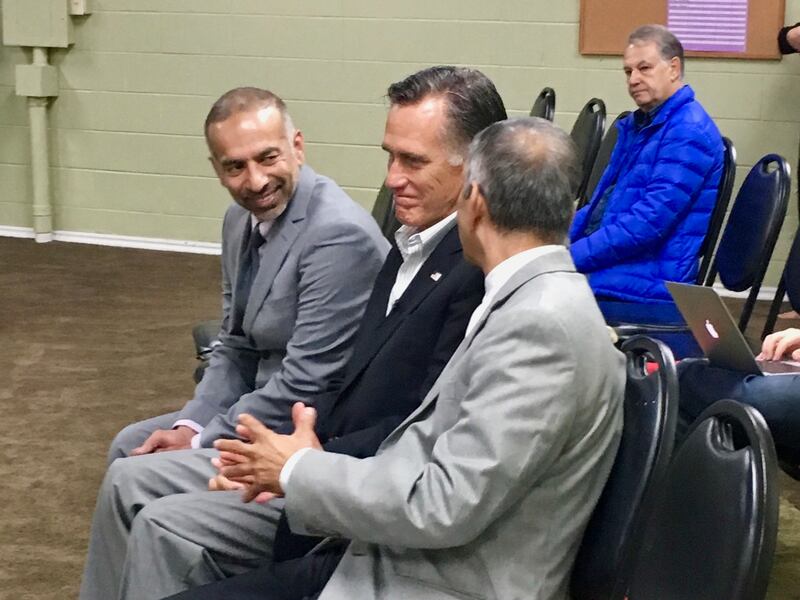
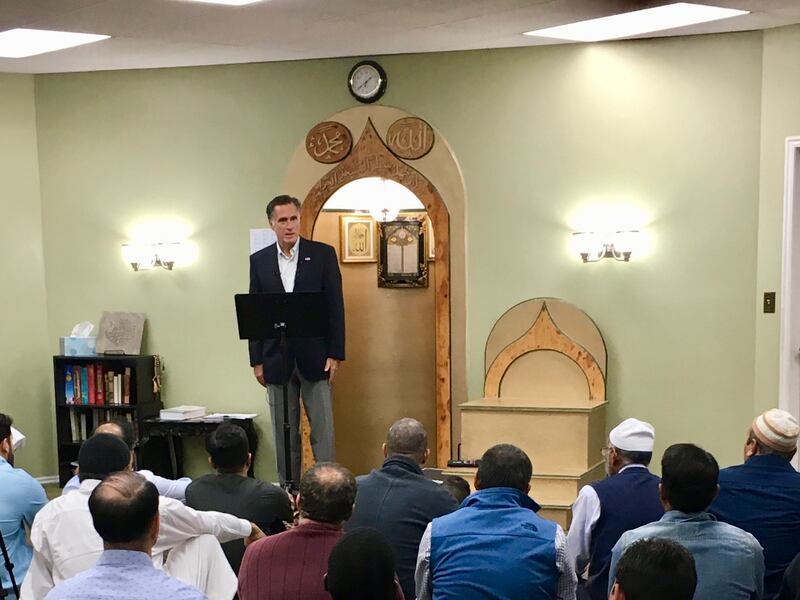


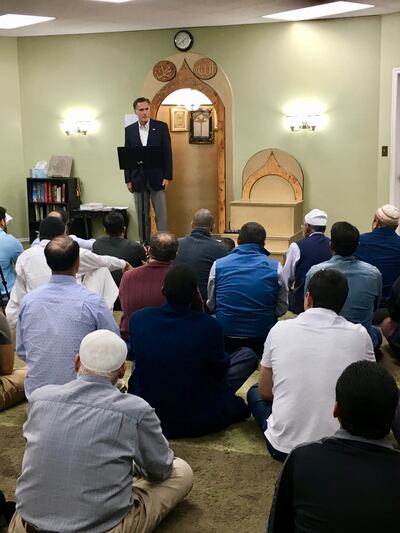
SANDY — Standing in his stocking feet, Republican Senate candidate Mitt Romney spoke and answered questions at the Utah Islamic Center on Friday before attending a worship service with about 200 Muslims.
Romney fielded questions on guns, immigration and health care, but interestingly no one asked him about President Donald Trump's order to restrict travel from several majority Muslims countries, which the president referred to as a "Muslim ban" during the 2016 election.
Asked outside the Sandy mosque afterward, Romney said he backs the travel restriction.
"I want to see what the results are for the effort to date but based on the analysis which was described by the president, I do support it," he said.
Romney made it clear that he doesn't believe people should be banned from the U.S. based on religion.
"In the campaign the president spoke about a Muslim ban, which I think was interpreted as preventing all Muslims from coming into the country. After he became president, he looked instead not to prevent people coming into the country based on religion but instead based on whether their nations had procedures to determine if someone could represent a risk or not," Romney said.
The U.S. Supreme Court in June upheld travel restrictions on Iran, Libya, North Korea, Somalia, Syria, Venezuela and Yemen. Romney said he believes it will continue to pass constitutional muster.
Trump has the right under the Constitution to safeguard the nation, Romney said.

"I think the president has a responsibility to protect the country, and the determination made by him and by his administration was that certain countries could not assure that the people were being properly vetted and therefore not allowed to come into the country," he said.
Romney's opponent, Democratic Salt Lake County Councilwoman Jenny Wilson, said she spoke against the travel ban and the council passed a resolution in opposition "the minute it was put in place."
The January 2017 resolution called on the federal government to rescind the president’s executive order and affirmed support for refugees in Salt Lake County.
"It was a very sensitive time in the community, and I'm not sure Mitt Romney understands that. He wasn't an elected official, he still isn't. He wasn't directly engaged as we looked at the challenge that it puts with this community," she said.
Wilson said it's another distinct difference between herself and Romney.

At the Islamic Center, Imam Shuaib Din introduced Romney as a person who has a "strong moral compass" and shares some of the same values as the Muslim community, such as right to life and sanctity of marriage.
Romney, he said, was the first Republican to speak at the mosque. Democrats Ben McAdams, the Salt Lake County mayor running for Congress, and Sim Gill, the Salt Lake County district attorney seeking re-election, visited earlier.
"Islam is not red or blue. Muslims are not Republican or Democrat," Din said. He estimated 30,000 to 40,000 Muslims live in Utah.
Imam Din said hosting candidates at the mosque helps Muslim voters feel like they have a reason to vote. It gives them an opportunity to meet people seeking public office and to ask questions on issues such as immigration and health care.
"That proves that Muslims have the same concerns as other Americans," he said. "We're just the neighbor next door."