







PROVO — When Utah-grown artist Samuel Evensen became a father five years ago, he remembers leaving what he calls a figurative Garden of Eden.
“I was just really shocked by how much it transformed me,” Evensen remembered of his oldest son’s birth. “It was a gradual transformation, but I really felt like, ‘I’m not the same person anymore. I’ve left an Eden, and now I’m in a new world.’”
According to Evensen, who’s based in Brooklyn, New York, watching his wife progress through pregnancy and meeting his newborn son made the story of Adam and Eve’s life in the Garden of Eden more meaningful and urgent to him.
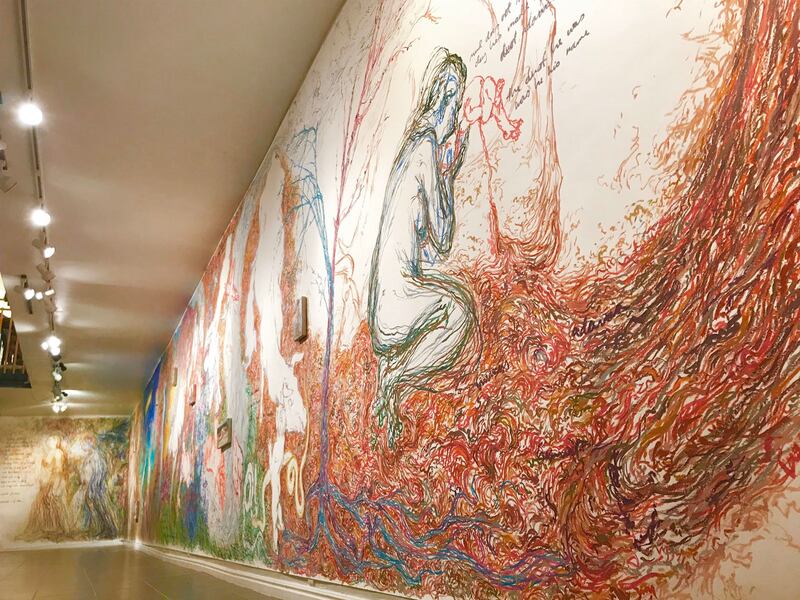
These personal experiences inspired Evensen’s latest installation, “In the high noon of the heavenly garden,” a floor-to-ceiling frieze featuring scenes from the Garden of Eden currently displayed at Provo store Writ & Vision.

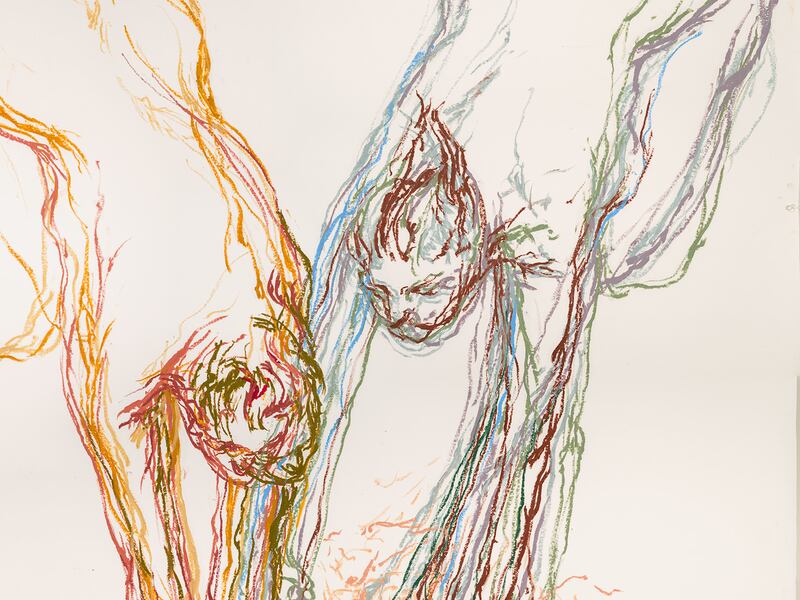
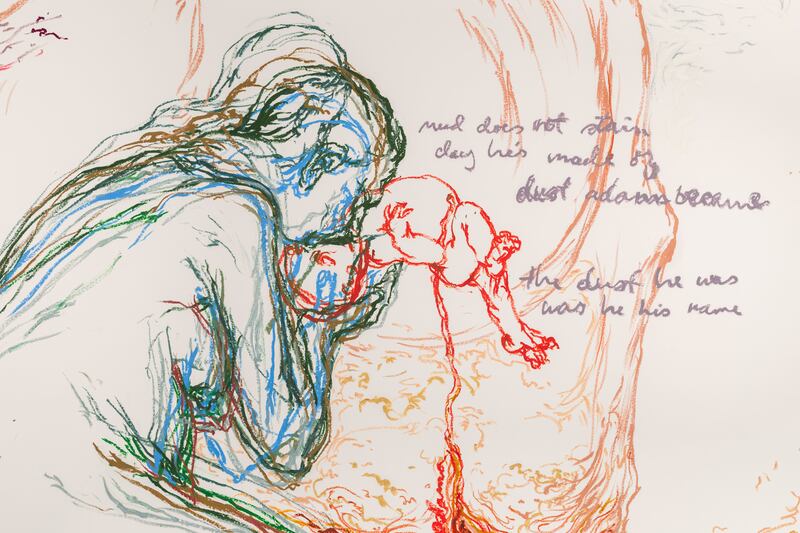
The frieze, named after a line of poetry from Marjorie Pickthall, was drawn on paper with oil pastel and consists of two large pieces. One depicts scenes from the Garden of Eden, and the other represents the curses that came upon Adam and Eve when they were expelled from Eden. Atop the drawings hang paintings of nude bodies on canvas, which Evensen painted from observation. Throughout the exhibit, Evensen also included written poetry about Adam and Eve.
Evensen grew up in Utah County and graduated from Brigham Young University in 2006 with a degree in illustration. He went on to earn his master in fine arts from the New York Academy of Art in 2008. Evensen and his wife fell in love with the city, where Evensen has worked as an artist for the past decade.
How Eden affects body image
According to Evensen, the Adam and Eve story affects the religious and non-religious alike. His work's overarching concept is how the narrative impacts the way we think about our bodies, including aspects like fertility, modesty, shame and gender.
“In terms of the way this narrative affects us, I think it’s not just all good or all bad,” Evensen said. “It’s really dynamic and I think it’s important for us to reflect on, ‘What does this mean, and how does it affect the way that we think about ourselves?’”

To explore this question, Evensen chose to paint models of all different ages, genders, ethnicities and body types. One of his models was pregnant and another transgender. He placed the canvas paintings directly on top of the oil pastel drawings of Eden to put contemporary bodies in the context of Adam and Eve’s story.
Evensen spoke about one model who had never modeled before, and had a body type that is not the traditional idea of Western beauty.
“When she came in to model for me, I was just moved by how beautiful her body was, and felt an obligation to honor the beauty of that body, and the beauty of the shape of her body,” Evensen said. “Part of what I’m exploring is, ‘Aren’t these bodies also beautiful? And also worth celebrating? Aren’t they also glorious?’”
Brad Kramer, Writ & Vision's owner, said the gallery has hosted several exhibitions that explore the creation account in Genesis, but Evensen’s is unique in its focus.
“Typically, when we think about the Genesis narrative or the creation narrative, the Adam and Eve story, we kind of think of it in terms of how it implicates our spiritual selves,” Kramer said. “Samuel is focusing on it from a different angle. He’s thinking of it quite explicitly in terms of what it means for how we relate to our bodies.”
Division and maturation

Another major theme in Evensen’s work is division and maturation throughout time. As Adam and Eve become more complex throughout the story, the contours of their bodies become more complex as well.
Adam, who is depicted as a baby in the beginning of the piece, is originally drawn with a single red contour. By the time God expels them from the Garden, both Adam and Eve are made of several complex contours and lines.
Apart from the contours, the actual images in the drawing represent division. In one part of the drawing, God (shown as a female-male duo) are shown dividing the earth, an image consistent with Evensen’s agrarian vision of Eden.
“In this story, we are Adam and Eve, and I tried to make that experience much more human by taking that singular epiphany and extending it out,” Evensen said. “That’s just really a reflection of my own experience as a person, as a human, that I have these moments of acquiring knowledge, or I have experiences of gaining knowledge, or leaving the garden into a new experience that are much more gradual than the singular thing.”
Although Evensen is a member of The Church of Jesus Christ of Latter-day Saints, he said “In the high noon of the heavenly garden” is not intended for a strictly LDS audience. The work includes nods to other religions and cultures.
For example, Evensen depicts Eve’s creation by showing her being divided out from Adam, inspired by the Jewish idea that Adam was initially both male and female prior to Eve’s creation. He also included the constellation of Orion in one scene, honoring Egyptian mythology.

Gesamtkunstwerk
Throughout the oil pastel drawings of Eden, Evensen also wrote various poems, most of them about Adam and Eve. His goal was to combine the text with the drawings and paintings to create an immersive, overwhelming experience.
Evensen drew inspiration from Richard Wagner’s idea of gesamtkunstwerk, a German term Evensen described as a combination of several mediums of art to create a grand aesthetic experience.
“I want you to be able to walk in and be totally immersed in this world, and I want it to be like a gesamtkunstwerk,” Evensen said. “I wanted the narrative to have a lot of movement and dynamism, and I wanted it to be really chromatic, and I wanted there to be text, and then I wanted there to be these other paintings, so this other level of the mythology.”

If you go …
What: “In the high noon of the heavenly garden”
When: Mondays and Wednesdays from 12 p.m.-4 p.m. until July 27, or by appointment by calling Brad Kramer at 801-647-7383
Where: Writ & Vision, 274 W. Center Street, Provo
How much: Free
Web: writandvision.com