
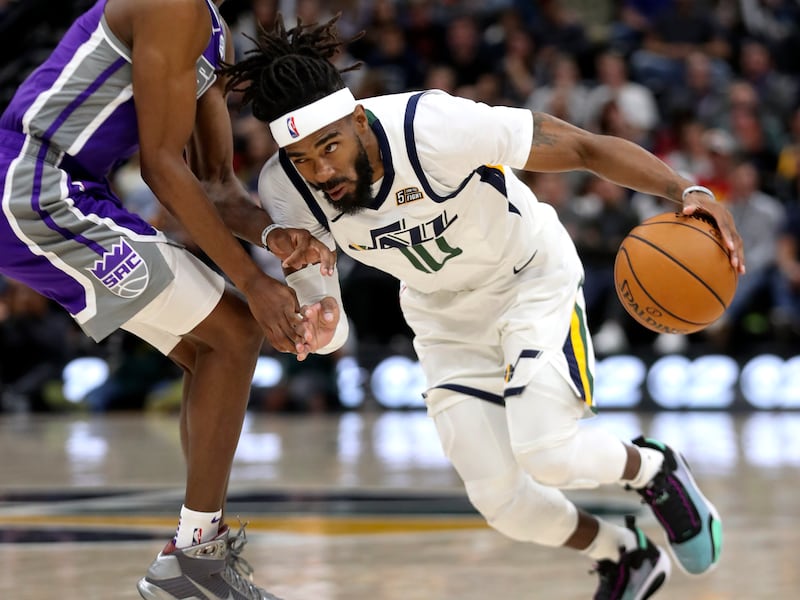

SALT LAKE CITY — Career averages of 14.9 points and 5.7 assists per game. Someone who can break down a defense and get his own shot. A great teammate and member of the community.
The Utah Jazz knew what they were getting when they made a blockbuster trade in late June for longtime Memphis Grizzlies point guard Mike Conley, a move that signaled the Jazz wanted to take the next step in building a championship-caliber roster.
As Conley and his teammates and coaches eye the beginning of the 2019-2020 regular season, they’ve gotten a start during the preseason on building the chemistry that’s particularly necessary for a point guard to have with those he works with. In Utah’s four preseason games against NBA teams (Conley did not play in the opener against Australia’s Adelaide 36ers), the 12-year veteran averaged 11.3 points and 3.8 assists per game.
“I’m a basketball player. I know how to play off the ball, I know how to cut, set screens, and that’s why I’m here, just to be a part of the system that helps create a lot of opportunities with guys that think that same way, so I’m good playing off the ball.” — Utah Jazz guard Mike Conley
The marriage, if you will, between Conley and the Jazz is an interesting one from a style perspective. While Utah has played at a faster pace in recent years, it still hangs its hat on ball movement in the halfcourt more than transition opportunities to create offense. Conley is used to that, as he’s spent his whole career until now with a Grizzlies team that typically played at a very slow pace.
That being said, it’s Conley’s ability to help give more life to a Jazz offense that often went stagnant in the past that’s a big reason Utah acquired him.
The third game of the preseason against the New Orleans Pelicans provided a great glimpse into the kind of offense the Jazz want to have, as they routinely generated great looks en route to scoring 127 points.
Conley contributed 13 of those, as well as seven assists.
“Offensively, that was the way that I’ve always dreamed of playing basketball and being a part of teams that do that not just one or two plays in a game, but like every possession down,” he said a few days later. “That’s as pure as the game can get for me, so I loved it, and I know a lot of guys had a lot of fun.”
With the way Utah’s offense works, however, Conley might have a slightly different role than he did for so long in Memphis. Since the Jazz’s system is so predicated on ball movement, the point guard often ends up with the ball less, but that’s fine with the newcomer.
“It’s not an adjustment at all, actually,” he said. “I really almost prefer it, just having multiple ballhandlers. Just because I’m a point guard doesn’t mean I have to bring it up every time or initiate offense. I’m a basketball player. I know how to play off the ball, I know how to cut, set screens, and that’s why I’m here, just to be a part of the system that helps create a lot of opportunities with guys that think that same way, so I’m good playing off the ball.”
Besides the more direct impact Conley is looking to have on the court, many have figured that he’ll continue to mentor rising star Donovan Mitchell like former Utah point guard Ricky Rubio did the past two seasons.
Mitchell said the biggest thing he is already learning from his new backcourt mate is how to have more patience on the floor.
“I think it helps especially me because I get to watch it firsthand pretty much every game,” Mitchell said. “I watch how he breaks down certain pick-and-rolls that maybe I struggle with or against teams that I feel like I’ve struggled with.
“To see him just pick it apart I think is something that’s really going to help me be able to pick it out on film, and then also being right next to him in the locker room I think is going to allow me just to ask him a few questions, whether it’s in-game or postgame or even if I have just seen something on TV.”
Mitchell said early in training camp that he and Conley were starting to mesh more quickly than he was expecting, which head coach Quin Snyder attributed to the unselfishness from both of them.
“I think that happens when you want to mesh,” Snyder said. “You’re looking for opportunities, you’re communicating. It’s really two guys that want to help each other. ... When both guys are trying to figure out how they can help each other, you find things, and some of them, we can try to identify and some of them, they’re going to find on their own.”