

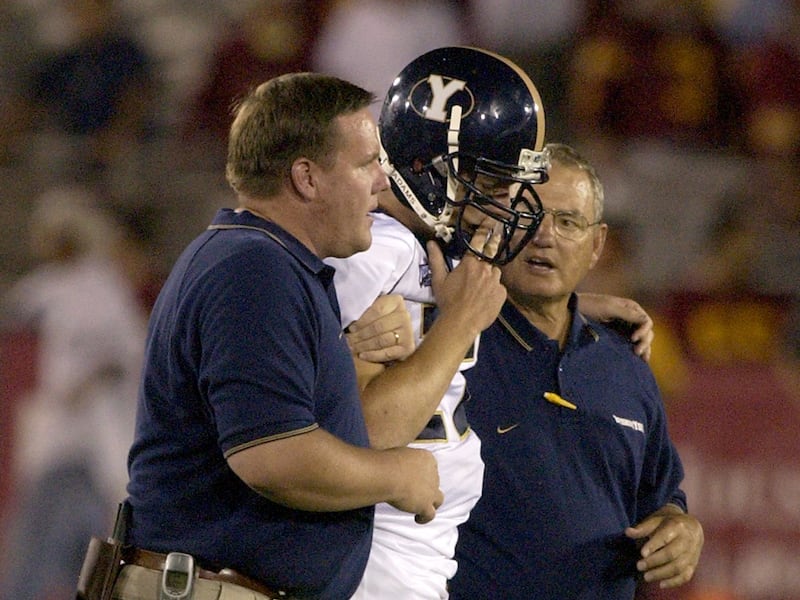

PROVO — George Curtis, who spent 20 years as BYU’s head athletic trainer, passed away early Wednesday morning after a lengthy illness. He was 72.
Curtis arrived in Provo in 1985 after serving as the head trainer for the Los Angeles Express of the USFL. He graduated from Southern Utah in 1971 and he was named the Outstanding Football Athletic Trainer of the Year by the All-American Football Foundation in 1999. Curtis retired from BYU in 2005 and was inducted into the BYU Athletics Hall of Fame in 2009.

Curtis is survived by his wife, Jan, and their seven children. He was preceded in death by one child. Funeral services will be held at 11 a.m., Friday, Nov. 8 at the Latter-day Saint Stake Center at 1050 North 600 West in Orem.
To the countless number of athletes that he treated, Curtis was more than just a trainer and he leaves an immense legacy.
“He was a big part of the program. Trainers never get enough credit because they spent a lot of time with athletes. They don’t get paid by the hour for a reason,” said former BYU quarterback Ty Detmer, who won the 1990 Heisman Trophy. “More than anything, it’s the type of person, the fatherly figure he was around the program for a lot of guys. He always had guys over to his house for chili or horseback riding, whatever it might be.”
While attending BYU, Detmer met with missionaries from The Church of Jesus Christ of Latter-day Saints at Curtis’ home in Lindon before joining the church.
“His house was open. I actually took the discussions at his house because it felt like home away from home for me being over there,” he said. “He was a very giving man, always serving others. He was a great man and somebody I loved and appreciated.”
BYU associate athletic director Chad Lewis, a former Cougar tight end, visited Curtis Sunday.
“He couldn’t speak but he was squeezing our hands really hard. We were reminding him of lifting weights and telling old stories,” Lewis said. “He was completely there in spirit, though his body couldn’t do anything other than squeeze our hands. He still was really strong with his grip. It was fun to have one last opportunity to say goodbye.”
Lewis said Curtis made a huge impact on his life. Lewis went from unsung walk-on at BYU to NFL All-Pro tight end with the Philadelphia Eagles. Among other things, Curtis spent extra time with Lewis in the weight room.
“When I look at the career I had in the NFL, coming from being a super-skinny kid, I see that George gave his life to help us train,” he said. “That was just as important as Norm Chow teaching me the offense and LaVell Edwards giving me a chance. George Curtis was just as critical and helpful to me getting to the NFL as any single person in my life.”
Curtis influenced generations of BYU athletes, Lewis said.
“He was completely selfless. Most trainers are; that’s the nature of their business. But he took it to a whole other level. If he needed to wake up early and do extra treatment so you could be ready for a game, he would. If he needed to stay until midnight to do extra treatment to get you ready for a game, he would. He’d do whatever it took. That was not just when I played at BYU. I would train here in the offseasons and he took care of me all of those years. He helped me, and anyone else, get ready. You didn’t have to be an All-American for him to care about you or give you treatment.”
Detmer recalled Curtis relating to players on a personal level.
“When guys would come back from the summer with long hair, maybe a ponytail, he’d snip it off and hang it on the wall,” Detmer said. “He was a character, pranking guys all the time. They’d go in for surgery and they’d wake up with writing on their body in various places. They knew George had been there.”
Lewis remembered Curtis sharing stories about past BYU players with current players while he taped their ankles.
“I was hungry to hear every story about every great BYU athlete. He would talk about Steve Young with the L.A. Express,” Lewis said. “Steve had a challenging time at that point of his career. His anxiety was off the hook. George saved his life by helping him get through every practice and game. He gave his life to help other people.
“You spend more time, by far, with the trainers than anyone else on campus. Even coaches. It’s pre-practice, post-practice, it’s traveling. You’re always around the trainers. George would tell stories and open up a window into someone’s life,” Lewis continued. “He’d describe why Ty Detmer was so amazing. By sharing those stories, he was changing and building and creating the culture of athletics at BYU. It wasn’t just football, it was every sport. He was mentoring the next generation of BYU athletes to be similar to the greatest of the athletes that have been here. It was powerful.”
Curtis baptized former BYU running back Jamal Willis.
“He was one that I really confided in, not being a member of the church, coming to BYU. He talked to me about the church and he was a big support system for me,” Willis said. “He was a leader from all aspects, a person who cared about everyone. I had a big connection with George. He was a great role model and an awesome individual.”
Contributing: Dick Harmon