


WASHINGTON — The Supreme Court on Tuesday considered what immigration-related decisions the executive branch can make and how it can make them, weighing whether the Trump administration violated federal law in 2017 when it unceremoniously eliminated Obama-era protections for immigrants brought illegally to the United States as children.
If it were a popularity contest instead of a legal case, these immigrants would easily win. Nearly two-thirds of Americans (63%) are in favor of allowing childhood arrivals to the U.S., who are often called “dreamers,” to become legal residents, according to Public Religion Research Institute.
But justices won’t rule on whether young immigrants deserve a path to legal residency. Instead, the three cases ask whether the Supreme Court has the authority to interfere with government officials’ decision and, if so, whether the administration needed to better explain why protections for childhood arrivals had to end.
Policy background
The cases center on the Deferred Action for Childhood Arrivals program, or DACA, which President Barack Obama created in 2012 by executive order to bypass the congressional gridlock stalling immigration reform. It enabled immigrants who were brought to the U.S. illegally as children and were in school, had a degree or were honorably discharged from the military to apply for two-year, renewable work permits.
Although it wasn’t viewed as a permanent solution for young immigrants, DACA was widely celebrated by universities, faith groups, businesses and civil rights organizations. Over the past seven years, around 700,000 young people have used their temporary legal status to attend college or launch their careers.
“It really meant being able to live a normal life and to have a shot to make something of myself,” Manny Diaz, a DACA recipient who was brought by his family to the U.S. from Mexico as a 7-year-old, told the Deseret News last month.
However, from the beginning, many Republican officials and conservative groups believed Obama had overstepped his authority. Republican-led states threatened for years to challenge DACA in court and, in 2018, seven finally did.
The president doesn’t have the authority to single-handedly decided to protect certain types of immigrants, let alone offer them benefits like health care or work authorizations, argued a brief from those seven states and five others calling on the Supreme Court to rule against DACA.
The Trump administration also believes the program is unlawful and has worked to end it over the past two years. The three cases in front of the Supreme Court, which were brought by a group of young immigrants, civil rights organizations, state leaders and universities, focus on whether these rollback efforts violated federal rules guiding how policies are created and repealed. Several lower court judges have ruled that they did.
Oral arguments
During oral arguments on Tuesday, U.S. Solicitor General Noel J. Francisco, arguing on behalf of the Trump administration, asserted that officials did nothing wrong.
“DACA was a temporary stopgap measure that ... could be rescinded at any time. And the (government’s) reasonable concerns about its legality ... provided more than a reasonable basis for ending it,” he said.
Liberal justices pushed back against Francisco’s claims, arguing that the administration failed to fully consider how ending DACA would affect not only program recipients, but also the businesses that hire them, schools that educate them and religious organizations that serve them.
Sixty-six health care organizations, three labor unions, more than 200 educational associations, six military organizations, 129 faith groups and 145 businesses filed briefs in support of DACA recipients, arguing that a ruling in favor of the Trump administration would interfere with their work, noted Justice Stephen Breyer.
Francisco reiterated that the administration had acted within its authority and considered the potential ramifications of its DACA decision. Even if the Supreme Court disagrees, the eventual outcome would be the same, he said.
“There is no reason why (the Trump administration) should have to reinstate DACA and then rescind it again,” Francisco said.
Attorneys arguing on behalf of DACA recipients and other program supporters said the law demands more from government officials than what the Trump administration has been willing to provide. Before ending the program, officials should have more carefully thought through how their decision would affect immigrants, “their families, employers, communities and (the) armed forces,” said attorney Theodore B. Olson.
“That decision required the government to provide an accurate, reasoned, rational and legally sound explanation. It utterly failed to do so,” he said.
The Supreme Court should require the Trump administration to do the right thing, even if the DACA program still eventually ends, Olson said.
“If they ... provided a rational explanation instead of just pushing a button or putting a rubber stamp on it ... that means the agency would have taken responsibility” for the consequences of its decision, he said.
What will happen next?
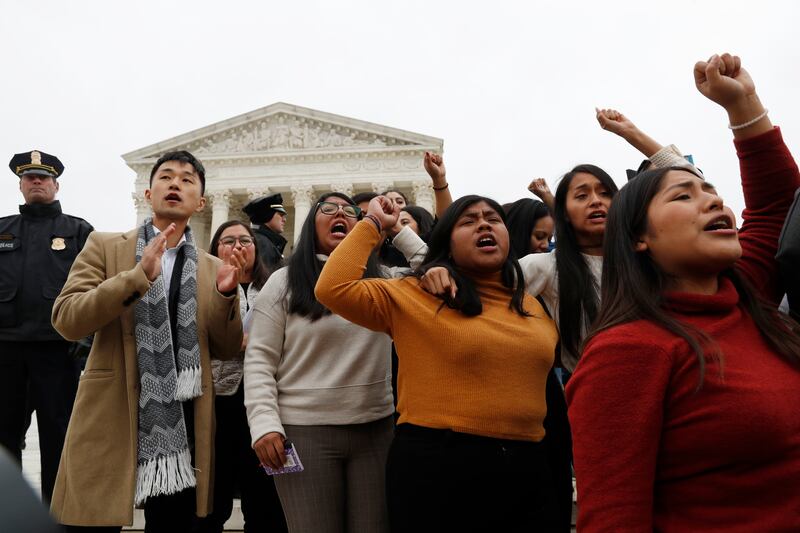
Outside the courtroom, hundreds of religious leaders, civil rights activists and DACA recipients rallied on behalf of the program. They called for the Supreme Court to rule against the Trump administration and lawmakers to pass more protections for immigrants.
“We have to remember that people have inherent dignity and value and that we should treat them as such. Our federal policies should reflect that,” said Giovana Oaxaca, a government relations associate for NETWORK, a Catholic social justice organization that helped lead a prayer walk Tuesday morning from Columbus Circle to the Supreme Court plaza.
Diego Tum-Monge, who, since Sunday, took turns with a friend waiting in the line to enter the courtroom, said he braved the cold and rain in order to show solidarity with DACA recipients and “bring attention to those that are in the shadows.”
“We want people to know that this is an important issue. And we hope that the future of our DACA recipients are secured,” said Tum-Monge, whose parents immigrated from Central America to Nebraska before he was born.
Standing nearby bundled in a thick knit cap and layered coats was Marisol Rodriguez, 20, whose parents brought her to the U.S. from Mexico when she was 6 years old on a temporary visa that expired. She recalled helping her mother study for the citizenship test, which she passed.
“A lot of my family members and loved ones are living undocumented,” Rodriguez said. “And so being here, it’s just really personally motivated.”
Her family’s future, as well as the fate of hundreds of thousands of other immigrants, will likely remain uncertain no matter how the Supreme Court rules.
If, as many legal experts predict they will, the justices decide that the Trump administration did not violate the law and either don’t comment on the legality of the DACA program or say it’s constitutional, then more immigrants who came to the U.S. illegally would be at risk for deportation in the short term. However, the next Democratic administration would be able to reinstate the protections through executive order, as the USA Today reported.
If, instead, the Supreme Court rules that the Trump administration acted improperly, then DACA would likely remain in place for only as long as it took government officials to write a more thorough explanation of why it needs to end.
Today, just as in 2012 when the DACA saga began, immigrant rights advocates’ only hope for more permanent relief rests in Congress. Archbishop José H. Gomez, who leads the Catholic Archdiocese of Los Angeles, was among those calling on policymakers to take action regardless of what the Supreme Court does.
“We should not have our young people living under the threat of deportation, their lives dependent on the outcome of a court case. So, we pray tonight that our president and Congress will come together, set aside their differences and provide our young brothers and sisters with a path to legalization and citizenship,” he said in a statement read during a Monday evening prayer service on behalf of immigrants.
The Supreme Court’s decision in the cases is expected by the end of June.
Matthew Brown contributed to this report.