

As we in the United States approach the national Thanksgiving holiday for 2019, it’s appropriate to consider things for which we should express our gratitude. Obviously, of course, there’s the good food that many of us will be eating. There are the family members with whom many of us will be gathering to share it.
However, there is much, much more. Indeed, our reasons for gratitude are virtually infinite. Here, let me suggest one vital factor in our lives that we almost always take for granted:
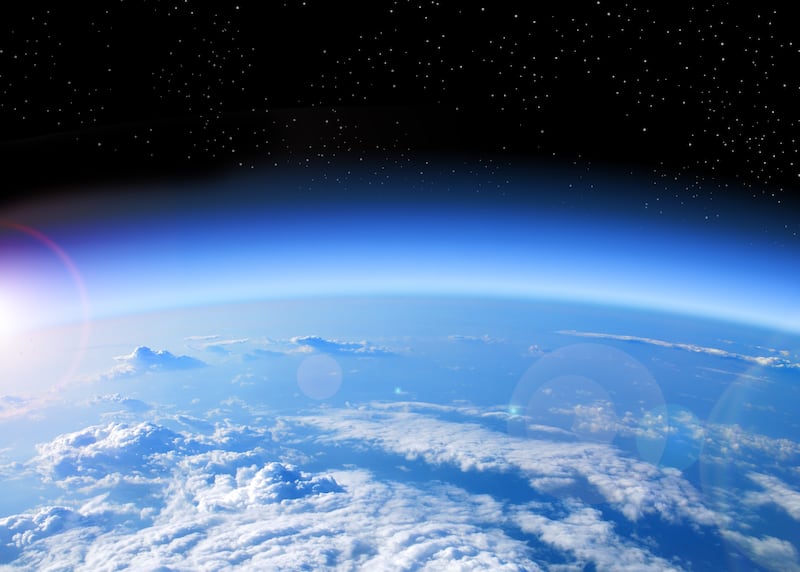
The phrase “thin blue line” is sometimes used to refer to the role of the police in society, who hold chaos at bay and thus permit order and civilization to flourish. The term could perhaps be used even more appropriately to describe the function of our terrestrial atmosphere, which allows not only civilization and order but sheer physical survival.
Our atmosphere as it exists today derives (as our oceans also do) from the “degassing” of the primitive semi-molten earth, supplemented by later additions belched up from volcanoes and emitted by hot springs.
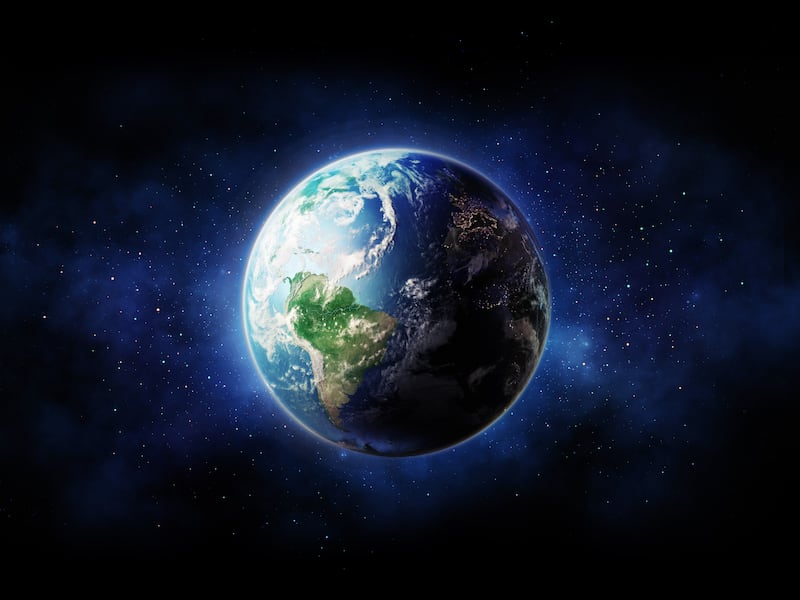
The atmosphere of early geologic times was composed of such gases as hydrogen, nitrogen, carbon monoxide, carbon dioxide, water vapor and various forms of hydrogen chloride. We couldn’t have survived those conditions. However, the lighter gases (e.g., hydrogen and helium) escaped toward space. Five hundred miles above the Earth, our “atmosphere,” if it can still be called that, is composed of 50% helium and 50% hydrogen.
Somewhat later in our planet’s history, living organisms developed that were capable of photosynthesis. They provided the oxygen that then permitted animal respiration and eventually the colonization of land, as well as providing the famous ozone layer that shields Earth (and us) from the sun’s ultraviolet radiation.
Evidence for this sequence of atmospheric development can be found, to some degree at least, in Precambrian rocks and a few fossils, which show a transition from a largely oxygen-free environment to what we might term a free-oxygen environment.
Our terrestrial atmosphere is an exceedingly thin envelope surrounding Earth. Perhaps somewhat more than 99% of our planet’s air exists within a region no higher than approximately 18 miles above sea level. Earth’s radius — the distance from its center to its surface or circumference — somewhat less than 4,000 miles, which means that the thickness of that oxygenated region of our atmosphere is a bit less than 0.5% of Earth’s radius.
But oxygen isn’t evenly distributed even within that thin envelope. Denser and, thus, heavier gases such as oxygen, carbon dioxide, nitrogen and water vapor hang low in the current atmosphere, mostly within about 3 miles of the planet’s surface. That thin band is equivalent to approximately 0.00075 of Earth’s radius, well under one ten-thousandth. Its outer edge is not far above our heads.
These heavier gases, especially oxygen, are essential to life. More than roughly 3 miles above sea level, we humans cannot usually function very well without supplemental oxygen.
Any resident of lower altitudes who has climbed in the Colorado Rockies or the Sierra Nevada of California, or visited the old Inca capital city of Cusco in Peru, knows the risks of nausea and lightheadedness that are encountered there. And death awaits those who travel, unaided, very much higher.
Federal regulations require the use of supplemental oxygen by pilots who fly more than 30 minutes at cabin pressure altitudes of 12,500 feet (roughly 3.8 kilometers, slightly more than two miles) or higher. And at cabin altitudes above 14,000 feet (about 2.5 miles), pilots must use oxygen at all times.
Altogether, the gases in the atmosphere serve to insulate the earth by filtering out most cosmic radiation and, as mentioned, blocking most of the sun’s ultraviolet radiation. Furthermore, they prevent large swings in temperature. They also burn up untold millions of meteors before those objects are able to collide with our planet. Again, in these ways, too, they are essential to life.
It’s also fortunate that our atmosphere deflects or reflects much interstellar “noise” back into space. Without that, radio and television broadcasts would be effectively impossible, lost in an impenetrable wall of static. On its “underside,” though, our atmosphere partially reflects (rather than merely transmitting) radio waves, which makes television and communication by radio possible.
As the Thanksgiving holiday draws near, there is much for us to be thankful for — including the very air that we breathe.
Daniel Peterson teaches Arabic studies, founded BYU’s Middle Eastern Texts Initiative, directs MormonScholarsTestify.org, chairs mormoninterpreter.com, blogs daily at patheos.com/blogs/danpeterson, and speaks only for himself.