

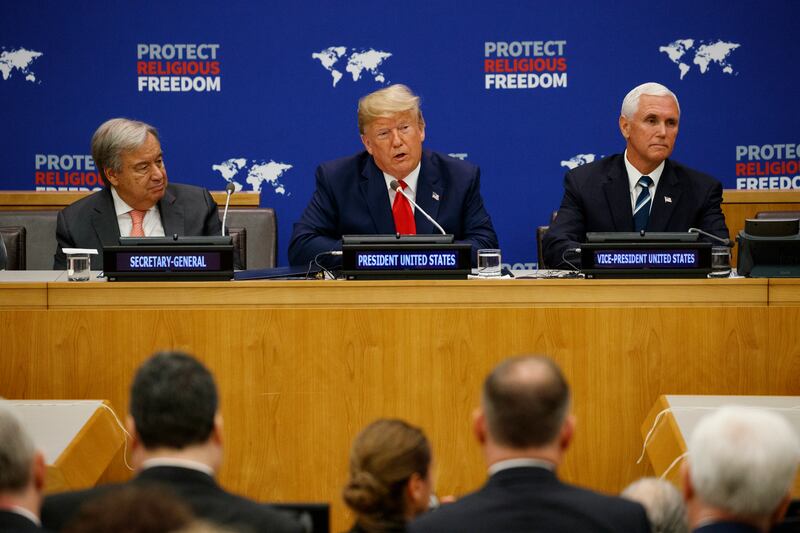

SALT LAKE CITY — The Trump administration’s rumored plan to withhold foreign aid from countries that mistreat religious minorities may be a bad idea, but not for the reasons you think, according to experts on international religious freedom.
Yes, the policy could be difficult to implement. Yes, the government would likely let religious persecutors who are also political allies off the hook.
However, what most worries some religion experts is that implementing such a policy change through executive order could degrade support for religious freedom here at home.
“In the worst case scenario, the administration would be perceived as not including the other political party on an issue that’s been largely bipartisan for 20 years,” said Chris Seiple, president emeritus of the Institute for Global Engagement.
Although Seiple and others support the idea of leveraging foreign aid to encourage better treatment of people of faith, they hope the Trump administration will proceed carefully. It already faces accusations of co-opting the cause of religious freedom for political gain.
“When we’re talking about integrating our religious freedom (goals) with our foreign policy, who is having that conversation? It needs to be a broad coalition,” Seiple said.
Religious freedom and foreign aid
Under current laws, the government can punish only the worst proponents of religious persecution, who are named annually on the State Department’s list of “countries of particular concern.” Potential sanctions, outlined in the International Religious Freedom Act of 1998, include the cancellation of state visits or reduction of certain assistance funds.
Under the rumored policy change, the Trump administration would be able to issue sanctions in response to less persistent but still problematic religious freedom violations, likely taking cues from the longer list of misbehaving countries produced each year by the U.S. Commission on International Religious Freedom.
Officials reportedly plan to leverage other countries’ desire for humanitarian, development and even military funds in order to mandate better treatment of people of faith.
“If the proposal becomes reality, it could have a major effect on U.S. assistance in a range of countries, from Iraq to Vietnam,” Politico reported.
The executive order, at least as it’s outlined by Politico, would build on existing religious freedom and foreign policy laws, rather than implementing something entirely new, said John Hanford, who co-authored the International Religious Freedom Act.
It’s been six decades since Congress passed the Foreign Assistance Act, which instructs the government to tie foreign aid to human rights, he said. And since 1998, federal officials have carefully tracked religious freedom violations and taken them into consideration in their foreign policy plans.
“The requirement to tie foreign assistance to human rights has been in the law for a long time,” said Hanford, who served as the U.S. ambassador-at-large for international religious freedom from 2002 to 2009.
That may surprise even those who closely follow the government’s international religious freedom work, since formal sanctions play only a small role in officials’ current approach. It’s often more meaningful to work with countries hoping to improve their religion-related record, rather than announce punishments from afar, Seiple said.
“We have to understand the interrelated set of issues on the ground ... and then make a tailored response to that context,” he said.
The government also has to consider other foreign policy concerns, which is why it often waives potential sanctions against key allies, Hanford said. He thinks building waivers into the rumored executive order would be a good thing, even if it made it so the Trump administration’s professed commitment to religious freedom was inconsistently upheld.
“It is important that we have waivers and ways to avoid creating more problems than we solve,” Hanford said.
Moving forward
Promoting international religious freedom is a delicate process, and so is passing related laws. In 1998, Hanford faced pushback from the State Department, the Clinton administration and lawmakers from both parties as he worked to build support for the International Religious Freedom Act.
“We were up against a lot of resistance to get this bill passed,” he said.
Officials worried about religious freedom work interfering with efforts to promote other human rights, Hanford noted. Battles were waged over what types of sanctions could be handed down and what should count as problematic behavior.
Hanford’s team was also up against the chaos of impeachment proceedings against former President Bill Clinton, which overlapped with work on the legislation.
It was a “very polarized time,” Seiple said.
In the end, the International Religious Freedom Act passed Congress with strong support from Republicans and Democrats, proving that tackling religious persecution can be a unifying mission.
“Religious freedom is an American ideal,” Hanford said.
Today, religious freedom still enjoys support from members of both parties, but related policy debates are increasingly polarized. Democrats have accused the Trump administration of privileging conservative expressions of faith and prioritizing the needs of persecuted Christians over the concerns of members of other faiths.
It wouldn’t be easy to build on the International Religious Freedom Act through Congress, and the stakes of the current crises affecting people of faith are too high to delay action, said Tony Perkins, chairman of the U.S. Commission on International Religious Freedom.
“I’m very concerned when I look at what’s happening with the impeachment hearings that many other very important issues are being missed,” he said. “We have momentum when it comes international religious freedom” that the government shouldn’t waste.
But the idea of implementing the rumored executive order without input from Democrats is also concerning, Seiple said.
“We need to be careful that such a policy is inclusive of non-Republicans,” he said.
Maintaining bipartisan consensus on international religious freedom would likely make more of a difference for persecuted people of faith in the long run, Seiple added.
“The more attention that we have on this, the more likely we are to have more political stability, more jobs, more economic empowerment and more women’s empowerment,” he said.