

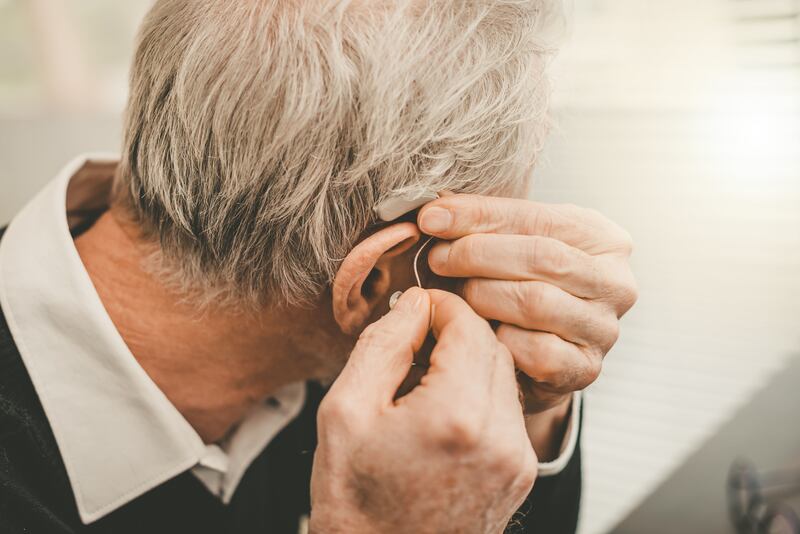

The only really drawn-out argument I ever had with my mom was about her hearing.
She badly needed hearing aids, but for reasons that many decades later I still can’t fathom, she fought and fought the notion. Maybe it was because she’d heard her own dad complain about the large hearing devices that perched behind his ears when she was growing up in the 1930s and ’40s. Or maybe she was just afraid. My mom was born blind and relied heavily on her hearing, but when I was a kid she’d had an ear infection and the doctor placed a drain tube in one ear. She swore she never heard completely well again.
I sympathize with the notion that she was unwilling to risk what was for her an especially crucial sense. But I will never understand how someone who was blind would try to navigate the world without hearing, too, when she had a choice.
I am not my mother, that’s for sure.
When my hearing started to go — a loss perhaps due to genetics, but just as likely to have resulted from a decade or so of reviewing too-loud rock and country music concerts — I immediately started researching hearing aids and setting aside money so I could afford to buy a pair.
The speed with which I embraced hearing-boost technology was made up of many components, not least of which is the fact that a journalist who can’t hear the difference between “socks” and “fox” could encounter serious problems in the retelling of other people’s tales. It’s also true that hearing aid technology has improved greatly over the years, so that my grandfather’s and even my mother’s hearing aids are hardly comparable to the tech available to me — and at a lower overall cost.
Had I been hesitating over the need for a hearing aid, though, one fact alone would have tipped the scales for me. Research shows that people who don’t hear well are more prone to cognitive decline and even dementia. Hearing deficit is also linked to depression, loneliness and isolation.
Why would I choose any of those possibilities over hearing the full-throated laugh of my niece Coralee or the springtime sound of birds chittering in the neighbor’s tree or the voices of my daughters teasing each other in the backseat on family road trips?
Coverage is a national policy discussion that’s certainly worth having.
I have a couple of friends who say they’ll put off addressing any hearing loss — ”another sign that age is winning” — as long as possible.
Me? I’m pretty sure I am going to be the exact same age whether I hear well or I don’t. So why would I choose “don’t”? I view this technology as a sign of my engagement with the world, not the fact I’m aging.
The only reason for forgoing needed hearing aids that makes sense to me is financial. Some people simply cannot afford the technology, and that’s one area where precious little help is available in the form of public or private insurance. Private insurance companies may negotiate discounts for certain hearing aid models, but even Medicare doesn’t cover purchase of the devices, although the older population that relies on Medicare is the same population most likely to need hearing help.
I am sure that not covering hearing aids saves the program hundreds of millions of dollars or more. I am also certain that not covering hearing aids likely costs the program hundreds of millions of dollars or more, as well, because of the well-documented link to costly challenges like dementia, depression, isolation and loneliness. Those contribute to other health conditions and make people more frail, racking up real dollars and genuine misery.
Coverage is a national policy discussion that’s certainly worth having.
At this point, though, a more important policy discussion takes place within families.
If you can’t hear, tell your family. Look at options. But get the help you need.
If you can hear, give thanks. Then do what you can to preserve the ability.