



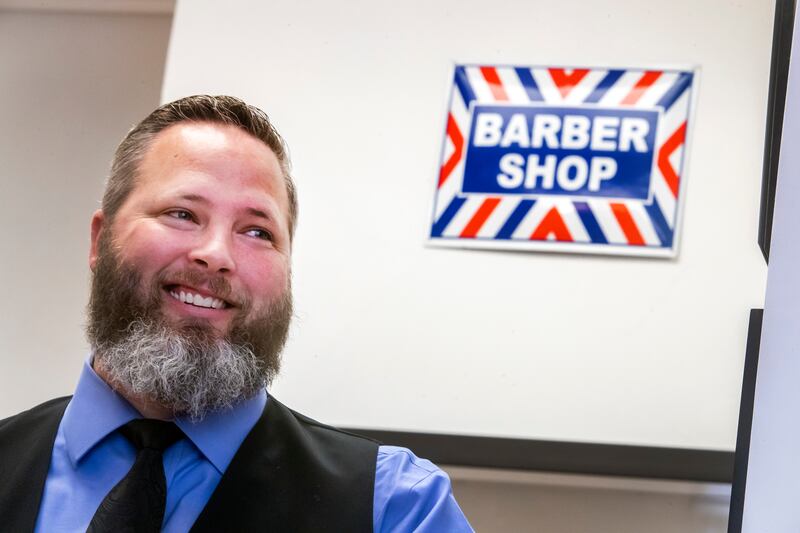
SALT LAKE CITY — Perry Knuth isn’t happy about having to add sales tax to the price of haircuts at his State Street barbershop, but he says he’ll deal with it if that’s what Utah lawmakers decide to do.
“They’re doing it like we’re selling bubble gum, for crap sakes,” he said. “I think it’s wrong."
Knuth, who has owned Perry’s Barber Shop for nearly 33 years, said he hopes his industry’s “awesome” lobbyist can head off the legislative proposal to start taxing dozens of services in the state.
But if not, “I’ll adapt. I can’t stop it.”

Adapting likely means rounding up his prices to the nearest dollar to include the tax so he doesn’t have to handle change. He figures he’ll need an accountant to help him remit the tax to the state.
“I’m just going to have the raise the price and I’ll lose tip money, he said.
Knuth is among a chorus of businesses that oppose HB441, a controversial Republican tax reform proposal that until Thursday was winding its way through the Utah Legislature.
GOP lawmakers and Gov. Gary Herbert pulled the plug on the bill this legislative session, but are still determined to impose sales taxes on a wide range of services including everything from haircuts to legal work. Herbert wants to convene a special session in the summer.
Pressure on lawmakers to vote against the legislation had built up the past few days, much of it coming from business owners and professionals who would have to charge sales taxes on their services.
Blake Moore, owner of Moore Green in North Salt Lake, read most of the original 8,030-line bill and expressed his opposition to his elected representatives. He worries how a tax on services would impact the lawn care and fertilization business he has owned the past 15 years.
"I'm concerned about it because that will obviously increase prices that my customers will have to pay for my service," he said. "My concern is people will stop buying our services."
With increased costs for wages, rent and insurance, Moore said he already had to raise his prices this year.
Imposing the tax, he said, would be one more way to widen the gap between legitimate lawn care companies and those that skirt the law.
"The landscaping industry is an industry that's very easy to get into. There are companies or guys that go out and do this type of work off the books. We compete against these companies and they don't pay employee taxes. They won't collect sales tax," Moore said.
Brian Hollien, president of Morris Murdock Travel, said it's "horribly misleading" for legislators to refer to the proposal as a tax cut. At best, he said, it would be tax neutral.
"The reality is there's going to be so many taxes on services that are totally unforseen and not thought out very well at all," he said.
To make the tax fair, Hollien said, the state would have to collect from every hotel, resort, cruise line and tour company in the world. He said there's no way a hotel in Tahiti is going to tax a Utah resident's booking — including determining in which county the person lives, because the rates vary — and remit that money to the state.
"It's simple not going to happen," he said.
Hollien said just collecting the tax presents a logistical nightmare for travel agencies.
"Somehow the legislators think that there's some magical solution or software or something to apply this. There's nothing out there for our industry that's going to do this," he said, adding that if there were, it could cost hundreds of thousands of dollars.
"It's not just the tax itself. It's all of the challenges of how do you even comply with it and then the cost of compliance," Hollien said. "And how would the state ever even see that this is fairly and equitably applied to everyone that should be paying these taxes?"
Interior designer Martha Hatfield said she wouldn't know where to begin to collect taxes on her consulting work.
"I'm good at making things beautiful. Don't talk to me about numbers," she said.
Hatfield, who ventured out on her own with Martha Hatfield Design about a year ago, said she fears a tax on services would "kill my business" as well as others.

"Many of us would close up shop," she said. "People would no longer start small businesses. I think it would seem too daunting."
Hatfield said she thought lawmakers were rushing the bill through, and that it felt "very underhanded."
"You know why they did it? It's because they didn't want the people of Utah to get in their face about it because they know we are opposed to it," said Hatfield, who made her feelings known to legislators all over social media.
David Bean owns three Dave's Barber Shop locations in the Salt Lake Valley. He figures that, like others in the cosmetology and barber industries, he'll need an accountant to help him sort out how to collect and remit sales tax to the state.
"I'm much better with hair than I am with math," he said.
Most barbers, he said, are independent contractors who make $30,000 to $60,000 a year, adding he lives in a small apartment and drives a truck with 200,000 miles on it. Taxing haircuts will drive up prices, and customers won't like it, he said.
"It's just going to make it a lot more expensive and a lot more difficult for an already struggling industry," Bean said, adding there are only 700 licensed barbers in the state.
Bean noted that lawyers whose services also would be taxed oppose the proposal.
"They'll find a way out of it," he said."But I don't have that kind of power."