

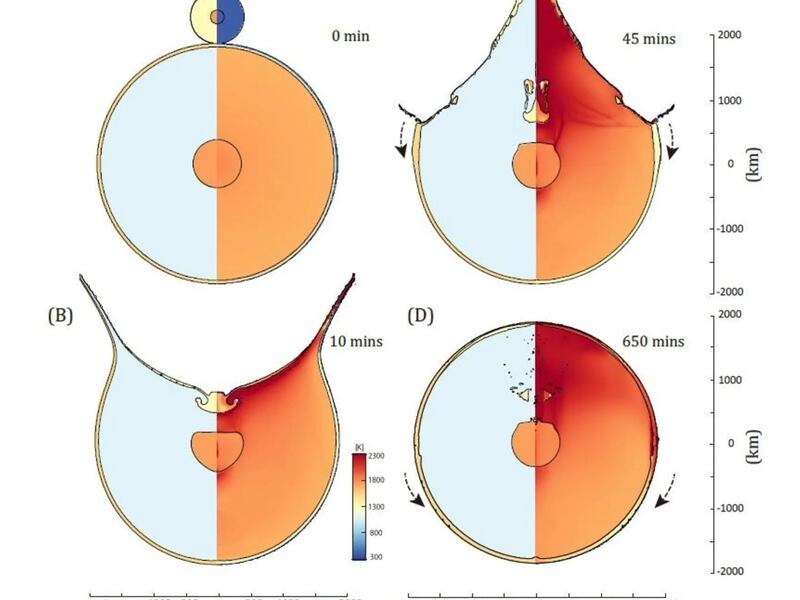
SALT LAKE CITY — Fun fact: the moon is lopsided — likely because it was hit by a dwarf planet, according to new research.
According to Gizmodo, researchers from the Space Science Institute at Macau University of Science and Technology estimate the moon’s asymmetric surface was caused by a collision on its near side.
Some differences between the near side and far side of the moon include differerent topographies, crust thickness and chemical composition.
Armed with the hypothesis that a massive object had hit the moon, the research team ran 360 computer simulations on whether or not a collision with a foreign body could affect the moon. Two models came back with results that explain what may have happened:
- “The near side-far side asymmetry was shown to be caused by a large object measuring 780 kilometers (480 miles) in diameter hitting the Moon’s nearside at 22,550 km/h (14,000 mph) or a slightly smaller object at 720 kilometers across (450 miles) at a higher speed of 24,500 km/h (15,000 mph),” the article says.
- Following the collision, debris would have been launched off of the moon’s surface before falling back down, resulting in an inconsistent crustal layer up to 6 miles thick.
The study could also potentially explain why chemical isotopes on the moon are slightly different to their Earth counterparts. Asymmetric features on other celestial bodies — like Mars — may have also experienced a similar collision.
“Indeed, several planets have hemispherical dichotomies, yet for the Moon we have a lot of data to be able to test models and hypotheses with, so the implications of the work could likely be broader than just the Moon,” said Steve Hauck, a planetary geodynamics professor at Case Western Reserve University.
I previously reported for Deseret News that seismic activity on the moon has led to the lunar surface shrinking like a raisin — however, it won’t cause the moon to implode any time soon, regardless of some theories.