
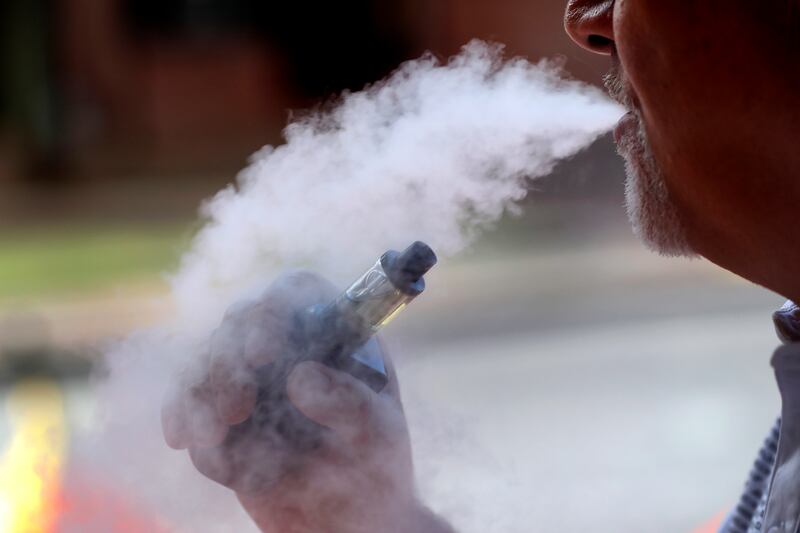

After an investigation of lung illnesses linked to vaping, federal and state officials have found vitamin E acetate to be the common denominator among cannabis products used by those sickened throughout the country.
According to The Washington Post, vitamin E acetate doesn’t necessarily cause harm when used as a supplement or if it applied to skin, but its molecular structure could become hazardous upon inhalation.
Vitamin E acetate is found naturally in some foods — such as canola oil and almonds — and is often found in skin treatments or as a nutritional supplement.
There are times when Vitamin E is advertised as a supplement in cannabidiol oil, which has been used for vaping,
As of Aug. 27, there were 215 possible cases of vape-related lung injuries reported by 25 states, according to officials from the Centers for Disease Control and Prevention. But other reports of lung illnesses are still under investigation.
On Wednesday, Oregon health officials released information on the death of a middle-aged adult in late July. The adult suffered from a severe respiratory illness and had used an e-cigarette containing cannabis oil. This is one of two deaths linked to vape-related illnesses in the United States.
It is unlikely that main e-cigarette manufacturers have suddenly changed their ingredients, according to reports.
“It’s probably something new that has been introduced into the market by an illegal manufacturer, either a new flavor or a new way to emulsify the THC that is causing these injuries,” said former Food and Drug Administration Commissioner Dr. Scott Gottlieb, according to The New York Times.
Oregon state and federal officials have said they are looking into possible contaminants or counterfeit substances, while an FDA spokesman said the agency is “looking into potential leads regarding any particular constituent or compound that may be an issue,” according to The Washington Post.
The FDA analyzed 12 nicotine samples and 18 viable THC samples and found that vitamin E was found in 10 of the 18 THC products analyzed. The New York State lab also found “very high levels of vitamin E acetate in nearly all” its tested cannabis samples.
In a statement released Thursday, New York State Health Commissioner Howard Zucker announced that “vitamin E acetate is not an approved additive for New York State Medical Marijuana Program-authorized vape samples and was not seen in the nicotine-based products that were tested.”
As a result, vitamin E acetate is now the key focus in New York’s investigation.
According to experts, the lungs are delicate and are not designed to handle anything other than gases.
Bryn Mawr College chemistry professor Michelle Francl stated that vitamin E acetate is basically grease and, due to its molecular structure, it has to be heated to an extremely high temperature — nearly four times higher than normal human body temperature — in order to be vaporized, according to The Verge.
Francl explained that once the vapor cools down in the lungs, it returns to its original state at that temperature and pressure, meaning that “it has now coated the inside of your lungs with all that oil.”
In Utah, clinicians have been treating several patients with lipoid pneumonia — lipoid pneumonia is a condition often found in elderly persons who accidentally inhale droplets of oil-based laxatives, according to The Hill.
One such case was that of 20-year-old Provo native Alexander Mitchell.
“He went from being sick to being on death’s door in literally two days,” stated Mitchell’s father, David.
According to Thomas Eissenberg, who studies vaping at Virginia Commonwealth University, inhaling oil into your lungs can be dangerous and could result in death.
“Basically, what the FDA should be doing is testing every one of these liquids to see if they have any oil at all and making a regulation that would ban oil in any of these products, whether it is a THC product or a nicotine product,” Eissenberg said, according to The New York Times.
The Vapor Technology Association, an e-cigarette and vaping industry trade group, has reached out to public officials, asking them to “thoroughly investigate the circumstances which might have led to each reported hospitalization before making statements to the public as to whether certain products are implicated in these incidents.”