

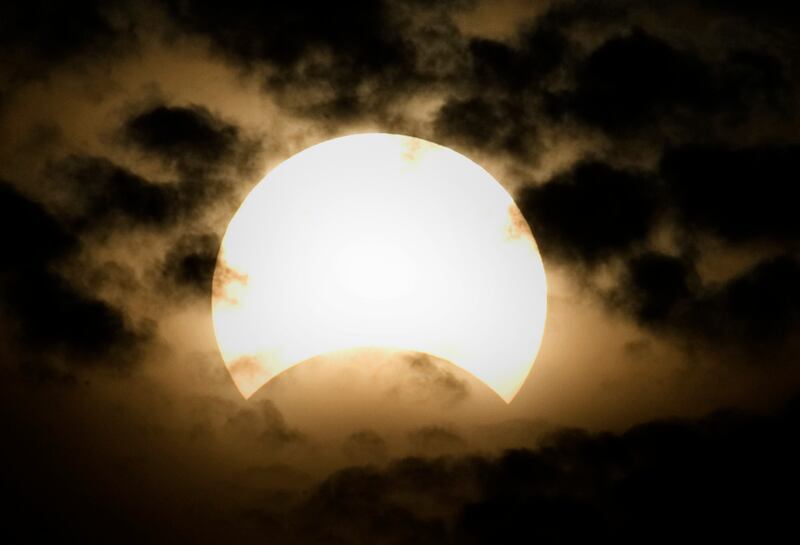

An annular solar eclipse like the one that occurred last Saturday won’t happen in the United States again for a while, but a total solar eclipse is heading for the eastern U.S. on April 8, 2024. Here’s everything you need to know about how to see it.
What is the difference between total and annular solar eclipses?
A solar eclipse occurs when the moon, Earth and sun align so that the moon momentarily blocks the sun. There are several classifications of eclipse, including partial, total and annular, per NASA.
While total and annular eclipses only last for a few minutes, the sun will appear in a state of partial eclipse in the hour or so preceding and following total and annular eclipses.
In an annular solar eclipse, which last reached the U.S. on Oct. 14, the moon appears smaller than the sun due to its position in its elliptic orbit. This leaves a visible corona of the sun around the moon. At no point during an annular eclipse is it safe to look directly at the sun, according to the National Park Service.
Where and when is the next total eclipse?
A total solar eclipse, like the one occurring in April 2024, happens when the moon completely blocks the sun from view.
The sky gets noticeably darker, although not totally devoid of light. During the two to four minutes of totality, when the sun is fully blocked, it is safe to look directly at it, according to the National Park Service.
Where is the best place to see the 2024 eclipse?
The April 2024 eclipse will travel over Mexico, the U.S. and Canada, according to NASA.
It will first make landfall in the U.S. in Eagle Pass, Texas, around 12:10 p.m. CDT, per the Great American Eclipse. It will then travel through parts of Arkansas, Missouri, Illinois, Indiana, Ohio, Pennsylvania, New York, Vermont and Maine.
When and how can I see a total solar eclipse?
Traveling to areas within the path of totality should ensure that you get a good view, but here’s how to have the best possible experience.
- Find an open area to watch the eclipse. Hanging out in a forest or between skyscrapers could block your view.
- Keep eye safety in mind. You can only look directly at the sun during the few minutes of the eclipse’s totality. If you are outside the path of totality or watching the partial eclipse, you need to wear eclipse glasses. Read NASA’s guide on solar eclipse safety for more information.
- Watch the weather. If it’s cloudy, you may not be able to see the eclipse at all, even if you’re perfectly within the path of totality.
- Plan on crowds. The most recent eclipse brought heavy traffic to Utah, per KSL. Be prepared for traveling to take longer than usual.
- Consider staying a while. If you want to make a vacation of it, some of North America’s most beautiful destinations are within the eclipse’s path. Visit coastal Mazatlán, Niagara Falls or the remote Canadian province of Newfoundland and Labrador.