

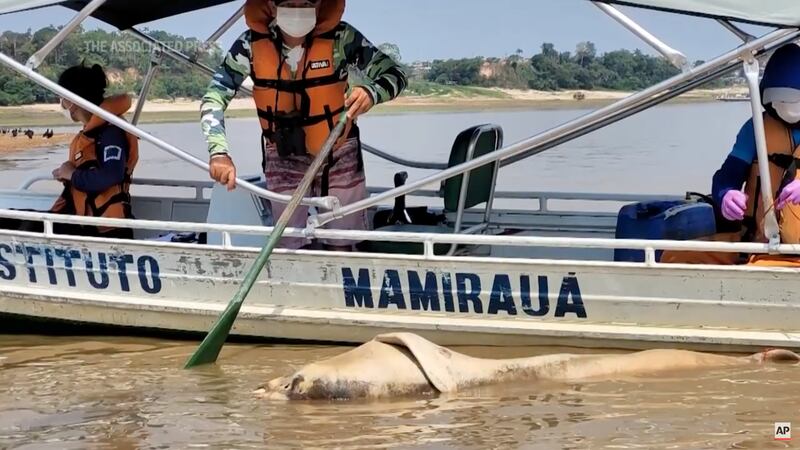

Over the past two weeks, more than 100 river dolphins have been found dead and beached on Brazilian Amazon river shores amid a severe drought in the area. Two more were found on Monday.
Most of the dolphins have been found in Lake Tefé, reported CNN, which is a branch of the Amazon River located in northwestern Brazil.
In Lake Tefé there are about 1,400 river dolphins, including the Tucuxis and red river dolphin species, Miriam Mormontel, a researcher at the Mamirauá Institute for Sustainable Development, told The Associated Press.
“In one week, we have already lost about 120 animals between the two of them, which could represent 5 to 10% of the population,” said Mormontel.
Experts suspect warmer-than-usual water temperatures are to blame for the deaths, as the area is experiencing severe drought, per NPR. The heat wave in the area has heightened water temperatures, which reached 102 degrees Fahrenheit in recent days.
Brazilian river dolphin species feed on fish, which local media has reported are also dying from the warmer water temperatures, making the situation even more dire, per NPR.
How rare are river dolphins?
“If these mortality rates continue to increase, we will enter a very critical situation, considering that both species are threatened to extinction,” Mormontel told NBC.
Because of habitat loss or obstruction, pollution and hunting, all six species of freshwater river dolphins are endangered or critically endangered across the world, per the World Wildlife Fund.
Three species live in the Amazon, including Tucuxis, Amazon River dolphins and the Bolivian subspecies of the Amazon River dolphin, per WWF.
What efforts are being made to save the dolphins?
According to the WWF, freshwater dolphins can weigh up to 352 pounds and get up to 9.2 feet long, which makes it difficult to move the animals to safer waters.
The river is in its dry season, on top of a drought, making it impossible in some parts to move the animals via the waterway, reported CNN. Another concern is the carrying of possible disease into other water sources.
“Transferring river dolphins to other rivers is not that safe because it’s important to verify if toxins or viruses are present (before releasing the animals into the wild),” André Coelho, who is a researcher at the Mamirauá Institute, told CNN Brasil.
Why is the Amazon River dolphin important?
The freshwater dolphins are at the top of the food chain in the Amazon, which allows them to regulate environmental indicators, per the environmental news agency Mongabay.
If the dolphins are doing fine, it usually indicates a healthy river, which will mean a flourishing community for humans, companies and other wildlife species, per WWF. But if they are declining — like they are now — it doesn’t bode well for communities along that span of the Amazon River.
Without waterways, “many communities are becoming isolated, without access to good quality water, without access to the river, which is their main means of transportation,” Ayan Fleishman, a geospatial coordinator at the Mamirauá Institute, told NPR.
According to NPR, Amazonas Gov. Wilson Lima declared a state of emergency due to the drought on Friday.