

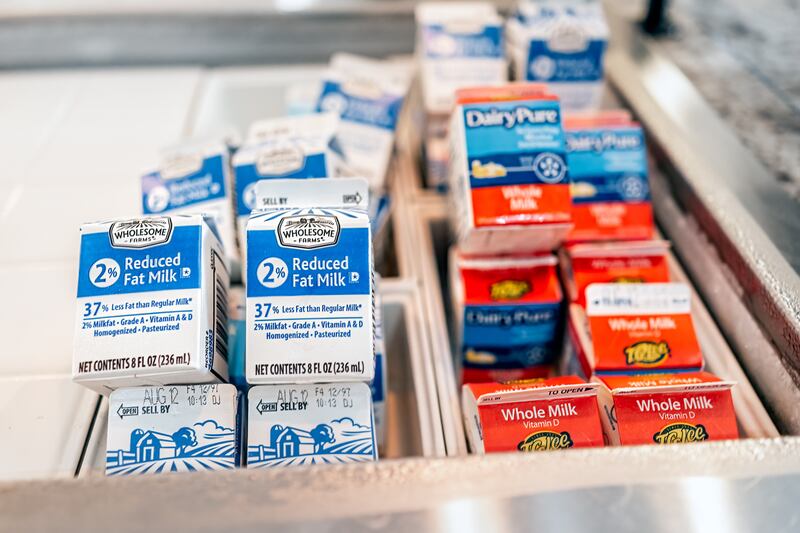

The House of Representatives is trying to shake up school lunches. On Wednesday afternoon, lawmakers passed a bill to allow whole milk to be served in school cafeterias.
The Whole Milk for Healthy Kids Act passed the House in a 330-99 vote, with only one Republican and a majority of Democrats voting “no.”
The current dietary standards were set by the Healthy, Hunger-Free Kids Act, which was the focal point of former first lady Michelle Obama’s “Let’s Move” campaign to curb childhood obesity. The House bill will overturn the Obama-era regulation and give children a whole milk option alongside the preexisting nonfat flavored milk or 1% milk in 2012 offerings.
Rep. Virginia Foxx, R-N.C., kicked off the debate on the House floor, listing the nutrients in whole milk, like protein, calcium and vitamin D, before mentioning that the drink acts as the much-needed fuel for Santa Claus, who travels the whole globe in one night, according to The New York Times.
“If whole milk is a good option to fuel Santa’s extraordinary Christmas Eve journey, then why isn’t it an option for American schoolchildren in their lunchrooms?” Foxx said. “Let’s end the war on milk.”
An opposing lawmaker, Rep. Bobby Scott, D-Va., a ranking member of the House Education and the Workforce Committee, who voted against the bill, argued the proposed bill doesn’t follow the advice of experts. He noted that the American Heart Association, American Academy of Pediatrics, the Physicians Committee for Responsible Medicine, the Academy of Nutrition and Dietetics, and a dozen other public health advocates “agree that fat-free and low-fat milk are the healthiest options for children.”
For years, whole milk has earned the reputation of being unhealthy because of its higher saturated fat content, which can increase the risk of cholesterol. However, more recent scientific studies do not fully support this claim and question the link between saturated fats with heart health. A 2019 study, in particular, found that “relative to reduced-fat cow-milk, whole-fat cow-milk consumption was associated with lower odds of childhood overweight or obesity.”
Democratic Rep. Seth Moulton of Massachusetts poked fun at the House speaker for prioritizing Big Milk’s agenda instead of tackling the pending negotiations over various foreign aid and border security while the holiday four-week recess fast approaches.
“Instead of providing aid to our allies or funding the government, today Congress voted on whether or not to (checks notes) deregulate milk?” Moulton said.
“Like, sure, but can (House Speaker Mike Johnson) please let us vote on important stuff too?” he added, attaching a photo of a milk carton with Johnson’s face underneath the words, “missing in action.” Still, Moulton voted for the bill.
Democratic Rep. Mike Thompson of California also echoed the need to address serious issues like gun violence, which is the leading cause of death among children and teenagers, instead of unbanning whole milk. “I spent the entire weekend in my district and not one person came to me to change the law on chocolate milk,” Thompson said.
Rep. Glenn “GT” Thompson, R-Pa., who introduced the bill, celebrated the victory by putting on a shirt that said, “I Drink Whole Milk & I Know Things.” He also held a bottle of chocolate milk in his hand.
Of course, players from “Big Milk” — like the International Dairy Foods Association and the National Milk Producers Federation — also praised the passage of the Whole Milk for Healthy Kids Act, while giving the Senate a nudge to push the legislation past the finish line.
But Meghan Maroney, campaign manager for the federal child nutrition programs at the Center for Science in the Public Interest, a consumer advocacy group, said the House bill appeases milk lobbyists instead of following science.
“How many parents would turn to their members of Congress for nutrition advice for their children instead of health experts?” asked Maroney. “It’s absurd. Nutrition standards for school meals should be based on science, not on regurgitated talking points from the dairy industry or any other industry.”
“There are many pieces of legislation members of Congress could endorse that would increase access to school meals and thus increase access to milk,” said Maroney. “But some in Congress would rather do backflips to please Big Dairy instead of serving the families and children in their districts.”