

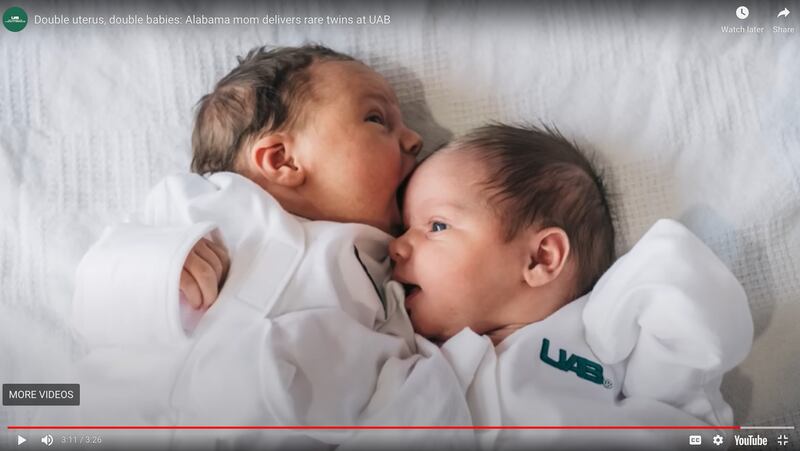

Kelsey Hatcher was diagnosed with a double uterus at 17, and that diagnosis helps explain how she delivered two babies over two days at the University of Alabama at Birmingham Hospital just before Christmas this year, per the University of Alabama at Birmingham.
The first baby, Roxi, was born vaginally on Dec. 19 at 7:45 p.m. Rebel, the second, was delivered at 6:10 a.m. on Dec. 20 by cesarean section. Both the girls and Hatcher, 32, who is now a mother of five, are healthy.
Hatcher discovers unique pregnancy
Hatcher scheduled an ultrasound “a few weeks” into what she thought was a normal pregnancy after noticing abnormal bleeding. When she went in for the appointment, the ultrasound technician said her pregnancy looked completely normal, and her daughter’s heart rate looked healthy.
Hatcher described the appointment to UAB News. She jokingly asked the nurse, “There’s only one, right?” and the nurse responded, “Yeah, there’s only one.”
Hatcher told the technician about her double uterus, and she responded, “You know, I thought I had caught something, let’s just go over there and check it out.”
“As soon as she had moved the ultrasound wand to the other side of my belly, like she didn’t even have the time to say anything, I immediately said, ‘Oh my gosh! There’s another one!’” Hatcher said.
Hatcher told Today.com, “I was in complete shock and think for the first, I don’t know, two to three weeks, my husband and I just laughed.”
How did this kind of pregnancy happen?
The National Library of Medicine published a report that described Hatcher’s double delivery as a one-in-a-million occurrence.
Three weeks before Hatcher’s delivery, UAB gynecologist Shweta Patel explained the process to UAB News.
“She is currently pregnant with a baby in each uterus,” Patel said. “She likely ovulated from each side and that ovulation led to an egg that traveled through each of her fallopian tubes that are attached to each of her uteruses, and sperm traveled up through each uterus and was able to conceive in that way.”
Maternal-fetal medicine specialist Dr. Richard Davis told UAB News, “With Kelsey’s babies, they each had their own womb, sac, placenta and umbilical cord, allowing them extra space to grow and develop.”
How Hatcher birthed the two babies
Patel said doctors at UAB were preparing for a number of different birth situations, including a vaginal delivery for the first baby, a C-section for the second or C-sections for both.
When spontaneous labor didn’t happen after 39 weeks, Hatcher was induced.
She described her contractions to UAB News. “As my contractions began, they were not consistently together but were within a few seconds of each other. I felt each side contracting in different areas as well. I felt one consistent with the monitor that started on the left side and moved to the right,” she said.
“Kelsey was essentially laboring in the left uterus while simultaneously undergoing the postpartum process in the right,” Patel said. “She was having contractions with Baby B while breastfeeding Baby A.”
Both babies were delivered successfully and were able to return home before Christmas. On Thursday, Hatcher posted to Instagram, “Well, we’ve survived a week!”
“Introducing the girls to our other kiddos was so sweet and special,” she continued. “We have enjoyed our relaxing time together and being able to spend Christmas together. We plan to soak up all the sweet moments together until we get back to semi routine next week with Daddy going back to work and kids back to school!”