

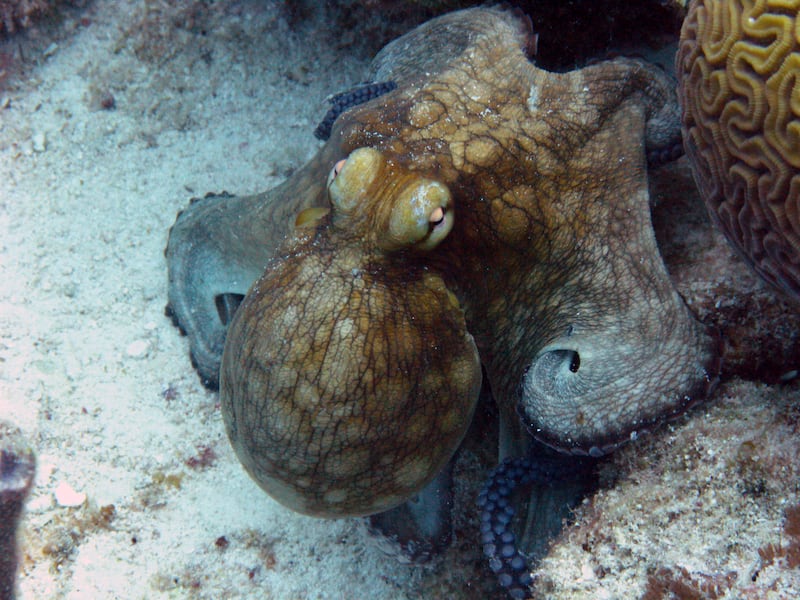

A new study revealed that two species of octopus have the capability to rewire their brains in response to temperature changes.
Because octopuses are cold-blooded, “they cannot internally regulate their body temperature,” making them more “vulnerable to external temperatures in the water,” as stated by Live Science.
What does the study say about octopus gene editing?
According to the study in the scientific journal Cell, two species of octopus studied outside the coast of California found that the animals were capable of editing their RNA, the messenger responsible for carrying and relaying information from DNA. By being able to alter the RNA, it makes the octopus more able to survive when environmental changes occur.
The RNA molecules impact “which proteins are made in the nervous system,” and when temperatures fluctuate, those proteins are sensitive and “their ability to function drops. A change of just a few degrees can be lethal,” National Geographic reports.
“Water is a pretty cruel substrate to live in,” Joshua Rosenthal, a neurobiologist at the Marine Biological Laboratory in Woods Hole, Massachusetts, who led the new study, told National Geographic. “It’s a real challenge to think at different temperatures. Nervous systems are just that complex.”
How did the octopus gene editing study work?
Researchers tested 12 wild-caught California two-spot octopuses, and they placed half in warm water tanks (71 degrees Fahrenheit) and the other half in cold water tanks (55 degrees Fahrenheit). They then worked with scientists from University of Michigan and Texas Tech University to explore “whether these RNA changes actually affected protein structure,” per Live Science.
In the study, gene editing mainly took place in order to acclimate to the cold water, not warm.
What do we already know about octopuses?
An octopus has 500 million neurons, and more than half of those are found outside the brain, and the highly intelligent cephalopods can also “solve puzzles, change their shape and color,” and “their arms literally have minds of their own,” as stated by Discovery.
Scientists plan to conduct more research to learn more about the puzzle-solving, gene-editing invertebrates.