

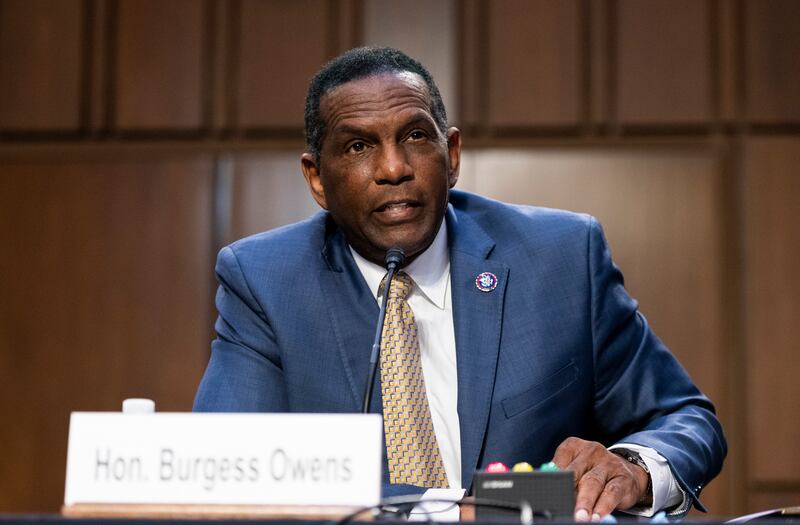

Rep. Burgess Owens criticized the Biden administration’s “irresponsible use of taxpayer funds” while questioning Transportation Secretary Pete Buttigieg at a committee hearing Wednesday.
Owens, R-Utah, expressed dissatisfaction in the department’s failure to alleviate supply chain issues even in a time of “record government spending.” He also raised concerns about inefficiencies in “transport for energy resources and goods,” and the department’s tendency to prioritize urban projects and projects in blue states, at a hearing of the House Committee on Transportation and Infrastructure.
“When policymakers prioritize equity and environment over competition and economy, American families are left footing the bill,” Owens said.
Committee Chairman Sam Graves, R-Mo., introduced the U.S. Department of Transportation’s four main 2024 funding requests, presented by Buttigieg, at the hearing.
During the hearing, Buttigieg was asked about continued funding of the CARES Act, the supply chain crisis, the infrastructure bill, and aviation and rail safety issues.
CARES Act
Standing for Coronavirus Aid, Relief, and Economic Security Act, the CARES Act was enacted shortly after COVID-19 hit the U.S. in March 2020. Most of the original provisions in the act have been phased out but a few were extended by subsequent legislation, per the U.S. Department of Treasury.
In the committee meeting, Buttigieg proposed continuing to provide funding for provisions in the CARES Act, including the American Jobs Plan, which would “invest $621 billion in transportation infrastructure and resilience over eight years,” he said.
Supply chain crisis
Buttigieg said in his opening statement that the supply chain crisis resulted from decades of underinvestment and neglect and the continuing influence of COVID-19. He also said the committee addressed the crisis by passing the Bipartisan Infrastructure Law, authorizing “up to $108 billion for public transportation — the largest federal investment in public transportation in the nation’s history.”
Infrastructure bill
Buttigieg answered committee members’ questions regarding grant programs authorized by the bill. He also discussed the issues and opportunities around the further development of electric vehicles, and the required infrastructure of charging stations, battery recycling resources and grid integration. Buttigieg also told committee members he was confident in his department’s capability of ensuring the cybersecurity of transportation systems from potential threats.
Aviation and rail safety issues
Buttigieg discussed steps taken toward modernizing air traffic control systems through satellite and how to incentivize and provide funding an update. He also emphasized the importance of restoring public confidence in flight safety and international cooperation.
During his questions, Owens brought up the Department of Transportations delay of the merger of Jet Blue and Spirit Airlines. He asked Buttigieg, “Mr. Secretary, I am increasingly concerned by your department’s actions that result in protecting 80% of market share among the four U.S. carriers. Do you believe in maintaining the status quo as a result of your opposition to the Jet Blue Spirit merger?”
Buttigieg responded, “Well, if we want competition, then we have to have fidelity in our watchdog role when it comes to mergers.”