

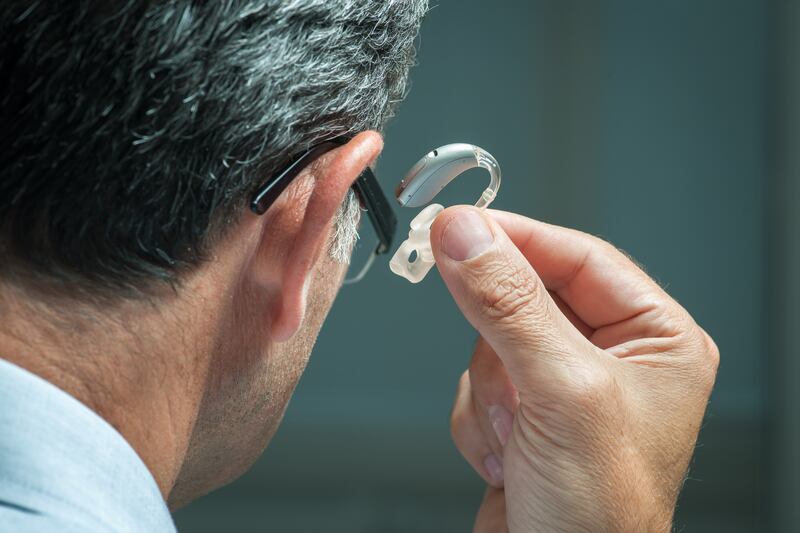

The Lancet Healthy Longevity journal published a study earlier this month showing new evidence for health benefits connected to wearing hearing aids.
This study was published with the backdrop of decadelong research on hearing impairment significantly increasing mortality risk.
Hearing impairment leads to greater risk of contracting other impairments
Hearing impairment seems to have several negative health effects. According to one 2014 study, participants from all demographics with hearing impairment had an increased mortality risk of 20%.
While hearing impairment increased mortality risk across the board, another study published in 2022 added that hearing loss specifically increased the risk of cardiovascular mortality.
Individuals with hearing impairment are at a higher risk for dementia and depression. In a cross-sectional study of nearly 150,000 participants, “hearing loss was associated with greater odds of depression.”
Hearing impairment does not lead to an increased risk of Alzheimer’s disease, but it was associated with dementia and cognitive decline, per a 2018 study. “Vascular dysfunction and impaired verbal communication may contribute to the association between hearing loss and cognitive decline,” researchers added.
An audiologist at the University of South Florida, Harvey Abrams, explained how hearing impairment can lead to depression. “People begin to withdraw from activities that would put them in touch with others and that can lead to loneliness and depression,” he said.
How does wearing hearing aids add onto life-expectancy?
The recent Lancet study followed nearly 10,000 participants with the average age of 48.6. Participants took a National Health and Nutrition Examination Survey between 1999 and 2012, which asked questions about hearing aid usage.
Individuals who reported they regularly used their hearing aids had a 24% lower mortality risk than those who never used them and those who didn’t use them regularly.
Janet Choi, an otolaryngologist at the University of Southern California, explained what she and her team attempted to uncover in this recent study.
“We’re showing that hearing aids can play a protective role,” she said. “Hearing aids are not just an optional device, it’s something that can really help people on a higher level.”
Discernible sound seems to help maintain brain health, Frank Lin, director of the John Hopkins Cochlear Center for Hearing and Public Health, hypothesized.
He said, “When you can’t hear very well, your brain’s getting a much more garbled auditory signal, and it leads to structural effects on the brain,” per The Washington Post.
In 2023, Lin published research showing that hearing aid use may reduce cognitive decline among older adults, according to the The Lancet. MRI scans of regular hearing-aid users showed brain tissue loss occurring at slower rates than non-hearing aid users.
Other influences
Since regular hearing-aid users may be more health conscious than nonusers, other factors besides the hearing aids themselves may have influenced participants’ mortality risks.
However, the Lancet study added, “The results remained significant after adjusting for relevant factors including demographics, income, education, insurance, and other medical comorbidities.”