


- A new biography of Patagonia founder Yvon Chouinard was released earlier this fall.
- Author David Gelles pulls no punches in the book, but finds no skeletons, either.
- The book addresses the nuance and complications of the influential owner and his company.
Yvon Chouinard — inventor of fleece jackets, the aluminum climbing nut, the layered clothing system universally adopted by outdoor athletes (and everyday people now, too) and whose name is synonymous with first ascents of some of the most exciting and challenging climbs across the West and world — was furious when he first made the Forbes’ billionaire list in 2017.
Describing the scene in a new biography released in September titled "Dirtbag Billionaire," David Gelles, the New York Times reporter, wrote that Chouinard “tromped around the office demanding something be done to rectify the situation.”
“‘Get me off that list!,’ he told anyone who would listen. ‘I hate that list!’”
Despite building one of the most beloved retail brands in America with Patagonia, this particular “dirtbag” — the affectionate moniker for a person so dedicated to outdoor sports that they forgo societal comforts and live on life’s outskirts like, well, dirtbags — found such recognition devastating.

Whether that’s through his lifelong pursuit of adventure, making it easier to navigate extreme landscapes with the right gear or through dedicated acts of conservation, Chouinard’s life, now in its 87th year, has always been dedicated to the outdoors. His priorities are well known: surfing, climbing, fishing and — most important — attempting to save the planet from its most impactful inhabitants.
Of course, his was not the standard path towards wealth accumulation, and certainly not comparable to the others who populate the billionaire list. Unconventional as his trajectory was, getting on the list was not a surprising result for someone so influential. Even if it was for him.
“Chouinard assembled a staggering list of accomplishments that enshrined him as one of his generation’s greatest outdoorsmen and one of its most successful businessmen,” wrote Gelles. “All this success, however, left Chouinard antsy and agitated at the end of his career. The fact that he was a living legend wasn’t really what irked him. It was the money.”

The billions in revenue represent just one of several contradictions in the life of the enigmatic founder and his company. In the biography, Gelles leans into those paradoxes of Chouinard’s and Patagonia’s story. By presenting them as they are and how the team navigated them in pursuit of their virtues, however, the company’s successes appear all the more significant.
One success was how Chouinard finally got off the billionaire list. It’s his most recent innovation and has the potential to be the most aspirational of them all.
Chouinard gave it all away. The company, the money, the profits. He found a way to make the earth — as the company markets — Patagonia’s only shareholder.
Even if Patagonia has never been perfect in its execution, its long-standing dedication to an ideal is exactly how Chouinard and his company were able to compromise on big things in order to pave a path for capitalism and conservation to coexist.
“For all the work we’ve done on our products and in our supply chain, and all the money we’ve given away to environmental nonprofits, it is still not enough,” Chouinard wrote in Patagonia’s 2025 Progress Report, published this month.
“Patagonia is not perfect by any means. We do not have all the answers, but the fear of getting things wrong in the process cannot stop us from trying to get things right in the end.”
“The consistency there becomes one of the most compelling parts of the story for me,” Gelles said. “How is it that the values that one man embodied when he started this company more than a half century ago are still the values that are propelling it into the world today and are still relevant today?”
Chouinard, Patagonia and contradictions
Gelles has covered Patagonia and Chouinard for the New York Times since 2017. He was present when they announced several political actions and his article accompanied the rollout of the new ownership structure. He spent a week with the Chouinard family in their house near Jackson, Wyoming, and has gone backcountry skiing with him, too. Gelles even joined the founder on a fishing trip to Argentine Patagonia.
Initially, Gelles said he wanted to write a book about the Patagonia brand, but through his reporting it became clear that there was no way to separate the two.
“You couldn’t tell the story of Patagonia without telling the story of Chouinard. And that is because in a very direct way it is his values, his priorities and really his life story — his adventures — that form the sort of foundational, spiritual and emotional architecture for this company," Gelles said.
“When you try to understand why Patagonia makes certain decisions, you have to understand that it’s because those are the things that Chouinard has cared about for 50, 60 years now. When you want to understand why it is that this company treats workers a certain way, spends its money in certain ways, the answer lies in the fact that that’s what Chouinard understood to be the right thing to do early in his life.”
As the biography progresses through the life of the founder and explains how he came to understand his values and principles, its focus expands. The second half chronicles the company’s growth, focusing on how those ideals were put into practice.

Those ideals, however, have sometimes been in conflict with the actual day-to-day realities of such a large business. Within the complications, Gelles dug into the dissonance and asked the myriad folks he interviewed to tell them about the dark side of things, or the buried stories of both the man and the brand.
“The truth is, ... there’s no great scandal here... (the book’s) honest about the contradictions, the paradoxes and the challenges of actually living up to one’s stated virtues.”
Is Patagonia really that influential?
From Gelles’s perspective, it’s hard to overstate the influence of both the man and the company. Chouinard’s climbing career — one that includes opening two of the 50 Classic Climbs of North America — and gear innovations alone would validate the suggestion. He gave climbers an alternative to hammering pitons into the rock and handed the broader world fleece jackets.
But the world of business is still where he applied many of his farthest-reaching ideals.
“It’s easy to look at a relatively small privately held company in California and say, ‘There’s only so much that they could do to sort of shape the broader business universe or to shape the culture of a community,’” Gelles said. But “Patagonia has actually been profoundly influential on the broader business landscape.”
From Chouinard’s early days with a hammer and anvil making climbing gear, Patagonia’s insisted on producing high quality, long-lasting products over shoddy replaceable ones. In doing so, it’s sought ways to limit the impact of making, distributing and selling them.
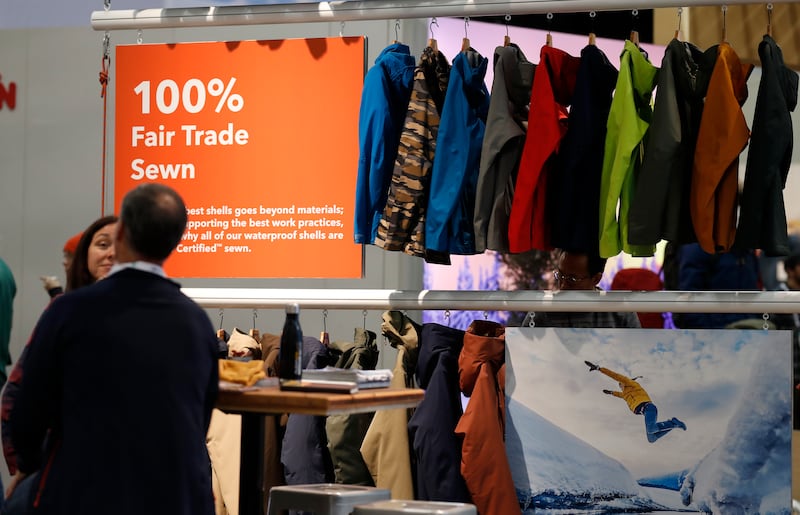
The company enforces strict conditions on where it sources raw materials, requires that the worker and environmental conditions of its factories be the highest possible and created replicable systems for those processes so other companies could follow.
Those efforts led to the foundation of a number of trade groups allowing many more organizations to take part in Patagonia’s model. Among them are the Fair Trade Certification, Regenerative Organic Standards and the Sustainable Apparel Coalition. They’ve also had a hand in forming Time to Vote and 1% for the Planet, both of which have thousands of active member organizations.

“While (Patagonia) doesn’t go out of its way to sort of talk about its influence on the broader business world,” Gelles points out, “You squint and you can see the fingerprints of Chouinard and his ethos all over corporate America.”
What fingerprints did the company leave on Utah?
Chouinard’s perceived legacy in Utah, however, is probably mixed.
In 2017, he pulled Patagonia from the Outdoor Retailer trade show in Salt Lake City over the state’s elected leaders supporting reducing protections for Bears Ears National Monument. His letter to Gov. Gary Herbert was titled, “The Outdoor Industry Loves Utah; Does Utah Love the Outdoor Industry?”

Peter Metcalf, the founder and a former chief executive of Black Diamond Equipment — a company that was originally a part of Patagonia, which Metcalf worked for — agreed heartily.
The trade show then moved to Denver for the next five years. Ultimately, it came back to Salt Lake City in 2022 after the Biden administration quelled conservationists’ fears over public land reductions, but the moment was polarizing for Utah.
That same issue sparked an even bigger act from Chouinard and was the catalyst for Gelles’ reporting on the company.
The first time he wrote about Patagonia was when the self-proclaimed “activist company” sued President Donald Trump over Bears Ears. The marketing campaign the company ran claimed “The President Stole Your Land.”
Though the use of the Antiquities Act to protect large swaths of land remains a contentious issue in Utah, Gelles believes that Patagonia’s decision helped cement the company’s legacy.
“That’s not a fight you pick if you’re just in it for the theatrics, right?,” Gelles said. “You don’t sue the president if you’re just greenwashing.”
At the time, former Utah Republican Rep. Rob Bishop was chair of the House Natural Resources Committee and he claimed through the committee’s official social media page that Patagonia was lying. He then invited the founder to testify in front of the committee on public land management, but Chouinard turned it down.
“I find it disingenuous that after unethically using taxpayers’ resources to call us liars, you would ask me to testify in front of a committee for a matter already decided by the administration and applauded by the Utah delegation just a week ago,” Chouinard wrote.
The lawsuit was tangled in court until the Biden administration made the conflict moot. Gelles wrote, however, that the episode was clarifying for Patagonia.
The following year, Chouinard rewrote the company’s mission statement: “We’re in business to save our home planet.”
What are the contradictions?
For a retailer of Patagonia’s size to earn billions of dollars requires a global supply chain that exacts a heavy toll on the planet. Not just in terms of fuels burned to support the transit and production, but also the scale amount of labor required and resources used. It’s something the company has always grappled with, Gelles explained in the book.
For a conservationist to be operating under such a business model may be the most obvious contradiction. The company has long reflected on those instances — in Gelles’s book and in their own literature — and taken strides to address them. Even so, it’s a reality that’s hard to reconcile.
“Patagonia is a paradox. Our charter mandates we follow social and environmentally responsible practices, yet every product we make takes irreplaceable resources from the planet,” wrote Ryan Gellert, Patagonia’s CEO, in the progress report. “Our existence seems counter to our purpose. That tension is not lost on us.”
Another is the company’s ownership structure. Chouinard’s family maintained 100% ownership of the company for decades. In an era where finding ways to include employees in ownership or profits is seen as a corporate virtue, the family’s decision to hold onto it led to a “minor furor,” Gelles wrote, among the employees. But it was one that quickly subsided as the idealistic mission added to the value.
The book makes clear that through addressing some of those challenges, the company drove many of its impressive innovations.
“When you think about the way in which they have really made efforts to clean up their supply chain and structure their company in a way that prioritizes responsible growth rather than this ‘growth at all costs’ mentality that infuses so many corporations in the country today,” Gelles said, “that, to me, is where the real innovation lies, more than just a product here and there.”
How Patagonia made the earth its ‘only shareholder’
In 2022, Gelles explained, Chouinard and his family owned all of the equity in Patagonia and they decided they wanted to divest themselves from the fortune, while ensuring the mission and values of the company remained. It’s complicated, but they did so by creating a series of trusts and nonprofits to manage the voting shares of the company and the philanthropy separately.
The total shares were divided into 2% voting and 98% non-voting. They placed the voting shares in a new entity called the “Patagonia Purpose Trust,” which Gelles explained is a legal entity that adds a layer of corporate governance above Patagonia, Inc.
The 98% non-voting shares were then distributed into a series of 501(c)4 nonprofits — different from 501(c)3s in that they can donate to political entities — called the “Holdfast Collective,” which distributes the funds to grassroots conservation efforts.
Now, the Patagonia Purpose Trust instructs the private company of Patagonia, Inc., to distribute 100% of its profits — roughly $100 million annually — into the Holdfast Collective on an ongoing basis.

“And the Holdfast Collective distributes those monies as it receives them on things like conservation, environmental activism, etc.,” Gelles said. “In doing so, the Chouinard family was able to successfully renounce their claim on the Patagonia fortune and forfeit their title as billionaires.”
What is Yvon Chouinard’s legacy?
“If you ask him — and I did — he would say that he did his best, but that it’s totally imperfect," Gelles said. “He understands that at the end of the day, Patagonia is taking a toll on the environment that he’s trying to protect, and that’s the paradox ... that doesn’t have a neat and tidy answer.”
Gelles said he thinks Chouinard is disappointed that more companies have not yet come along with him on his corporate vision. Of course, it is not the easiest road for a business to take — limiting its impact, trying to sell fewer, but higher-quality items, to give back to the planet.
“It’s very hard for a company to snap its fingers and suddenly be just like Patagonia. I know other companies have (tried), because I hear the stories about companies that either worked with them directly or were inspired or influenced by them,” Gelles said. “Even with the best of intentions, it’s very hard for most companies to do it with the consistency that Patagonia has demonstrated.”
Chouinard laments that our society plays pickleball instead of tennis, rides e-bikes instead of pedal bikes or uses auto-belays at the climbing gym rather than ropes on rock. He’s frustrated, Gelles said, but more broadly “disappointed in humanity for our continued disregard for the planet and our continued insatiable materialism.”
At the same time, Gelles said he believes that Chouinard is “pretty at peace,” grumpy and cantankerous as the man may be. “When you find him in the quiet moments — alone on a river or at home in the kitchen — there’s a deep sense of contentment."

That is probably because, when you assess whether or not he lived up to his stated goals, Patagonia and Chouinard have done a pretty good job.
And whether everyone agrees with Chouinard’s vision of conservation and the way humans should interact with planet Earth, Gelles believes that Chouinard’s — and Patagonia’s — consistency staying true to his values is deeply relatable and impressive.
“That is what I hope is the takeaway: that everyone who works, every company, can find their own ways to identify what they care about and do their best to live in accordance with those values, even if it means sacrificing some profits, even if it means sacrificing some growth,“ Gelles said.
“There’s nothing illegal about that. Companies make choices every day. They make choices about what they care about, what they prioritize. Not every company can be Patagonia, but every company has the opportunity to try to move things in the right direction.”