


- President Trump signed an order directing federal agencies to legally challenge "burdensome" state AI laws
- Trump's AI czar says a hundred new state-level AI regulations with more coming "doesn't make sense"
- The president argues the move will help the U.S. win race for global AI domination.
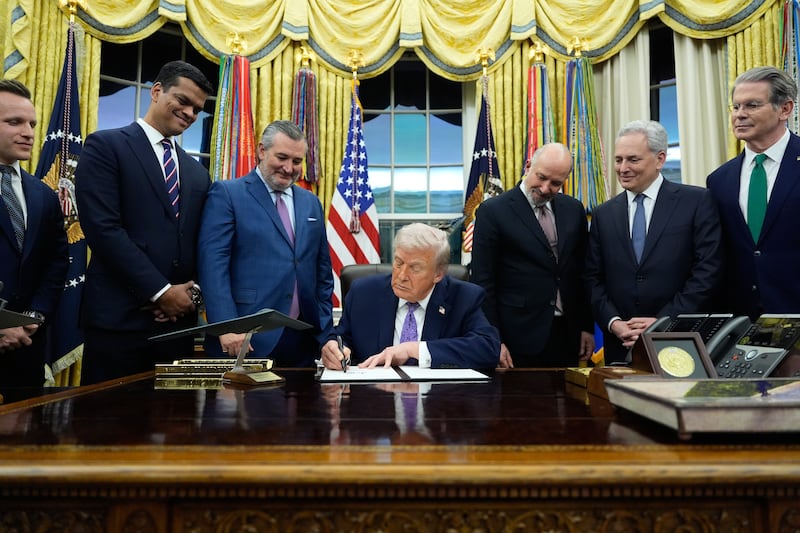
President Donald Trump signed an executive order Thursday aiming to block state-level artificial intelligence regulations that he says will stifle the development and success of U.S. companies in the fast-emerging industry.
A growing number of states, including Utah, have enacted new laws to provide safeguards against potential AI-driven harms as federal lawmakers have so far failed to address widespread and bipartisan concerns over the risks of artificial intelligence tools.
During an Oval Office signing ceremony, Trump said he had spoken with leaders of the top U.S. tech businesses and was convinced that allowing state-level regulatory actions to proliferate will overcomplicate the playing field for domestic AI development efforts.
“We want to have one central source of approval,” Trump said. “Every time you make a change, and it could be a very reasonable change, you still won’t get it approved if you have to go to 50 states. So this centralizes it.”
The president also pointed to the global race for AI domination as a motivator for a universal, light-touch regulatory framework that is overseen by the federal government.
“I believe there will be only one country that benefits and it should be the United States,” Trump said. “And it will be if we are unified. China is unified because there is one vote and that’s President Xi.”
The executive order directs the U.S. Commerce Department to create a list of problematic state-level AI laws and tasks the U.S. attorney general’s office with creating a task force to pursue legal challenges to the targeted legislation. The order also calls for measures to block federal broadband funding to states that have adopted AI legislation that could be deemed “burdensome” to the industry.
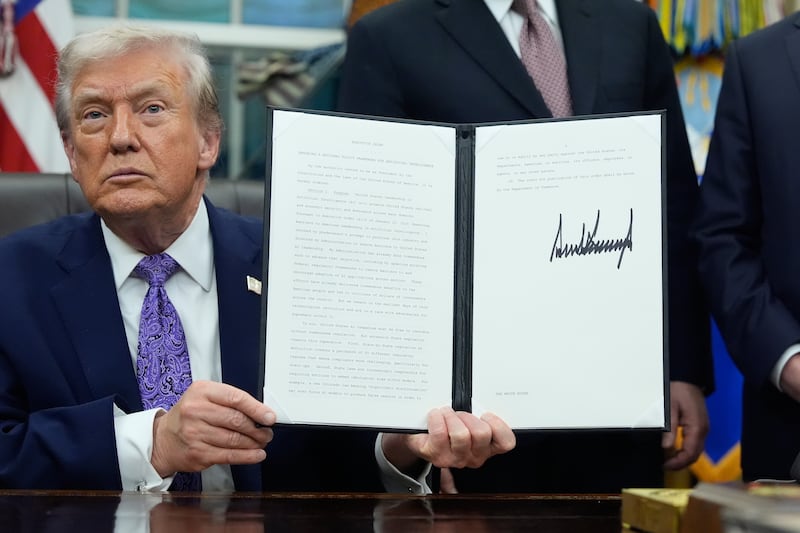
David Sacks, Trump’s AI czar, said during the signing ceremony that the administration is working with members of Congress to create new federal regulatory standards for the AI industry but, in the meantime, the executive order will serve as a tool to quell what he called “the most onerous and excessive state regulations.”
“We have over a thousand bills going through state legislatures right now to regulate AI,” Sacks said. “Over a hundred of them have already passed. You’ve got 50 states running in 50 different directions. It just doesn’t make sense.”
Sacks also noted there will be some exemptions for newly adopted state AI regulations, including those addressing child safety issues.
How will Trump’s order impact Utah’s AI laws?
A breakdown by international law firm Perkins Coie notes five new Utah artificial intelligence bills went into effect earlier this year with two of the bills, SB 226 and SB 332, amending 2024’s Artificial Intelligence Policy Act.
Passed earlier this year, HB 452 created new rules governing AI chatbots used in mental health treatment, while SB 271 expanded existing prohibitions against abuses of personal identity to include AI-generated content, like deepfakes. SB 180 created new requirements for state law enforcement agencies to keep a written AI policy and disclose the use of AI when used to generate documentation like police reports.
The Artificial Intelligence Policy Act adopted in last year’s legislative session established new, wide-ranging transparency requirements for businesses and licensed professionals to disclose when they use AI tools.
It’s not clear how Utah’s standing AI rules will be viewed in the Commerce Department’s assessment efforts but some critics believe the new executive order will face immediate legal challenges.
In a statement released Thursday, Brad Carson, president of Americans for Responsible Innovation and a leader of the pro-AI regulation super PAC Public First, said Trump’s executive order is a “dud”, politically and legally.
“This EO is going to hit a brick wall in the courts,” Carson said. “The executive order relies on a flimsy and overly broad interpretation of the Constitution’s interstate commerce clause cooked up by venture capitalists over the last six months. What’s more, this EO directly attacks the state-passed safeguards that we’ve seen vocal public support for over the past year, all without any replacement at the federal level.”
AI industry advocacy groups such as TechNet have previously argued that pausing state regulations would benefit smaller AI companies still getting on their feet and allow time for lawmakers to develop a country-wide regulatory framework that “balances innovation with accountability,” per a report from the Associated Press.
In a statement, TechNet president and CEO Linda Moore argues that AI “is transforming every sector of our economy” and that a state-based regulatory approach threatens “America’s ability to compete globally.”
“President Trump’s Executive Order on Eliminating State Law Obstructing National AI Policy is an important step to ensuring there are clear and consistent rules that can keep Americans safe while allowing innovation to thrive,” Moore said. “States will still play a vital role, but a strong federal standard is essential to advancing AI innovation.”