

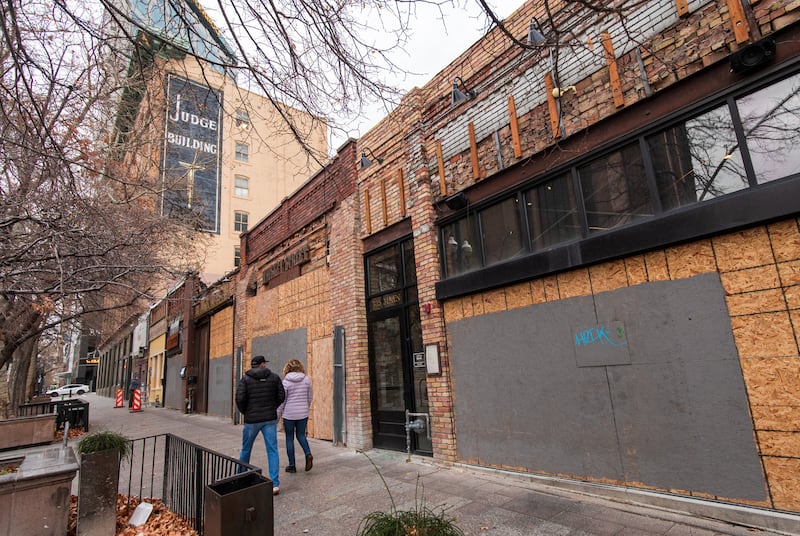
The sound of hammering from a pair of buildings in downtown Salt Lake City’s “restaurant row” is muffled by the plywood boards that cover their exterior windows on Main Street.
It’s just loud enough to fill the air on a quiet overcast December morning, days before Christmas.
These sounds also serve as a reminder that the heart of the city’s downtown core is still rebuilding from a devastating fire that has kept five businesses closed since August. But some signs of returning to normal are now taking shape, months later.
Salt Lake City crews removed construction fences outside of the affected buildings last week, allowing for easier walkability between 300 South and 400 South, better connecting the businesses on either side of the fire zone. The section had been closed off to fix some of the underground infrastructure.
Two of the five businesses most affected by the fire are on the cusp of reopening soon, said Dee Brewer, director of the Salt Lake City Downtown Alliance. White Horse Spirits & Kitchen could open as early as next month, while Eva is expected to reopen shortly thereafter.
“(I’m) very excited to have those restaurants back online,” he said.
White Horse owners have provided semi-regular photos of the reconstruction progress to social media since the fire, posting images of a repaired interior just before Thanksgiving. It’s “coming along,” and on track to open in mid- to-late January 2026, Jason LeCates, the business’s co-owner, told members of the Utah Department of Alcoholic Beverage Services Commission in a meeting last month.
Eva, on the other hand, suffered more extensive smoke and water damage, which is why owner Charlie Perry told KSL in August that repairs could take weeks or months to complete. He did not immediately respond to KSL’s request for an update.
When will the rest reopen?
Repairs to London Belle Supper Club, Los Tapatios Taco Grill and Whiskey Street Cocktails and Dining — the three other businesses affected by the blaze — are ongoing. LeCates is also the co-owner of Whiskey Street, and he said he was hopeful that the business could reopen by the second half of 2026 or early 2027, but there’s plenty of work to get to that point because essentially everything inside it was destroyed by the fire and fire response.
“Thankfully, the important parts of the building are going to survive, and that’s the historical aspect of it — the front of the building and the north and south walls. ... But we do have to take it down to the dirt and do seismic upgrades,” he told Alcoholic Beverage Services officials in November. “We have to bring the building up because it’s basically new construction, so it is going to be a big deal.”
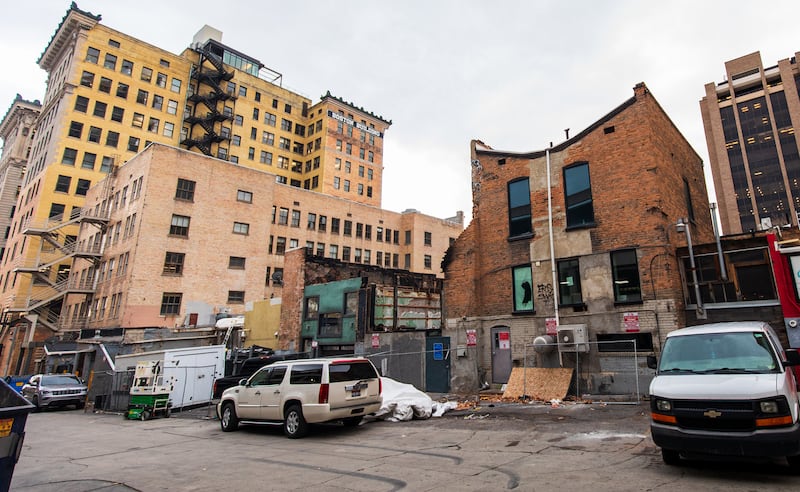
London Belle, where the fire originated, was “pretty much a total loss,” as well, said Frank Paulraj, the business’s co-owner, in the same meeting. Fire investigators only turned the building back over in November, which delayed plans to reopen.
He still plans to rebuild, but he doesn’t expect it to reopen until at least 2027. The state board granted both businesses extended closure provisions for their liquor licenses because of the circumstances.
It wasn’t immediately clear when Los Tapatios might also reopen, but the Mexican restaurant does have another location in Salt Lake City (120 N. 900 West), as well as a location in Taylorsville (3269 W. 5400 South) that is still open.
Salt Lake City leaders passed a few emergency changes shortly after the fire, including funding for the barriers that were recently removed. They also approved funding support and created a new disaster relief loan program, while residents raised $500,000 in support of workers impacted by the fires.
A revamped downtown?
Downtown business has been interesting this year. The Downtown Alliance reported an 18% growth in ticket sales at downtown events in 2024, and the organization anticipates another mammoth spike in 2025, thanks in part to the Utah Mammoth doubling sporting events at the Delta Center.
That can trickle down into sales for other downtown businesses, but sales have been “soft” across the food and beverage industry as a whole this year, Brewer said. He believes it might be a sign of a “wobbly” economy, resulting in people spending more carefully.
However, he’s also optimistic for the future, especially as a vital piece of downtown returns. The businesses affected by the fire intend to come back, and they could change what the area looks like when they do.
Some of the owners have discussed creating “additional dining experiences” as they rebuild, Brewer told KSL. These could include multiple levels, including new rooftop patios that didn’t exist before the fire, which could enhance what makes that block so popular.
“I think what people really loved about that block was the density. That is to say, people would come down without a reservation, without necessarily knowing where they were going for sure ... because they knew they could find something interesting,” he said.
Bringing life back to the Main Street block is not the only thing he’s excited about in 2026. The fire added to a host of other challenges facing the food industry this year, such as softer sales and rising costs, which led to the closures of a few other businesses in and around downtown.
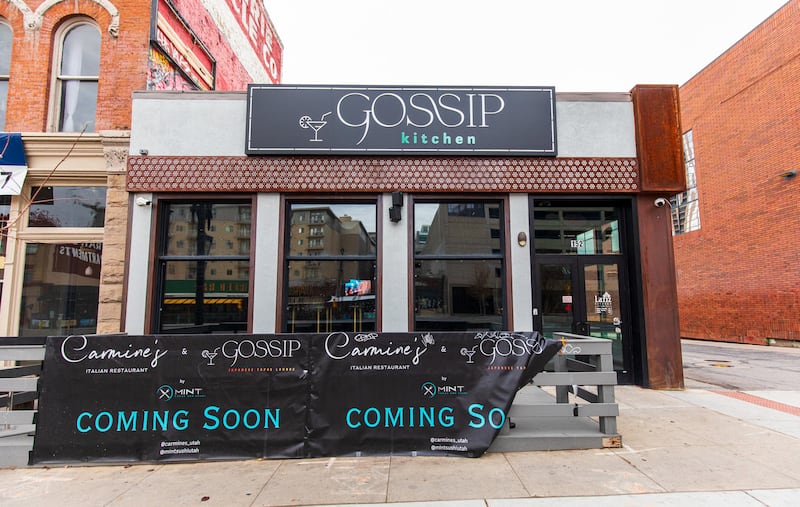
But the industry is also nimble, which has helped refill some of the recent closures. Owners of Carmine’s Italian Restaurant and Mint Tapas and Sushi recently put new signage up for a joint venture called Gossip Kitchen at the site of the old Laziz Kitchen, 152 E. 200 South, which closed in October. It’ll feature Italian cuisine with a speakeasy featuring Japanese tapas when it opens as early as next month, the owners wrote in a social media post last week.
Current Fish & Oyster, 279 E. 300 South, closed in November, but that location was also scooped up quickly. Before closing, owners of the restaurant said that a Japanese-Peruvian concept was already in the works for the building, likely to open in early 2026.
Brewer said he’s aware of a few other projects, which will also be unveiled in 2026, but he said he’ll let the owners behind those projects announce them when they’re ready.
“You just see concepts come and go,” he said. “That’s just sort of the nature of being in the business of the latest new thing. ... There’s a lot of new energy and new operators in town, and we look forward to that.”