

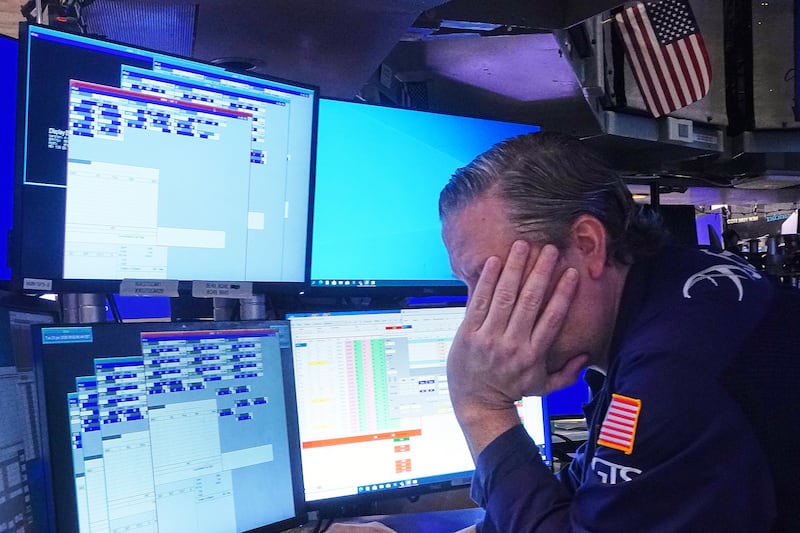

- U.S. stock indexes took big losses Tuesday amid President Trump's tariff threats
- Trump's pursuit of Greenland is driving up tension with European Union.
- The strength of the U.S. dollar also weakened Tuesday.
The Dow Jones Industrial Average was down more than 600 points around midday Tuesday and other major stock indexes were riding big losses following a series of social media posts from President Donald Trump threatening to impose new levies on European trading partners.
The eight countries called out by Trump for new trade tariffs are standing in opposition to his threats of taking control of Greenland, an autonomous territory that has been under Denmark’s rule for some three hundred years.
“We have subsidized Denmark, and all of the Countries of the European Union, and others, for many years by not charging them Tariffs, or any other forms of remuneration,” Trump wrote in a Truth Social posting. “Now, after Centuries, it is time for Denmark to give back — World Peace is at stake!"
The president listed Denmark, Norway, Sweden, France, Germany, the United Kingdom, The Netherlands and Finland as countries that will see a “10% Tariff on any and all goods sent to the United States of America” beginning Feb. 1 and escalating to 25% on June 1 and remaining in place “until such time as a Deal is reached for the Complete and Total purchase of Greenland” according to the posting. It isn’t clear whether the trade fees would be assessed on top of current levies.
France, Germany, Sweden, Norway, Finland, the Netherlands and the UK have dispatched a small number of troops to Greenland in a so-called reconnaissance mission, according to a BBC report.
As of midday Tuesday, the Dow Jones had lost nearly 1.6%, the tech-heavy NASDAQ Exchange was down just over 2% and the S&P 500 was around 1.8% in the red.
Investors were also fleeing U.S. government assets in the face of a potential new global trade conflict.
The dollar index, which measures the dollar’s strength against six major currencies, fell 0.98% — a huge move in currency markets, per a report from CNN. The dollar index was set for its worst day since last April. Yields on U.S. Treasury bonds, which move in the opposite direction of prices, were up sharply Tuesday with yields on the 10-year and 30-year notes at 4.28% and 4.9%, respectively, at midday.
Brad Long, chief investment officer at Wealthspire, said investor response to the latest tariff threats echoed the negative market reactions that followed an openly hostile series of exchanges and tit-for-tat tariff declarations between Trump and Chinese President Xi Jinping last spring.
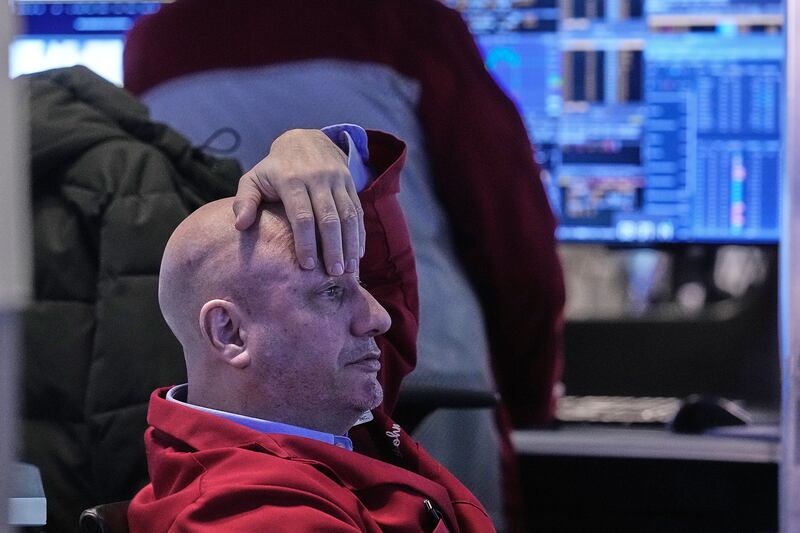
“While tariffs is not new and Greenland, frankly — or the administration’s interest in Greenland — isn’t new, the weaponization of tariffs in the short term to achieve kind of a noneconomic or maybe economic adjacent goal is new,” Long told CNBC on Tuesday. “Europe walked out of 2025 largely unscathed, or at least unscathed on a relative basis for tariffs. Now, this is a direct line to some of the U.S.′ closest allies — eight nations across Europe, 10% to 25% tariffs. We’re kind of picking back up the 2025 April volatility of Trump uncertainty and shifts in policy.”
Showdown in Davos?
Trump is due to attend the World Economic Forum in Davos, Switzerland, this week where a number of European leaders are also attending.
On Tuesday, French President Emmanuel Macron told an audience at the forum that now was “not a time for new imperialism or new colonialism”, criticizing the “useless aggressivity” of Trump’s pledge to levy tariffs on countries that opposed a U.S. takeover of Greenland, according to a report from the Guardian.
European Commission president Ursula von der Leyen, also speaking from the Davos event, noted the EU and U.S. had struck a new trade agreement last July “and in politics, as in business, a deal is a deal. When friends shake hands, it must mean something.”
EU members are also considering retaliatory trade measures in the event the new U.S. trade levies go into effect.