

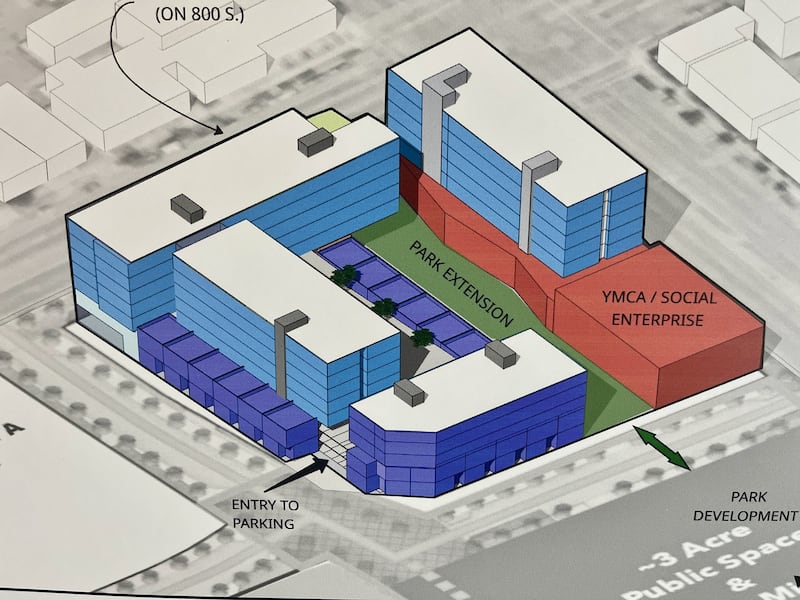
When Salt Lake City began transforming its old transportation fleet property nearly a decade ago, leaders thought it could help unlock a lagging part of Utah’s capital.
However, by the time they returned to the project, following a pause during the COVID-19 pandemic, the demands of growth had already taken over. Planners still marvel over how the city is now racing to catch up with the market, as it inches closer to turning 8.75 acres in the Granary District into a mix of housing, commercial, community and outdoor uses.
“There’s already new development and lots of great local businesses that made the most of this,” said Logan Hunt, real estate services director within the Salt Lake City Department of Community and Neighborhoods. “I think there’s a lot of development pressures that have shifted the landscape in the Granary District.”
Representatives of the Salt Lake City public lands and community and neighborhoods departments, as well as the Salt Lake City Arts Council, unveiled preliminary design concepts and updated timelines for the transformation of the Fleet Block, located between 800 South and 900 South at 300 West to 400 West, during an event on Tuesday.
An online survey is slated to launch on Wednesday to gather feedback on a final plan for the space.
While it’s in a growing area of the city, the project has also captured attention because of the unofficial use of the block toward the end of its previous existence.
Families of people killed by police violence, whose faces were depicted on murals on the previous buildings, say they hope the city delivers on its promise to turn the area into a community “healing” space.
Reimagining Fleet Block
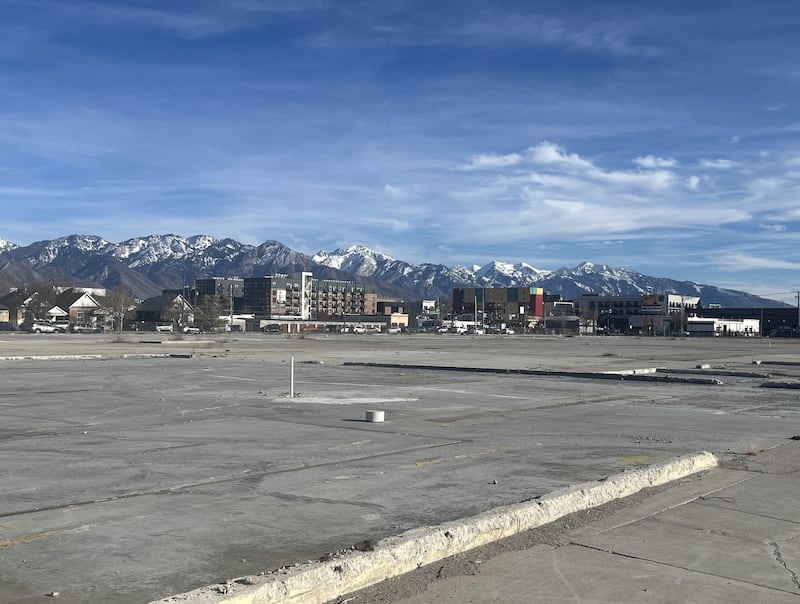
The block is nothing but dirt and concrete now as lengthy mitigation work continues on the ground level. That’s expected to continue over the rest of this year, before the preliminary infrastructure comes together, Hunt told KSL. He believes the construction of midblock streets will likely begin next year, once that’s over.
Construction of a 2.4-acre open space could also begin in spring 2027, said Makayla Maponga, a planner for Salt Lake City Public Lands. The department unveiled a rough sketch that calls for an amphitheater lawn, a stormwater garden, a lawn surrounded by trees and other natural elements within the open space.
A playground or many other typical park features weren’t included since the city designated the space as a “public square” from the beginning, she explained.
The open space is one the city has eyed for some time because the Granary District, the city’s old industrial hub, is what Maponga calls a “green space desert.” A 2019 departmental study found it had the lowest level of green space service in the city, and that was before several new housing developments opened.
“There was already a huge deficit and a huge need here, so I think right now we’re just focused on trying to provide as much as we can in this space,” she said.
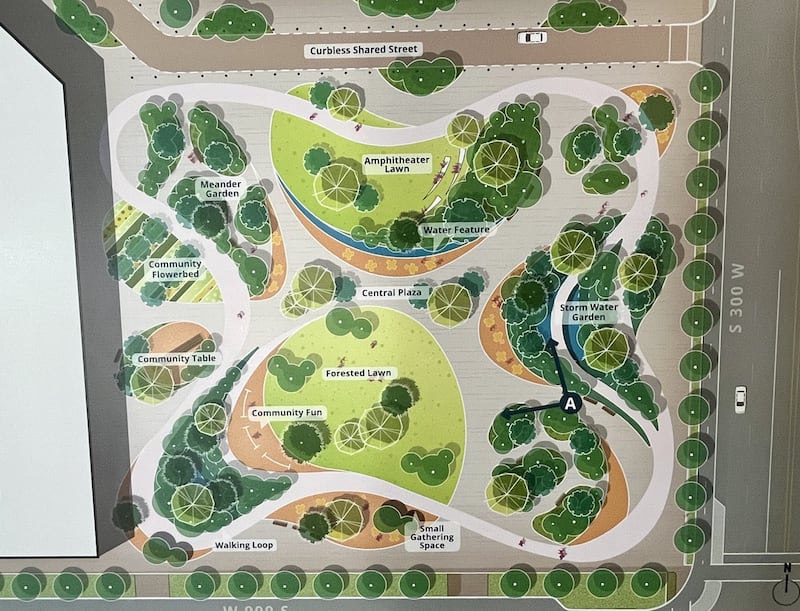
A final plan for the open space is expected to be released this summer.
The remaining block pieces will fill out over time. Part of the survey aims to determine what types of community assets the space could hold, such as social enterprise businesses, nonprofits, affordable housing or community event space, Hunt said.
Brinshore Development and Mercy Housing, which Salt Lake City selected to develop the lot’s northern quadrants last year, are still working to secure financing. They will take the feedback collected from the community and incorporate it into their plans for the neighborhood, he added.
Their projects are expected to be built out in multiple phases over the next several years, meaning redevelopment will be a gradual process.
Honoring the block’s other history
Several groups of family and friends of 29 people killed in police incidents, whose faces were depicted in massive murals on the Fleet Block building from 2020 to 2025, attended Tuesday’s meeting to learn more about another element of the overall project.
The Salt Lake City Arts Council issued a request for qualifications for U.S. artists or artist teams that will build an “anchor artwork” within the open space.
Renato Olmedo-González, public art program manager for the city arts council, told KSL in January that “the conversations and values of those murals generated are continuing to inform our approach to the site.”
He had no updates on what could be included in the artwork on Tuesday, but the council anticipates selecting an artist this summer. It anticipates that there will be some community feedback before the artwork is installed in 2027, and the space will be opened to the public in 2028.

Gina Thayne was one of a handful of surviving family members who attended Tuesday’s open house to keep tabs on the plan, since Salt Lake City Mayor Erin Mendenhall made pledges to the space in 2022.
Her nephew and custodial son, Dillon Taylor, was killed by Salt Lake City police in 2014. The shooting was later determined to be justified, but some family members received $85,000 from a settlement. Thayne believes the city is on the right track with turning the space around, but she hopes the city can include criminal justice elements that might reduce future incidents.
She also came to express her desire to include the old murals in some way through the new community art piece. The old murals were a “healing spot” for her and other families, as they dealt with the loss of family members and the stigma surrounding their deaths.
The murals, she explained, highlighted the happy memories the public never saw, and may have helped highlight the need for due process.
Karina Palacios nodded in agreement as Thayne spoke with KSL. She’s learned to navigate a similar grieving process since her brother, Bernardo Palacios-Carbajal, was killed by police in a shooting also later determined to be justified in an incident across the street from Fleet Block in 2020.
She would like to see the old mural concept incorporated in some way, instead of having their names added to a plaque or tucked into a small element of a larger piece. She and Thayne each hope families and friends can speak with the selected artist to convey their thoughts before the piece is designed.
“I have my doubts, but I’ve been trying to stay very optimistic on that,” Palacios said of the city’s plan. “I would rather it be something big like the murals.”