

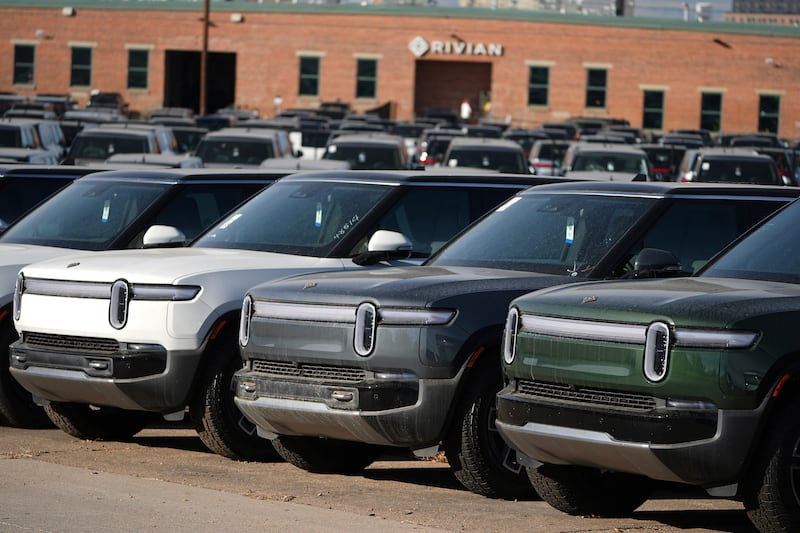

Is the future of taxis robotic?
In a statement Thursday, Rivian Automotive announced a new partnership with Uber Technologies, sharing that the pact is designed to aid both companies’ plans for autonomous vehicles. The companies expect to deploy 10,000 fully autonomous R2 robotaxis in the first phase of R2 robotaxi deployment.
If all milestones are reached, the companies will have “deployed thousands of unsupervised Rivian R2 robotaxis” across 25 cities in the U.S., Canada and Europe by the end of 2031.
Initial deployments are expected in 2028 in Miami and San Francisco.
Uber is expected to invest $300 million in Rivian initially, subject to regulatory approval.
“This partnership accelerates our path to Level 4 autonomy and supports our goal of building one of the safest autonomous platforms in the world — across both shared and personally owned vehicles,” Rivian CEO RJ Scaringe said.
As reported by CNBC, Scaringe and other executives credited new technologies, including artificial intelligence and more capable semiconductor chips, for finally allowing companies to successfully launch robotaxis.
According to a public filing Thursday from Rivian, four other investment tranches will occur if certain milestones are met through 2031. Uber is also expected to pay certain licensing fees to use Rivian’s autonomous driving system software, the filing said.
In total, Uber is expected to invest $1.25 billion in Rivian and will deploy up to 50,000 R2 robotaxis.
“We’re big believers in Rivian’s approach — designing the vehicle, compute platform, and software stack together, while maintaining end-to-end control of scaled manufacturing and supply in the U.S.,” Dara Khosrowshahi, CEO of Uber, said. “That vertical integration, combined with data from their growing consumer vehicle base and experience managing the complexities of commercial fleets, gives us conviction to set these ambitious but achievable targets.”
Waymo currently dominates the robotaxi market in the U.S., but this new partnership, and Rivian’s R2 and supporting technology, will enable Rivian to compete.
For Rivian, this deal follows a $5.8 billion software deal with German automaker Volkswagen that was announced in late 2024.
For Uber, the deal marks an increase in the company’s plans for robotaxis following recent announcements. On March 11, Uber and Zoox announced a strategic partnership “to deploy Zoox purpose-built robotaxis on uber,” an Uber investor news release detailed. Uber has also previously announced deals with Lucid, Stellantis and Nvidia, according to CNBC.
Investors have forecast the autonomous vehicle and robotaxi market to be a multitrillion-dollar industry, leading companies to try to capitalize on the opportunity — despite many firms, including Uber, previously failing to hit targets when it comes to robotaxis.
Shares of Rivian were up almost 4% in Thursday’s morning trading, while Uber’s stock was down below 1% following the announcement, according to CNBC.
What is the R2?
The R2 is Rivian’s electric SUV that company officials have said will be more affordable than previous models.
The vehicle will seat five people and have an estimated battery range of about 300 miles, according to Rivian.
It has been noted to be crucial to Rivian’s future as a viable automaker, Scaringe said on a podcast with “On with Kara Swisher” in January.
“Rivian isn’t being designed just for R1,” Scaringe said. “If the goal is to build a company that’s only going to make 15,000 cars a year, it would look very different as a business. But we’ve really invested in the business and contemplating and planning for Rivian to be a much larger company.”
He added that this goal hinges on the success of R2 to be able to support the capital construction rate of the business.