



- Deseret News/Hinckley Institute of Politics polls gauged the impact of the Iran war on households in Utah and the nation.
- An overwhelming majority have elevated concerns about higher prices and worry over personal finances.
- Groups like the Utah Food Bank face challenges as a growing number of individuals and families need help.
Active military conflicts in the Strait of Hormuz were on the rise again after Iran threatened to attack U.S. ships following President Donald Trump’s announcement that Navy vessels would begin escorting ships through the area.
The strait is a critical shipping passage through which 20% of the world’s oil exports travel on the way to global markets. The passage has been closed while negotiations to end the war remain stalled and a fragile ceasefire agreement appears to be crumbling.
And the fallout continues to hit Americans in the pocketbook.
Consumers in Utah and across the country are facing fuel costs that have risen steadily since the U.S. and Israel launched attacks on Iran in late February and, according to the latest tracking by AAA, gas prices are currently the highest they’ve been in four years. Federal reports released last week found that increased gas and diesel costs are beginning to impact prices on a broad array of goods and U.S. inflation, per the Federal Reserve’s preferred tracking metric, just hit its highest level in nearly three years.
New poll finds widespread concern about war’s economic impacts

New polling by the Deseret News in partnership with the University of Utah’s Hinckley Institute of Politics finds households in Utah and across the country united in their concern over how economic fallout from the Iran War is challenging their collective financial well-being and ratcheting up anxieties.
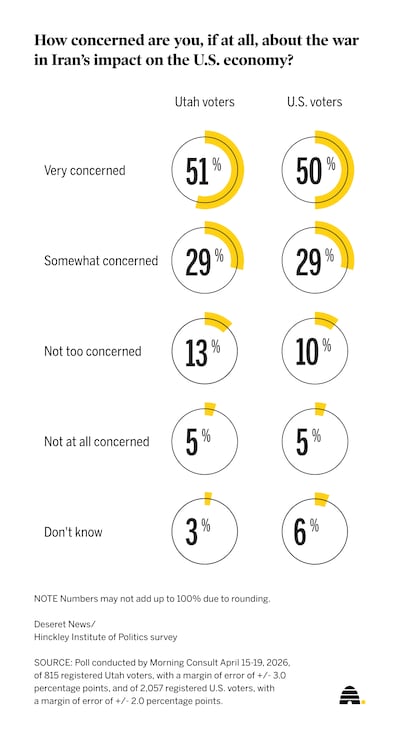
The survey revealed a striking level of worry among respondents in both the statewide and national samples, with 80% of Utah participants and 79% of national respondents reporting that they’re at least somewhat concerned about the Iran War’s impacts on the U.S. economy with 51% and 50%, respectively, saying they are very concerned. Just 18% of Utah poll participants and 15% of national respondents said they were not too concerned or not at all concerned about the impacts.
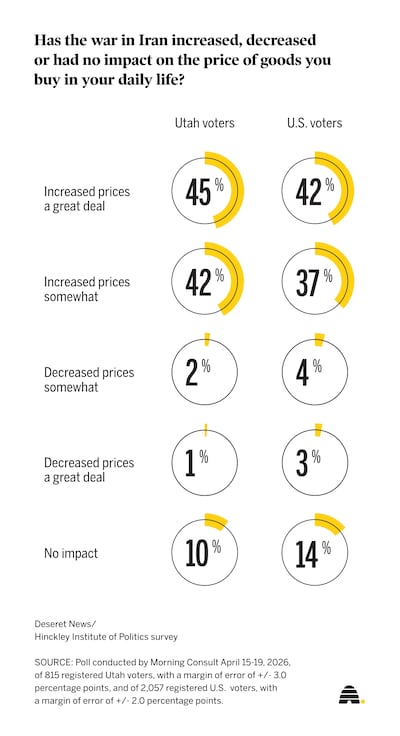
Overall concern about how the war in Iran is affecting household budgets was similarly widespread with 87% of Utah respondents and 79% of national participants saying the cost of daily goods has increased somewhat or a great deal while 3% and 7%, respectively, report they are paying prices that are somewhat or a great deal lower since the war began.

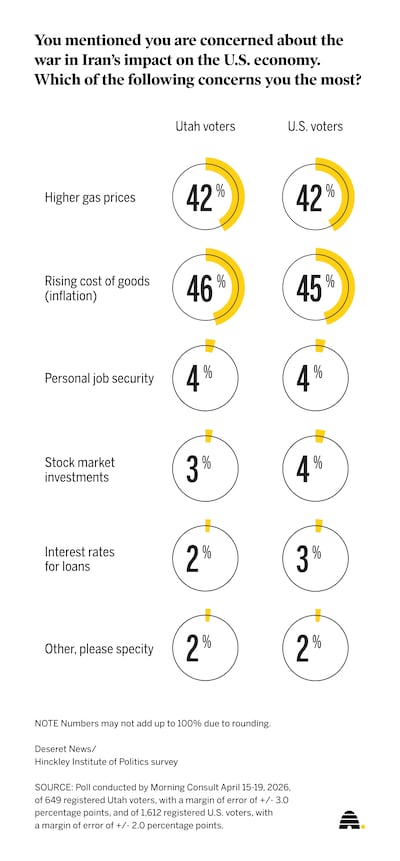
When asked to identify their top specific worries, respondents in both the Utah and national surveys point to cost-related pressures.
The rising cost of goods was the top concern for a plurality of both groups, chosen by 46% of Utahns and 45% of national respondents. Higher gas prices were next at 42% for both Utah and national poll participants. The next most prevalent economic concerns were job security, chosen by 4% of both groups and stock market investments, the top worry for 3% of Utah participants and 4% of national respondents.
Pollsters also explored how people feel about their financial situations and perceptions, which, perhaps not surprisingly, are in alignment with other responses on economic worries.
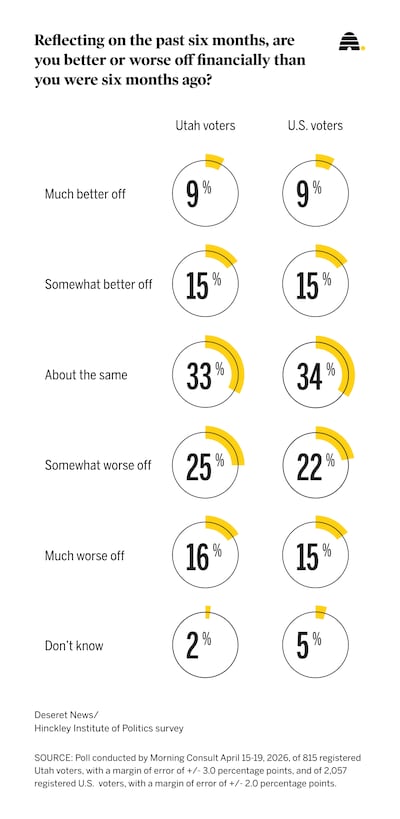
Over the past six months, 41% of Utah participants and 37% of national respondents report their financial well-being is somewhat or much worse off, while 24% of both groups said their finances are somewhat or much better than six months ago. Those reporting that their finances are about the same as this time six months ago included 33% of Utah participants and 34% of national poll respondents.
Overall, the new polling data paints a picture of a public that strongly associates the war with rising costs, feels significant about economic consequences, and is experiencing — or perceiving — a decline in personal financial stability.
How economic conditions affect those who help people in need

Those economic consequences are extending beyond household budgets, creating new challenges for groups tasked with trying to provide support for individuals and families struggling to keep up with the rising costs of basics.
One of the most pressing current issues for the Utah Food Bank is the high cost of diesel, the fuel that powers almost all of the nonprofit’s fleet of delivery vehicles. With a massive statewide distribution network, the food bank reports its trucks travel nearly 800,000 miles each year, a distance equivalent to circling the planet at the equator 32 times.
Utah Food Bank president/CEO Ginette Bott told the Deseret News her organization’s reach reflects where those in need live across the state and cutting back deliveries isn’t feasible.
“We really can’t eliminate the steps to distribute food,“ she said.
Instead, Bott said the food bank is finding ways to adapt and looking for efficiencies while also weighing staffing and budget implications.
In a recent blog post, the Utah Food Bank noted that diesel fuel was selling for around $3.18 per gallon at the start of the year. On Friday, the average cost of a gallon of diesel was $5.42 in Utah, per AAA tracking.
While the internal challenges are ongoing and significant, Bott said the deeper concern is how the current economy is impacting the people they serve.

“They’re making choices like gas in the car or food on the table or keeping the heat on or putting food on the table,” Bott said.
Seasonal pressures are elevating the strain on the most vulnerable Utah families, Bott noted, as the end of school and beginning of summer vacation adds to the financial burdens of those with school-age children.
“Kids in need who have been getting breakfast and lunch at school will soon be at home every day and parents and guardians are faced with additional meals, more cost,” she said. “At the same time, many families are also forced to find ways to keep up with increased childcare expenses.”
Bott said that even without elevated economic challenges, “this is a really tough time of year for families.”
In addition to pushing more Utahns into dire financial straits, rising prices are having impacts on the food bank’s donation community.
Bott notes that well over half of the food bank’s monetary donations come from individuals. While the organization has been seeing a lower number of donations, the gifts coming in are of larger dollar amounts. Corporate giving, however, has shown a notable slowdown as many businesses that may have made regular donations multiple times a year are paring back. Bott said those businesses are facing the same rising economic challenges as individuals and families across the state.

Despite the challenges, Bott highlighted Utah’s nation-leading culture of giving.
“We put out the call and people rally,” she said. After making a recent appeal for help in a media interview, Bott said over 100 food drives were organized in a matter of days.
“We’ve been raised that way and we’ve been taught that,” Bott said. “When I hear stories from my peers, who don’t have the same culture, their scenarios are so frightening.”