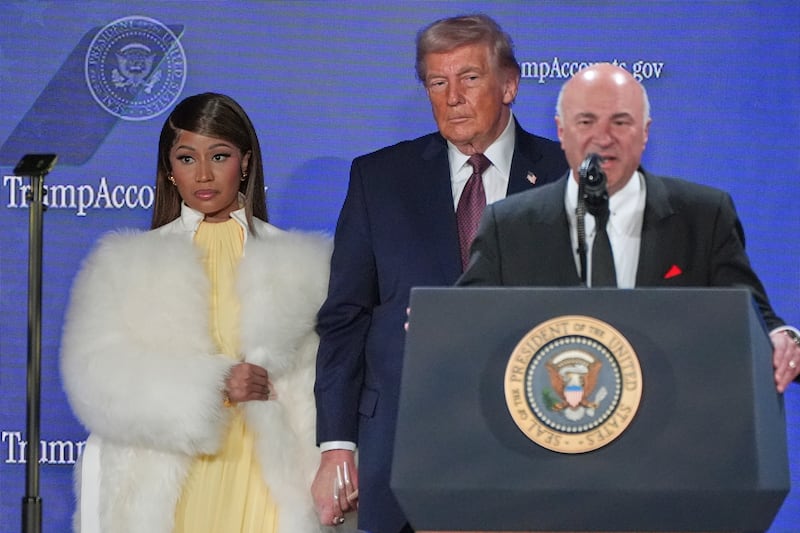

- Tucker Carlson hosted Kevin O'Leary for an extensive discussion of the Utah data center project.
- Carlson challenged O'Leary on tax incentives, job creation and the value of AI investments.
- While O'Leary complained about resident pushback, Carlson argued taking tax subsidies creates accountability.
In a Wednesday interview on his eponymous weekly podcast, conservative commentator Tucker Carlson was pretty clear about his views on Canadian businessman and TV celebrity Kevin O’Leary’s plans to build a massive new data center in northern Utah.
He’s not a fan.
Carlson took O’Leary, who has made a series of national media appearances in the last week to advocate for the massive development, to task on a number of aspects of his plan, including asking the “Shark Tank” star to explain why Utah taxpayers should subsidize the project “if it’s a private business and your tenants are some of the richest companies in the world.”
O’Leary characterized the tax subsidies as a typical incentive package meant to make investing in Utah more attractive to his development company than siting the project in another location. Utah taxpayers don’t have to support the subsidies, O’Leary said, but without them the state would be out of the running for the 10,000 construction jobs and 2,000 permanent jobs that would accompany the first phase of the project as well as follow-on investment and ongoing tax revenues.
“What can you give me to incentivize me versus the state right beside you which is willing to give me an incentive package,” O’Leary said. “I can build it in Texas. I can build it in Jacksonville (sic), Mississippi.”
Here’s what O’Leary wants to build in Utah

O’Leary’s plans call for the phased development of data processing facilities on 40,000 acres in western Box Elder County that when completely built out would consume 9 gigawatts of energy, a level that far exceeds the peak usage of the entire state of Utah and would become the largest data center of its kind in the world, according to the developers.
Concerns surrounding the proposal, which has so far earned unanimous approval from an obscure state agency known as the Military Installation Development Authority as well as the Box Elder County Commission, are myriad. The main points of contention, however, are focused on water use and environmental impacts from the data center and its on-site, natural gas fueled power generation in a state that finds itself in the midst of severe drought conditions and air quality challenges that stretch back decades.
Those approvals include a package of tax breaks for O’Leary’s development, including 100% personal property tax relief, in the form of rebates, on the data center portion of the project. Real property tax on the “compute campus” would be taxed at a rate of 0.927%, but 80% of that tax revenue would be returned to the developers with the state and MIDA sharing the proceeds of the remaining 20%.
An energy use tax would also be reduced for the project, from 6% to 0.5%, a move state officials say is necessary to allow O’Leary’s company to “be competitive.” That reduced rate would still generate some $30 million annually for Box Elder County in the first phase of the project, according to MIDA, and over $100 million annually on a fully built out project.
According to O’Leary, who was sporting a ball cap emblazoned with “Utah National Security” during the Carlson interview, the potential clients for the Utah data center would include the world’s largest tech companies, the so called “hyperscalers” that are pouring billions of dollars into facilities to support the fast-growing realm of artificial intelligence software. Think Microsoft, Amazon, Google, Meta, etc.
Resident concerns and accountability

O’Leary complained about the pushback from Utah residents that arose and has grown since news of the data center plans became public late last month.
He told Carlson that, in his decades working as an entrepreneur and investor he had never seen “controversy ... or attacks like this.”
In some instances, O’Leary has called out individuals by name who have voiced opposition, accusing them of being foreign operatives. He has also claimed, without evidence, that nonresident protestors were bused by some unnamed organization to a Box Elder County Commission meeting earlier this month to protest against the project.
But Carlson pointed out that the act of taking tax subsidies put O’Leary and his development company in a position of accountability when it comes to Utah residents.
“If you take money from taxpayers you should expect them to weigh in, too, and take their complaints seriously and not just dismiss them,” Carlson said.
While O’Leary argued that he’d earned de facto taxpayer approval via the elected officials who have so far signed off on moving his project forward, Carlson shot down that argument as well.
“(Utah) taxpayers had no choice,” Carlson said. “They tried to say no to this data center and then they got laughed at, then the governor, Spencer Cox of Utah, who really is a kind of living symbol of our ruling class, said that the state has an obligation to do this and basically, as you’re doing, waved away concerns as, like, foreign propaganda. I think there are probably non-crazy people who live in Utah that think, ‘Why is this good for me? Why should I pay for this?’”
Carlson also suggested to O’Leary that the true test of how Utah taxpayers feel about his data center project could be tested by a referendum vote. That effort appears to have already begun with a filing submitted last week that is currently under review by the Box Elder County Attorney’s Office.
Should it move forward, referendum organizers would have 45 days to gather 5,422 signatures and meet other criteria to put a measure on the ballot seeking to overturn the commission’s May 4 vote to advance O’Leary’s data center plans.
Questions about tax incentives

O’Leary said the practice of states offering incentives to lure business investment is a long-running practice. He said he believes it is an outgrowth of the free market working as it should, pitting states against each other in the name of competition.
“You may not like the policy of giving incentives for manufacturers and real estate … but you don’t have to do it,“ O’Leary said. ”A state can stop doing it and then for a while, maybe, they’ll be less competitive in terms of getting new projects. I didn’t make those rules up. I’m a football player on the field of capitalism and I play by the rules."
Carlson also braced O’Leary on the topic of job creation. The podcast host asked O’Leary to justify the tens of millions of dollars in tax subsidies the initial phase of his project could receive against a gain of just 2,000 permanent jobs for the Utah economy. O’Leary said that the AI processing that would occur at the Utah data center would lead to “millions” of additional jobs, but failed to provide examples of exactly what jobs would include.
Instead, O’Leary pointed to previous major technological breakthroughs like automobiles, television and the internet as examples of changes that initially scared people but eventually led to economic benefits.
“You can’t get an answer from me because nobody knows what jobs (AI) is going to create yet,” O’Leary said. “Every technology that’s come in … always creates new jobs and I assume the same for this tool."

Who is “Mr. Wonderful?”
O’Leary, 71, earned degrees from the University of Waterloo and Western Ontario University’s Ivey Business School and found his first business success in software development amid the early days of personal computing. He co-founded a company called SoftKey which later became The Learning Company, which was acquired by Mattel in 1999 for $4.2 billion. He would later launch O’Leary Ventures, O’Leary Funds and most recently, O’Leary Digital, which is his investment arm focused on data center developments.
O’Leary, who earned the nickname “Mr. Wonderful” from one of his “Shark Tank” co-stars, an ironic play on his blunt, no-nonsense style of delivering advice or putdowns to hopeful entrepreneurs, got his start in reality television on a Canadian program called “Dragon’s Den,” a precursor of sorts to “Shark Tank,” where hopeful entrepreneurs pitched investor “Dragons” hoping to lure their interest.
He was an original cast member when “Shark Tank” debuted in 2009 and continues to appear on the show. He also played a role in the Oscar-nominated 2025 film, “Marty Supreme.” O’Leary played businessman Milton Rockwell opposite the movie’s lead, Timothée Chalamet.