


- America is woefully behind China in mining and processing rare earth minerals, which are critical to modern life.
- The White Mesa Mill in southeastern Utah could potentially lead United States' processing by 2027.
- The facility faced environmental backlash from neighbors but may become an integral part of America's renewable future.
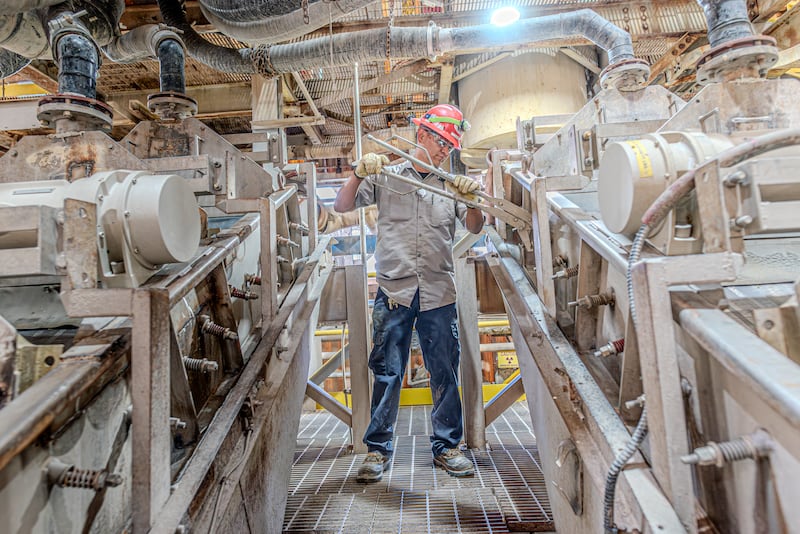
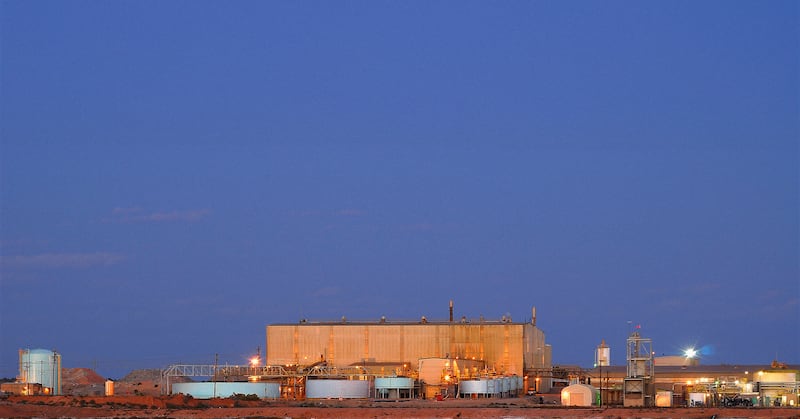
The White Mesa Mill in the southeast corner of Utah is the only conventional uranium processing plant left in the country. By virtue of that capability and the team’s expertise, it’s on the cusp of becoming one of the very few scalable rare earth mineral processing facilities in the United States.
While that may not sound too thrilling on its surface — just wait for the periodic table and processing circuit facts — it’s a significant geopolitical matter, particularly in light of President Donald Trump’s recent trip to China.
That’s because it’s hard to overstate how dependent the world is on China for rare earth minerals. While the global share of those mined coming from the country is itself quite big — about 70% — its dominance in processing is what’s really staggering.
Of the world’s entire supply of processed rare earth minerals, some 90% come from China.
Once refined, a difficult and time consuming process, those elements are used for everything from national security and defense manufacturing through renewable energy systems, batteries and electric vehicles. They are found in cellphones and car engines and Americans interact with them every day in ways both obvious and obscure.
The result is that the United States is dependent on China for the materials necessary for modern society. It’s the reason the Council on Foreign Relations called rare earth minerals part of “America’s most dangerous dependence.”
Both independent and government analysts “have long understood” that the United States is “dangerously overdependent” on China for, among a few things, rare early elements, wrote Heidi Crebo-Rediker, a senior fellow at the Council on Foreign Relations and the State Department’s first chief economist.
“These resources — which are key inputs in advanced technologies, energy infrastructure, and defense systems — play a vital role in the United States’ peacetime economy and national security,“ Crebo-Rediker wrote. ”Over the past decade, Washington has taken some meaningful steps to address the country’s supply chain vulnerabilities. Yet these efforts remain too modest.”
It’s a view shared by the team that owns and manages the White Mesa Mill in Utah.
“One of the places where the United States is kind of getting our butts kicked right now is in mineral processing and rare earth processing. And so we, of course, understood that and we started looking at the White Mesa Mill and saying, ‘Wait a second, we can do a lot of that stuff,’” said Curtis Moore, the senior vice president of marketing and corporate development at Energy Fuels, the Denver-based company that owns the mill.
“It’s truly a piece of critical infrastructure in the United States because it has some capabilities that literally no other facility in the United States has.”
Rare earth elements aren’t rare
There are 17 elements on the periodic table — the 15 on the second-to-last row plus an additional two — that are classified as “rare earths.”
Those rare earth elements, or REEs, are the pure form of the metals. Unlike other metal elements such as copper, gold and silver, they are not found in large, concentrated deposits.
They’re often found combined with other metals in some version of an elemental melting pot of ore, clay or sand. Those are called “rare earth minerals” or, more colloquially in the mining and processing industry, as “feed stocks.” It is from those that the individual elements are then isolated.
“When Earth was created, those elements — those metals — are so similar to each other that they tended to kind of stick together," Moore said. “So, where you find one of these rare earths, you will find all of the rest of them in different concentrations.”
Separating these combined minerals into isolated elements is what makes processing them at an industrial scale so hard. Though the name suggests otherwise, it’s not because they are “rare” to find.
Which brings Moore to the first of his three rules about rare earth elements that everyone needs to know. “Number one,” he said, “rare earths are not rare.”
Moore said that they’re actually quite common and that it’s not unusual to find various deposits, which are often unearthed as a byproduct of other mining.
“But what it really boils down to is whether you can mine and process those rare earths economically and responsibly,” Moore said. “And that’s where things start to get narrowed down.”
Which explains why there is only one existing rare earth processing facility in the United States. MP Materials, which owns and operates the Mountain Pass Mine in California near Las Vegas, has been doing so for 70 years.
Moore’s second rule is that rare earths are often found mixed with uranium and thorium, which are the elements used for nuclear applications that the White Mesa Mill specializes in. The fact that so many of those elements are packaged with radioactive material is what makes White Mesa Mill, he said, a uniquely positioned mill for processing rare earth elements.
The mill, which is an existing hydrometallurgical processing facility, already has the expertise, capabilities, licenses, infrastructure and tailings to deal with radioactive material. That’s different from some of the few other companies like USA Rare earth also rushing to help the U.S. compete with China.
The third is that rare earth processing is a niche industry that requires companies to own a full vertical integration — from mine ownership, processing, metal making through manufacturing magnets or batteries — in order to be economically viable.
Competing with China
When compared to China, Moore said, if a company only owns a few steps in the process, the whole enterprise “becomes wildly uneconomic ... in a hurry.”
“China doesn’t look at every little step. They say, ‘We got to mine a mineral and we’re going to produce an electric vehicle drivetrain,’” Moore said. “We have to look at it in the same way. And that’s what our company is doing. We are vertically integrating this rare earth supply chain right now.”
Energy Fuels not only owns domestic mines, it owns or has stakes in several other international sites that will eventually produce uranium and rare earth feed stock in Madagascar, Brazil and Australia. In addition to that side of the supply chain, the corporation is also set to close this summer on Australian Strategic Materials, which owns a rare earth metal and alloying plant that will push its integration closer to a finished product.
As for processing, Kim Casey, the director of investor relations, explained that the mill currently has a capacity to process 1,000 metric tons of rare earths annually. The company has two more phases of expansion planned — requiring pending regulatory permits — that will increase the REEs it can process and the scale at which it can.
Building should start in 2027, which means that Energy Fuels is still several years away. “But it’s not like we’re 10 years away,” Moore said. “We will have a very competitive supply chain in place by, say, 2029.”
At which point, Casey said it’s just a matter of time until Utah is the center of American rare earth processing.
“The White Mesa Mill is really going to turn out to be, like, the center of the world for rare earth processing,” Casey said, ”in Blanding, Utah."
Uniquely far away
Adjacent to U.S. 191, the mill is deep in the Four Corners region of Utah. It’s about a mile west of the Bears Ears National Monument boundary, and near — strictly in the western sense — to both the Valley of the Gods and the San Juan River.
“It’s uniquely far away from a lot of bigger places,” said one person who works at the Mill. “We’re very isolated in the U.S. ... The nearest Walmart’s an hour and a half away.”
Six miles to the north is Blanding, the largest city in San Juan County with about 3,300 residents, where many of the folks who work at the mill live. About seven miles south is the town of White Mesa on the Ute Mountain Ute Tribe reservation.

The mill opened in 1980 to process the uranium pulled from the thousands of nearby mines then prevalent in the region. Its initial planning documents suggested that it would have a similar lifespan to other mills in the area — about 15 to 20 years — and then close down.
“At that time, the Ute Mountain Ute Tribe gave their consent to do that. Well, now — many decades later — the mill’s still operating,” said Tim Peterson, the cultural landscapes director for the Grand Canyon Trust, an advocacy group that’s opposition to the White Mesa Mill is long-standing and well-articulated.
Over the past 46 years, sentiments about a radioactive facility operating in the region have shifted and the mill has become quite a contentious issue for some, including the neighboring tribe whose water table is close to the mill’s tailing pools that store radioactive byproduct. They’ve issued a resolution stating that they want mill operations to cease.
Scott Clow, the environmental programs director for the Ute Mountain Ute Tribe, who is clear about not being a member of the tribe nor a spokesperson, said that the tribe’s frustration begins with the mill being built on cultural sites that it has held sacred for generations.

“From a tribal cultural perspective, the tribe is very disturbed by that,” Clow said.
But that’s not all. Clow said that “the White Mesa Mill in Utah is a profound environmental issue we’re concerned about.”
That’s for a variety of reasons that are shared by more people than just tribal members. Among the biggest contentions is that it stores hundreds of millions of pounds of radioactive material in large tailing pools within a robust ecosystem home to people, cultural history and a unique ecology.
Another is that in the years when nuclear energy was less publicly acceptable, the mill began processing uranium from what it called “alternative feeds,” which meant it accepted radioactive byproduct from other facilities around the world.
“You could imagine the tribe’s perspective to have that facility on top of the sacred sites become an international radioactive waste dump,” Clow said.
There’s no free lunch
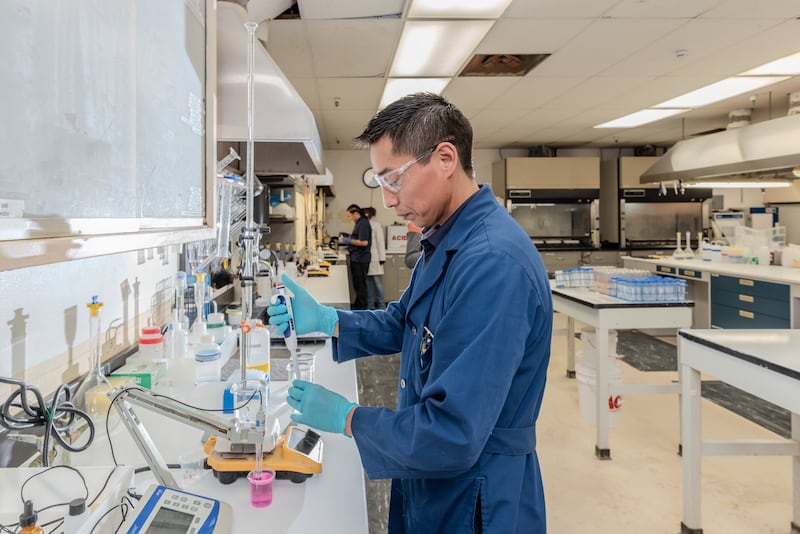
The environmental tension regarding the mill is not just words on the screen either. It’s a reason why Deseret News is not publishing the names of anyone who works at the mill in this story.
One said that since the mill now processes rare earths, there’s potential for some of the anger over environmental concerns to be tempered. As a result, it’s not as easy of a target anymore.
“I don’t think we’re changing people’s minds,” they said, “but now it’s a lot harder to speak against us.”
While the mill’s pivot to add rare earth processing to its repertoire does complicate some environmental concerns, it certainly does not alleviate them.
Still, Clow said that the fact that any future with renewable energy requires mining is “not lost on” him nor the tribe “at all.” It was something he’d like Energy Fuels to understand from the tribe’s perspective.
“There’s no free lunch, man. It’s a perhaps overused and misused term but in the sense of physics ... input equals output. And so we’re well aware that in order to build out electrical infrastructure, renewable energy, electric vehicles, computers — all of it — it takes mining,” he said.
“We all drive vehicles that are made out of mined things. The tribe has been in the oil and gas business for 75 years. So they’re well aware of that. But yeah, there’s no free lunch.”
Boom and bust
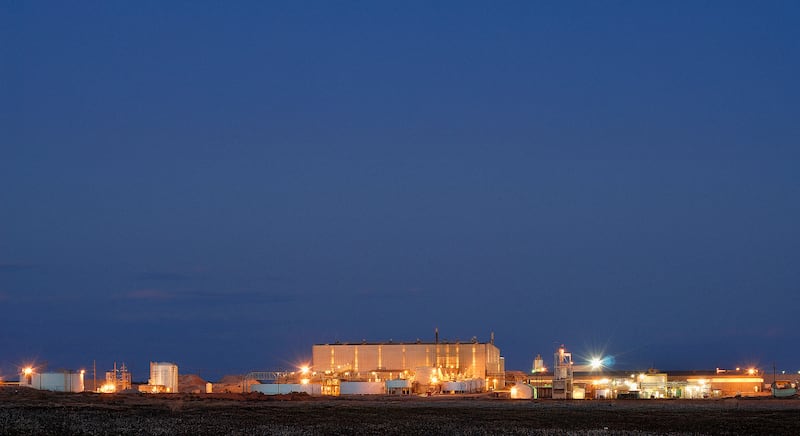
These days, nuclear energy is popular in ways that would have been hard to fathom over the past 45 years. That industry has navigated major ups and downs related to alternating public support and fear, all of which has impacted the people who work at the White Mesa Mill, some of whom have been there for 40 years.
The potential rare earths offer as new revenue is exciting as a means to ensure consistent work for the 105 or so people who rely on the mill. As one person said, it’s not like they can just go down the road from Blanding and find more work if the mill goes under.
“Rare earths is a chance of stability,” said one mill worker. “Uranium — even in a hundred years from now — will never be as stable of a situation."
To get to this point though, they had to earn it. It took an effort that’s worthy of a movie or documentary treatment, a team member suggested.
Against the odds, working with limited resources and — literally — duct tape, the rare earth team dedicated nearly every waking second for at least four years to figure out how to turn an existing uranium mill into a scalable rare earths processing circuit.
“What we’ve done has set us up with the potential to really move the needle,” the mill worker said. “So, we’re proud of that. And hopefully we get to stick around and keep doing it.”
What’s the milling process?
The primary feed stock the White Mesa Mill uses is called monazite sand, which contains uranium as well as many other rare earths. To date, all of their feed stock has come from the Chemours Corporation’s mines in Florida and Georgia, which means it’s mostly a domestic product.
Eventually, however, the sands will come from all over, including some from the United States, but will primarily be coming from those mines they purchased in Brazil, Australia and Madagascar.
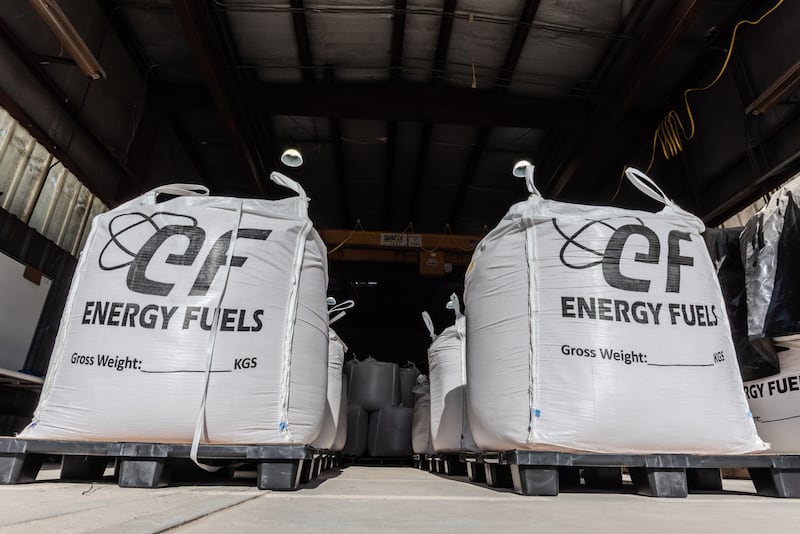
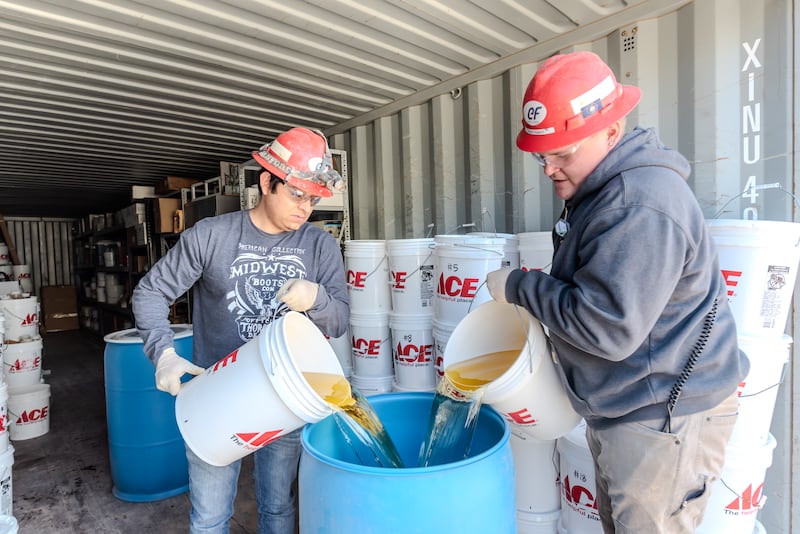
Once the sand arrives in giant white “super sacks,” Moore explained, it’s put through a caustic process called “crack and leach.” By applying an acid that targets the stable metallurgic elements, the desired metals are made soluble and then separated from the sand.
Next, the mill uses a similar process to purify the metal to what it’s applied to uranium for the past 45 years. It’s called solvent extraction.
To do so, the facility requires three or four swimming pool-sized tanks to refine and obtain the desired element. For rare earths, however, those tanks are hot tub or wash basin-sized and there’s a series of 50 to 100 of them.
After the REEs are purified, they’re dried into a dust and shipped to a metallurgic and alloy plant, which then transforms that product into a manufacturing grade metal.
As of now, the mill is doing that within the confines of its existing uranium business and permits. Plus, as legislators in Utah, Wyoming and several other states race to develop nuclear energy facilities, the demand for its processed uranium puts pressure on the facility’s finite resources.
Which is why Energy Fuels has applied for new permits so the White Mesa Mill can do dedicated rare earth processing — rather than a complimentary circuit to uranium — and build a new facility. Those approvals are pending but with Utah elected officials pushing for more rare earths, they appear probable to both adversaries and Energy Fuels alike.
Ending a cold war
Moore believes, however, that it does not matter where a person lands on the political spectrum as those mined minerals are necessary for the country’s global, economic and technological success.
Plus, the materials are at the heart of the country’s “cold war” with China and that national security piece cannot be overlooked.
Yet, that sense of being overlooked is part of the frustration felt by locals who do not want to live near a radioactive facility. And while regulations from the Atomic Energy Act and the radioactive material license mandate nuclear facilities are strong enough to safely hold dangerous materials for 1,000 years, Clow said that the only people who really understands such timelines are the community who live adjacent to the mill.
There’s evidence that the Utes and Paiutes have been in the region for 10,000 years. Meanwhile, the radioactive industry is about 100 years old. Clow said, “Those people don’t understand a thousand years.”
“They say, ‘yeah, it should be safe for a thousand years,’” Clow said, but “when you look at this facility that’s been there for 46 years, it’s going to be there forever; that radioactive material will be there forever.”
There’s still no such thing as a free lunch. Clow himself said that you “don’t get something for nothing.”
For Energy Fuels and the team at the White Mesa Mill, that something is not just addressing a critical dependence, it’s stability and many other things, too.
“Our site’s a good example of why, man, we’ve got to start giving industry — I don’t know — not a break, but just realize its value,” said members of the mill team. “If the White Mesa Mill would have been closed up 10 years ago, there’s no conversation happening. And if we are going to do rare earths, it’s going to be a lot harder, a lot more expensive. You’re going to have to go dig up a new piece of ground somewhere, put in new facilities.”