



The sayings write themselves: Love is an art form. Art isn’t paint, it’s love. All you need is love.
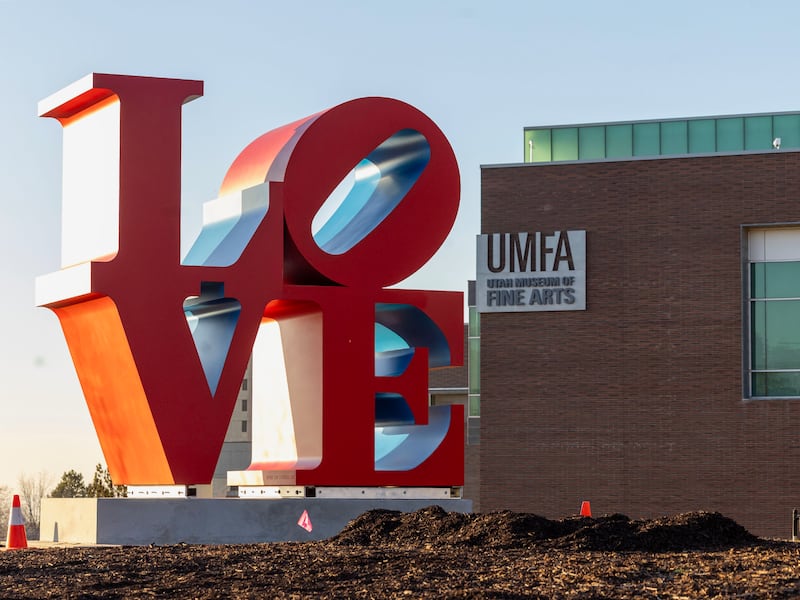
And yet, watching Robert Indiana’s 12-foot “LOVE” sculpture being gently lowered into place at the Utah Museum of Fine Arts on the University of Utah’s campus this week feels different. This new addition to the UMFA’s world-class collection represents a literally huge gift of public art to the people of Utah.
The yearslong effort to bring the iconic sculpture “Red Outside Blue Inside” to Utah after more than 20 years in midtown New York City is a tale of vision, persistence and philanthropy.
Robert Indiana, a self-proclaimed “designer of signs” and a key figure in the American Pop Art movement of the mid-20th century, first sketched “LOVE” — with the “O” at a slant — as a holiday card commissioned by New York City’s Museum of Modern Art in 1964. His first corten steel sculpture of the design was cast in 1970 and placed at the Fifth Avenue and 60th Street entrance to Central Park.
More than four stacked letters, Indiana played with the meaning of the word and its use by other artists over time. The result is a statement on the “power of abstraction and language,” according to Christie’s.
Indiana created 86 iterations of his iconic sculpture. Some are rusted and raw, but the vast majority are painted brilliant shades of blue and red. Most stand 6 feet tall; just nine are the 12-by-12-foot version now on the U’s campus. They have stood sentinel in Tokyo, Seoul, Scottsdale and Milwaukee. The BYU Museum of Art treasures its version.
Cast in 1999, the U’s “LOVE” sculpture was offered for sale by Christie’s and we jumped at the chance. With $2.5 million from generous donors and another $2 million in state funding, this classic piece of mid-century art was headed to Utah.
Placing this sculpture at the bustling corner of South Campus Drive anchors the UMFA’s growing collection of outdoor works. It will serve as a bridge to the wider community and welcome visitors to campus for years to come.
It also makes a statement about who we are and what we believe.
The Utah Museum of Fine Arts protects and conserves the university’s remarkable art collection of 22,000 objects begun on campus in 1916. Annually, more than 80,000 Utahns — from campus, our capital city and across the region — participate in and enjoy the UMFA’s myriad offerings. The Utah Division of Arts & Museums counts another 300 pieces in its public art collection.
In 1985, Utah lawmakers passed the Utah Percent-for-Art Act, which designates that 1% of construction costs (capped at $200,000) of new or renovated state public buildings will be used to commission artworks. That funding has helped to create glasswork prisms at Utah Tech University and Salt Lake Community College, bronze sculpture at Mountainland Technical College in Payson, and the “Three Medusae” in the U’s new Applied Sciences Building atrium.
While the LOVE sculpture acquisition at the UMFA was not funded by Percent-for-Art funds, these related efforts demonstrate a shared understanding and belief in the power of art to reflect a community and its environment and to connect us with our past, present and future.
We hope “LOVE” will make you pause, wonder and contemplate our state’s great legacy of supporting artists and public access to art — from Robert Smithson’s “Spiral Jetty” in the Great Salt Lake to Lee Greene Richards’ New Deal-era murals adorning the Capitol rotunda to Stephen Kesler’s breaching whale, “Out of the Blue,” at 9th and 9th.
In addition to the UMFA, the University of Utah is the origin soil for the state’s arboretum and gardens, its natural history museum, and our professional theater and modern dance companies, among other institutions beloved by Utahns. This monumental sculpture is yet another visionary investment in the state’s cultural landscape.
We are determined that there will be many more.