

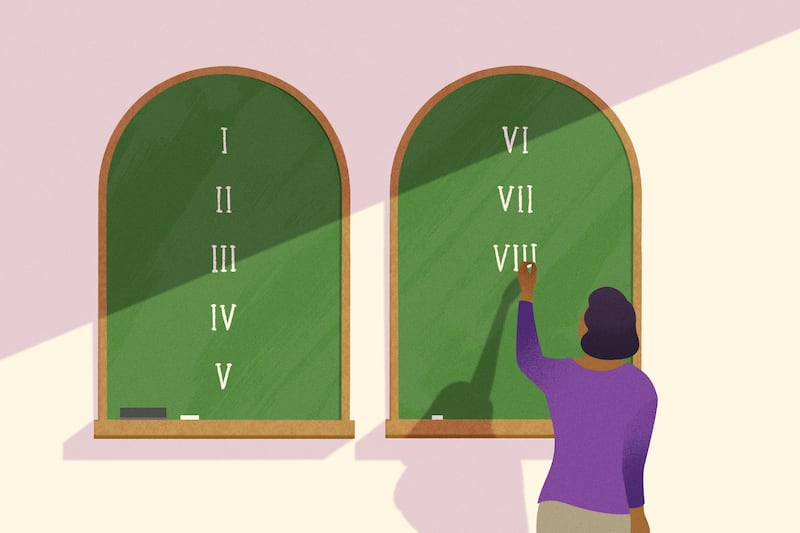

- Legislative measures in Utah and beyond assert the need for including religious elements in public school instruction.
- Veteran Utah lawmaker Sen. Todd Weiler penned a religion/education opinion column in The Wall Street Journal.
- Several new local laws have promoted incorporating religious elements into public school instruction.
The growing confluence of religion and the public classroom has snagged broad attention — both nationally and in the Beehive State.
Several Southern states are calling for the Ten Commandments to be posted in classrooms — and a Utah lawmaker penned a Wall Street Journal opinion piece under the headline “Religion Belongs in American History Class.”
Meanwhile, several bills opening the way for religion-based discussion and instruction in public schools have now become law following the recent 2026 Utah legislative session.
Supporters of such religion-influenced measures say they are not designed to proselytize. Instead, they say, the measures are meant to be reminders of the historical role that religious faith and principles have played in the American experience and history.
Ongoing tensions between elements of religious faith with public school systems will likely continue in the courts, as school boards, teachers and, yes, students decide whether two concepts — religion and secular learning — can and should coexist.
The overarching debate: How should “church” and “state” in public schools be separated — or should they be separated at all?
Ongoing Ten Commandments battles
Last month, the 5th U.S. Circuit Court of Appeals rejected challenges to a Texas state law requiring the Ten Commandments to be displayed in public schools.
While opponents of the law have argued that hanging the Ten Commandments in the classrooms amounts to government-mandated religious indoctrination, the conservative-leaning appeals court in New Orleans rejected those Texas arguments, saying the requirement does not violate the rights of parents or students, the Associated Press reported.
“No child is made to recite the Commandments, believe them, or affirm their divine origin,” the ruling said.
Meanwhile, the American Civil Liberties Union and others challenging the Texas law on behalf of parents said, in a statement reported by The Associated Press, that they plan to take the “Ten Commandments in the classrooms” action to the U.S. Supreme Court.
“The First Amendment safeguards the separation of church and state, and the freedom of families to choose how, when and if to provide their children with religious instruction. This decision tramples those rights,” they said in the statement.
Expectedly, the Texas law has reportedly prompted mixed reactions in the Lone Star State. Some residents are enthused. Others, alarmed. And some teachers have resigned instead of hanging the Ten Commandments in their classrooms, the AP reported.
Besides Texas, Louisiana, Arkansas and Alabama have also passed laws regarding the posting of the Ten Commandments in classrooms. And yes, those laws have also been challenged.
In Alabama last month, Republican Gov. Kay Ivey signed a law requiring the Ten Commandments to be displayed in fifth through 12th grade public school classrooms where U.S. history is routinely taught, as well as common areas like cafeterias and school libraries, according to The Associated Press.
Meanwhile, an analysis of state legislation compiled by the bill-tracking software Plural found at least 30 measures introduced during current or recent sessions would require the display of the document at schools.
The bills were all reportedly introduced by Republican lawmakers — and nearly all of them in GOP-controlled states.
Ensuring ‘safe spots’ for religious discussions in Utah classrooms
Utah’s not counted among the several states with legislative bills calling for Ten Commandments displays in classrooms.
But some local lawmakers have successfully advocated for religious texts and discussions to be allowed in Utah public classrooms.
Senate Bill 268, which was signed into law in 2025 by Gov. Spencer Cox, focused on how religion and religious liberty are addressed within Utah’s public K-12 and higher education institutions.
SB268 was drafted to amend educational standards to “specifically allow instruction on religious liberty as part of the (high school) social studies requirement — specifically within the American constitutional government and citizenship courses.”
Sen. Todd Weiler, R-Woods Cross, said during a legislative hearing on the bill that teachers should be free to examine the role of religion in historical and constitutional contexts — including philosophical questions concerning religion and the history of religion.
And students, he added, should be allowed to express faith beliefs in their works without facing discrimination based on religious perspective.
The “Religious Curriculum in Schools” bill, emphasized Weiler, doesn’t mandate. It doesn’t force a teacher to say anything about a specific faith practice.
Instead, the bill offers instructional safety.
“My primary purpose in running this legislation is to make sure that the teachers in the state know that it’s safe to talk about, say, what motivated the pilgrims to come across the ocean, or what motivated the pioneers to cross the plains.
“That’s a message that we need to send — especially if it’s a response to a question being asked by a student as a sincere question.”
An attorney, Weiler has asserted that Supreme Court prohibitions against school-sponsored prayers and worship in public schools created an “unintended and unfortunate chilling effect” on discussions about religion — including the role of religion in American history.
Teaching the role of religion: ‘An exercise in intellectual honesty’
Weiler’s argument for religion being both safe and welcome in public classrooms has gone beyond the Utah Capitol.
In last month’s WSJ guest column, the veteran Utah lawmaker wrote that most American schoolchildren place hands over hearts and pledge allegiance to “one nation under God.”
“Yet too many of them,” he added, “graduate without ever learning what God meant to the Americans who founded and preserved the nation — or why religious language appears at so many of the nation’s defining moments.”
U.S. history, asserted Weiler, can’t be taught accurately without acknowledging the role religion has played in the “actions and ideas” of the American people.
“Utah is taking the lead in addressing how to make the teaching of history more responsive to the reality of history.”
Newly passed Utah legislation that incorporates the historical role of religion and religious liberty in the formation of the American experience doesn’t promote religious belief, wrote Weiler.
But since the nation’s beginnings, religious principles and religious conviction have factored into American history — including the efforts of the abolitionists and the champions of the Civil Rights Movement.
“Civic education is more than memorizing dates,” Weiler concluded. “It is an exploration of the moral reasoning that shaped American history. Teaching the role of religion in that history isn’t a religious project but an exercise in intellectual honesty.”
Incorporating religious texts in history/civics study
Meanwhile, new legislation sponsored by Weiler’s Republican colleague, Rep. Tiara Auxier, R-Morgan, calls for religious sources such as the Bible to be included in Utah’s social studies education as examples of documents influencing America’s “founding and literary thought.”
Beginning in the 2028-2029 school year, the Utah State Board of Education is tasked with ensuring that American history and government courses in grades 3-12 include analysis of religious references in “founding documents” that includes references from the Declaration of Independence such as “Nature’s God” and “Creator.”
Included in the new law is direction that schools may offer in social studies instruction a “study of historical documents” such as the Ten Commandments and the Bible, including the Hebrew Scriptures and New Testament, “as literary and historical texts that have influenced American constitutional history, civic thought and cultural development.”
Additionally, according to the bill’s language, a school’s Utah history instruction may include “study of religious beliefs and texts that influenced the state’s early founders and the state’s history.”
The new law also prohibits “content-based” censorship of American history and heritage documents “due to their religious or cultural nature.”
Schools, meanwhile, are directed to focus on a religious texts’ historical context and influence — “rather than on theological or doctrinal questions.”
While presenting HB312 to lawmakers during the 2026 legislative session, Auxier said her bill “goes a long way” to ensure Utah school kids “are being taught the amazing values and principles that America was founded on — and it’s our responsibility to pass it on to the next generation.”
Some historians, meanwhile, debate the historical accuracy of the “Biblical origin story for America.” The reality, they say, is more complicated.
In an April article prompted by Utah’s HB312, Education Week cited a 2024 webinar hosted by the American Historical Association that examined the role of the Bible in the nation’s founding — and on religious mandates in public schools.
“To understand the Declaration of Independence requires more than just consulting the Bible,” Holly Brewer, an associate professor of American history at the University of Maryland, said during the webinar.
Religious arguments played an important role in the founders’ thinking, Brewer said, but so did other philosophical influences.