

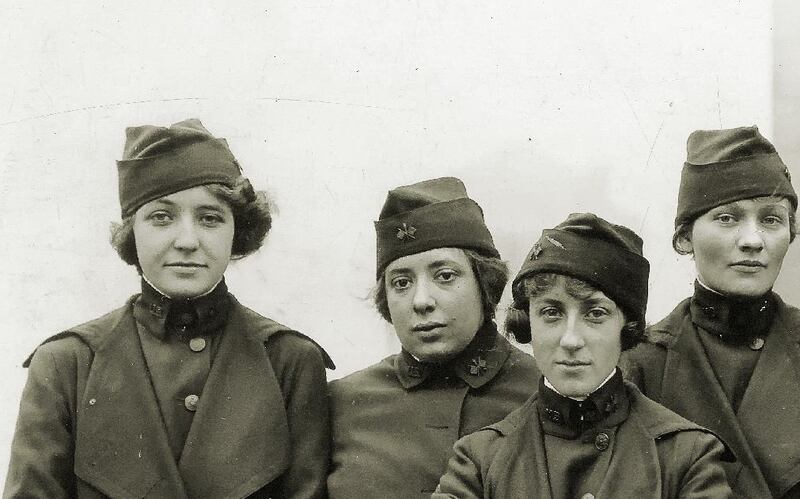
SALT LAKE CITY — War correspondent Harry Williams picked up the phone in Paris. It was May 1918 and artillery shells were raining down around him. He expected the line would be filled with heavy static and the sound of foreign-speaking voices.
To his surprise, he was greeted by a polite and professional American — a Hello Girl.
“The whole thing sounded so much like Los Angeles that I could have given three cheers for the Bell telephone system,” Williams said. “I breathed a silent prayer that all the Hello Girls in the world might prosper and marry well.”
These women were more than just phone operators. Their triumphs and tragedies are documented in Elizabeth Cobbs’ “The Hello Girls: America’s First Women Soldiers” (Harvard University Press, 400 pages, adult nonfiction).
“Harry Williams’ experience was repeated 26 million times over during the thick of fighting in 1918,” Cobbs said in an email interview with the blog, From the Desk of Kurt Manwaring. “From their arrival in March 1918 to the war’s end on Nov. 11, the 223 uniformed members of the U.S. Signal Corps faced the hazards of war to keep millions of officers and men connected when it mattered most.”
Cobbs terms the women “soldiers” in her book title, but they served as volunteers. This distinction challenged the women both on the European warfront and the American homeland.
Gen. John J. Pershing was largely responsible for the Hello Girls’ involvement in the war effort. The four-word counsel he was given by Secretary of War Newton Baker left plenty of room for improvisation: “Go, and come back.”
“So when Pershing cabled that female operators must ‘all take the soldier oath,’ no one contradicted him directly, even though War Department officials were horrified,” Cobbs said.
Pershing would come to rely heavily upon the women — especially Grace Banker, the bilingual chief officer of the first unit that left for France in 1918. Banker and some of her Hello Girls accompanied Pershing to the battles of Saint-Mihiel and Meuse-Argonne, Cobbs said. In fact, Banker would sometimes be on duty for 21 of a day’s 24 hours.
So yes, fatigue was an issue, but these women faced other serious challenges, too. Cobbs said any woman who volunteered to work with men was usually perceived as suspect — “nice girls” didn’t do that kind of thing.
“Some of the male soldiers resented them, and especially their proximity to combat and ... Gen. Pershing,” Cobbs added. “Some men also assumed that the women would go into hysterics at danger, and fail to perform their demanding duties.”
The reality was much different. On their first day, the women faced shelling with stoicism, and proceeded to do their tasks with even more efficiency than their male predecessors.
“It took the average male soldier 60 seconds to connect a call. It took the average woman a speedy 10 seconds,” Cobbs explained. “In wartime, delays of this magnitude could kill.”
The composure and competence of the Hello Girls largely negated the stigma among those who saw them at work.
“Most male soldiers became their avid admirers,” Cobbs said.
Two of these women died during the war. The rest returned home — but were not given much of a hero’s welcome. In fact, the women who volunteered to put their lives on the line in the war faced decades of battles for basic benefits when they came home. The War Department, Cobbs said, would plot to deny them veterans’ benefits — including their war medals — once they returned,
Merle Egan played a key role in fighting for the rights of her fellow Hello Girls. During the war, she managed the switchboard for the critical Versailles Peace Conference.
“When she later learned female soldiers would receive no recognition or benefits — including hospitalization for war-related injuries — she took up a fight that lasted 60 years,” Cobbs said. “At age 91, Egan and 30 other surviving veterans finally got their discharge papers and medals.”