

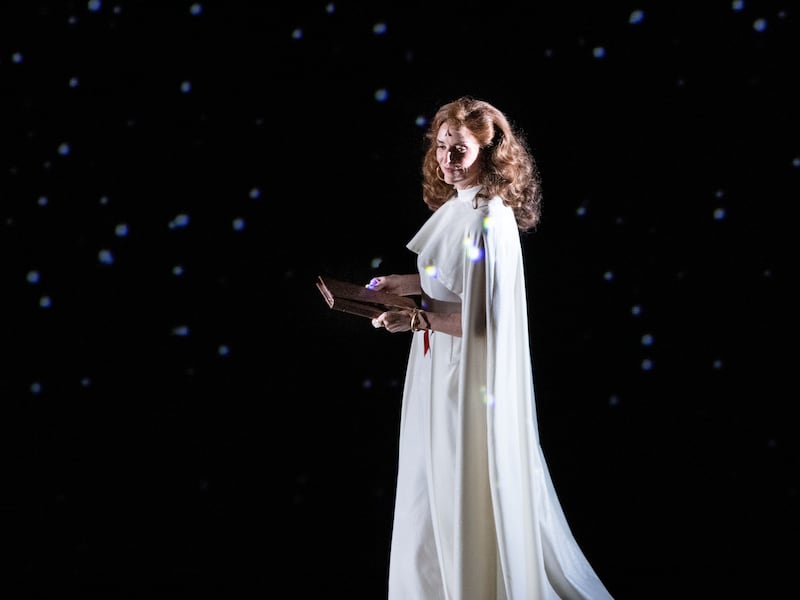

Sharlene Wells had to stop laughing before she could respond to an email about potentially taking part in an upcoming Utah Opera production.
While Wells was flattered, she felt she needed to clarify a couple of things.
One, she didn’t sing opera. Two, she didn’t act.
“I’m not sure how you’re going to use me,” she wrote.
That didn’t seem to faze anyone.
Out of amusement and curiosity, she hopped on a phone call with Utah Opera to hear why, exactly, she could be a good fit for the company’s production of Beethoven’s “Fidelio” — the only opera the composer ever wrote.
It turns out Utah Opera was revamping “Fidelio,” putting a modern spin on the 1805 opera that required someone to take on a brand new role as a narrator of sorts.
”Well, I’ve done that my whole life,” thought Wells, who was crowned Miss America in 1985 and later became the third female sportscaster in ESPN history.
She accepted the opportunity, with one caveat: “If at any time you don’t think that I’m right for the part, will you pull me?” she asked. “You got to promise me.”
On Saturday night, the Paraguayan-born Utahn who has traveled the world covering sports, worked inside the Pentagon as a communications director and is currently in a leadership position at Mountain America Credit Union, officially made her opera debut.
Ahead of opening night (“Fidelio” runs Jan. 17-25 at the Capitol Theatre), Wells spoke with the Deseret News about riding a steep learning curve — and how two important lessons from her youth helped her navigate it.
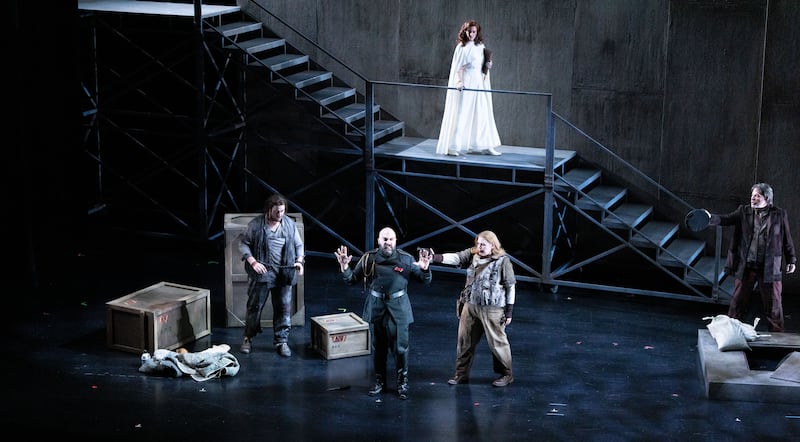
‘It feels like I’m overacting’
Wells had actually never even heard of “Fidelio.” But a quick search online revealed it is a highly popular opera — Classic FM puts it at No. 6 on its list of top 20 operas.
Based on a true story from the French Revolution, “Fidelio” follows a woman named Leonore who disguises herself as a man to infiltrate a dungeon where her husband is being unjustly held by a corrupt government official.
“The themes are relevant today — everything from love and dedication and courage and sacrifice, to tyranny and revenge," Wells told the Deseret News during a Zoom call.
This relevancy lent itself to a creative twist at the hands of stage director Tara Faircloth.
As Wells tells it, the messages of both the German dialogue and music are essentially the same. To establish more of a distinction between the spoken parts and lyrics, Faircloth reinvented the dialogue by creating a character called the Oracle, who instead reads aloud quotes from a book that holds humanity’s wisdom.
Taking on the Oracle role, Wells steps onto the stage in a flowy, white pantsuit and cape, paired with gold bangles and earrings, to read quotes Faircloth found from notable figures like Nelson Mandela, John Steinbeck and Martin Luther King, Jr. to help move the French Revolution-era story along.
Her appearance marks a stark contrast to everyone else in the production. She’s speaking English, not German, and her bright clothing stands out from all the muted or neutral colors characters wear to go along with the story’s prison setting.
“I feel like I’m dressed up to be on some kind of ‘Star Wars’ planet,” Wells said with a laugh.
She initially thought her role as the Oracle would place her to the side of the stage reading from a book. But she got a real surprise when she learned that her character would not only take center stage but also kick off the entire production.
It felt like a lot of pressure, Wells said.
She had been in a few high school musicals growing up, but she was always in the chorus — never in a solo position.
On top of that, she also had to learn to do a little acting and choreography. She felt like “a fish out of water” as she struggled to incorporate different emotions into her readings.
“It feels like I’m overacting,” she said at one point during rehearsals.
“And they’re going ...‘This is opera,’” Wells recalled.
But now, ahead of the production’s run, Wells is feeling good about it all — and she has a pair of important lessons from her childhood, in part, to thank for that.
‘Don’t practice sloppy!’
For the talent portion of the 1985 Miss America pageant, Wells famously performed on the Paraguayan harp — a special nod to her upbringing in South America.
Although music has been a part of her life since childhood — she actually wrote her first song when she was 14, inspired by The Carpenters’ “Rainy Days and Mondays” — it’s a lesser known part of her multifaceted career.
But music, she said, is initially what got her in front of people. And it’s influenced all of the other chapters in her career — ESPN included.
Growing up, Wells took piano lessons from her mom, a concert pianist. She was required to practice every morning. Her mom would be making breakfast in the kitchen and, on occasion, would shout out to her daughter in the other room.
“Don’t practice sloppy!” she’d say.
Anytime they had a guest from the U.S. visit their home in South America, Wells said she’d be required to play the piano. But to her surprise, her mom really didn’t focus on the quality of her performance. She could mess up a whole line and her mom would tell her she did great. What her mom really cared about, she said, was everything leading up to the performance.
“The discipline that I learned from practicing — practicing perfectly, not sloppy — that really stuck with me," Wells said. “If you’re going to practice something, practice it well.
“That absolutely translated to everything else that I’ve done — speaking, getting ready for speeches, getting ready to go on camera,“ she continued. ”Practice it well. Prepare well. Don’t practice sloppy. Don’t just think that you’re gonna wing it, because a lot of people (think) oh, if you’ve got the gift of gab, just go wing it. That’s not how you deliver the best product. So I learned a lot from the practicing part of it, and that’s why every one of my kids practiced piano at 6 in the morning, you know, starting from age 5.”
When she was a young teenager, Wells fell in love with the Romantic Era composers. As a 14-year-old, she’d fall asleep to a cassette of Tchaikovsky’s Piano Concerto No. 1 every single night. During her senior year of high school, she learned the first movement of Rachmaninoff’s Concerto No. 2.

It remains her all-time favorite piece, and currently sits on the piano at her home in Sandy, along with some music from jazz pianist Diana Krall. She hopes to relearn it one day.
Wells entered BYU as a piano performance major — and lasted one week.
“I went to my lesson with Dr. Paul Pollei, and we have one lesson, and he goes, ‘OK, I want you practicing five hours a day. And I just went, ‘I’m picking something else,’” Wells said with a laugh. “I can’t do anything five hours long. … I’m good with nine holes of golf. My attention span just won’t do it.”
She wound up pursuing a degree in communications, which led her into a rich broadcasting sports career covering global events like the World Cup and French Open.

After almost two decades covering sports, Wells left her full-time gig at ESPN, in need of more flexibility as she raised her children.
In doing so, she quickly discovered that music was still a part of her.
Courage over fear
Growing up, Wells never considered herself a performer — the thought of performing on stage actually made her wobbly.
“I hated that feeling of being scared to death, and I found that when I played a piano solo, I was especially nervous,” she said.
But for Wells, singing and playing the piano was a little more comfortable. So during the years she was primarily at home with kids, she started to dabble in music again. She took voice lessons and even released a couple of albums with Deseret Book.
Over the years, though, she has been intentional in overcoming her fear of performance, of taking the stage.
When she was a 13-year-old in Buenos Aires, Argentina, she was challenged by an English teacher to run for school office. She’d have to give a 30-second speech.
“I can’t do that,” Wells immediately thought.
But her teacher asked her to focus more on her courage instead of her fear. So Wells accepted the challenge and gave the speech.
Seven years later, in that same gym down in Buenos Aires, she gave a 45-minute speech as Miss America.
And she didn’t even have a lump in her throat.
I kept making decisions based on courage, not on fear, over and over.
— Sharlene Wells
“It was simply that I kept making decisions based on courage, not on fear, over and over,” she said.
Whether it was joining BYU’s Young Ambassadors because they were in need of an alto, saying yes to KSL’s invitation to become a sideline reporter for BYU football — even though she didn’t know much about the sport — or, most recently, taking part in Utah Opera’s “Fidelio” despite some serious initial hesitations, Wells generally prefers to seize the moment and work through the fear.
“That’s the story of my life, is just kind of getting pulled in,” she said. “That’s been kind of the story of my life, is that I really believe in grabbing opportunity even though I’m scared to death of what it’s going to look like — and if I can even do it.”