
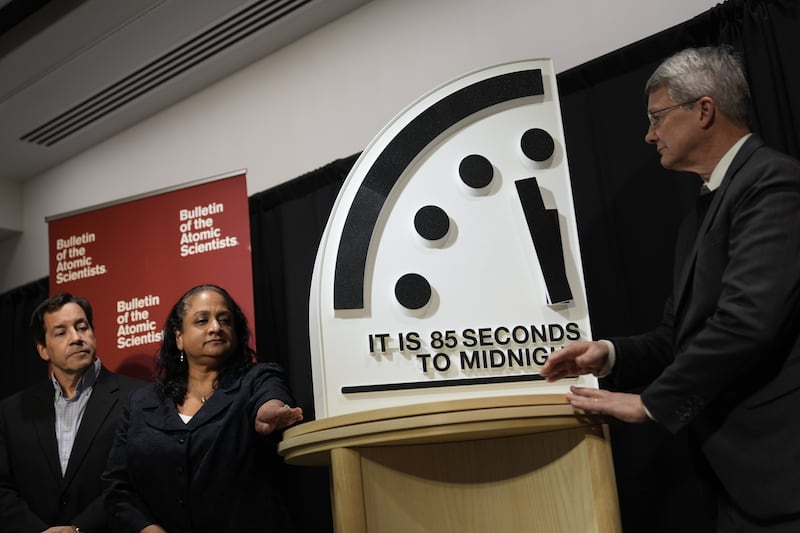
Scientists gathered and moved the “Doomsday Clock” to 85 seconds on Tuesday, the closest it has ever been to midnight.
Each year the clock is adjusted based on a variety of issues factoring together to determine how close we are to a theoretical annihilation. This year, atomic scientists cited multiple reasons for the forward movement of the clock, including rising nationalistic autocracies.
“The dangerous trends in nuclear risk, climate change, disruptive technologies like AI and biosecurity are accompanied by another frightening development: the rise of nationalistic autocracies in countries around the world,” said Daniel Holz, president of the Science and Security Board, in a statement. “Our greatest challenges require international trust and cooperation, and a world splintering into ‘us versus them’ will leave all of humanity more vulnerable.”
Since the Doomsday Clock was created in 1947, it has moved forward and backward based on the world’s reaction to major issues impacting Earth’s habitability. According to a statement released by the Science and Security Board, Russia, China and the United States have not heeded past warnings and instead become more aggressive and nationalistic.
Since its inception, during the early Cold War that followed World War II, the Doomsday Clock has served as a reminder and warning of the dangerous actions being taken by humans that may lead to the world becoming uninhabitable. It often highlights global tensions.
Most recently, Russia’s invasion of Ukraine has been worrisome to the Science and Security Board, along with recent conflict in Iran.
“The Russia–Ukraine war has featured novel and potentially destabilizing military tactics and Russian allusions to nuclear weapons use,” the statement said. “In June, Israel and the United States launched aerial attacks on Iranian nuclear facilities suspected of supporting the country’s nuclear weapons ambitions. It remains unclear whether the attacks constrained those efforts — or if they instead persuaded the country to pursue nuclear weapons covertly.”
Russia, China and the U.S. have each modernized nuclear warheads, and the U.S. has plans to implement a new defense system called the Golden Dome, which includes space based interceptors, likely leading to a space-based arms race, according to the board’s statement.
Why should people care about the Doomsday Clock?
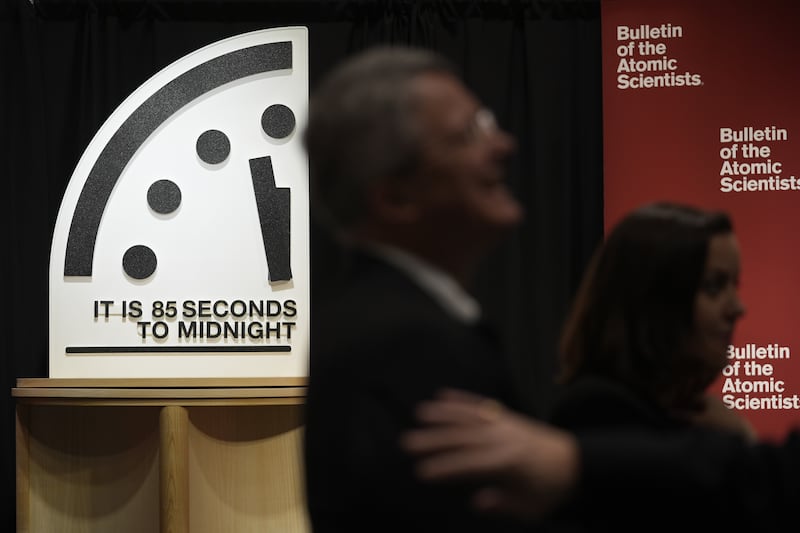
While the timeline isn’t necessarily an inevitable date for the world’s destruction, it’s a symbol of warning for the inhabitants of Earth to turn its attention to the numerous disastrous conflicts and problems happening right now.
The clock is a symbol that there is still time remaining for humanity to change course and start focusing and working together on problems like climate change and technology innovations instead of focusing on conflict.
Here’s a history of how the Doomsday Clock has progressed:
- 1949: Three minutes to midnight; arms race begins
- 1953: Two minutes to midnight; hydrogen bomb testing
- 1963: Twelve minutes to midnight; following the Cuban missile crisis
- 1968: Seven minutes to midnight; United States involvement in Vietnam
- 1984: Three minutes to midnight; Soviet-U.S. relationship growing colder
- 1991: Seventeen minutes to midnight; George H.W. Bush and Mikhail Gorbachev sign the Strategic Arms Reduction Treaty
- 2012: Five minutes to midnight; Kim Jong-un and the threat of nuclear war in Northeast Asia