



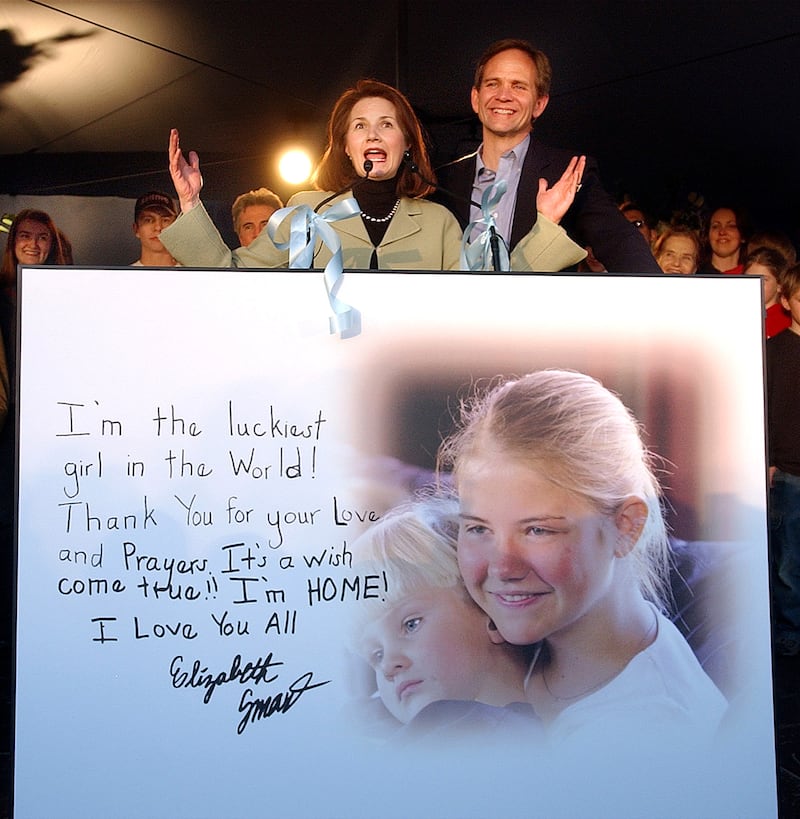
Nine brutal months after being abducted from her Salt Lake City home in the middle of the night, relentless rescue efforts finally brought 15-year-old Elizabeth Smart back.
As the teenager returned home, surrounded by and grateful for a network of family, friends and a community that never stopped saying her name, never stopped searching or praying for her safe return, Smart found herself wrestling with somewhat of a morbid thought.
“I’m just forever going to be known as the girl that was kidnapped. I’m just forever going to be known as Elizabeth Smart, kidnapping victim, rape survivor.”

“I remember just feeling like, ‘Wow, if I died tomorrow, my funeral would just be, oh, she survived a kidnapping,’” Smart recalled. “And I remember sitting there thinking, ‘I don’t want my funeral to be like that.’
“Honestly, I don’t even want that to be mentioned.”
So early on, Smart made a decision to enlarge her life, to fill it with opportunities and memories and purpose.
In the nearly 24 years since her abduction, Smart has become a tireless advocate and beacon of hope for sexual abuse survivors and families of missing children. She’s often opened up about her abduction and captivity, including through the recent Netflix documentary “Elizabeth Smart: Kidnapped” and a YouTube channel where she tackles frequently asked questions.

Her advocacy work has kept her in the public eye, with her kidnapping front and center. But when it comes to Smart’s day-to-day life, there’s a happiness so expansive that the kidnapping is no longer the focal point.
“I have so much more to reflect on than just my abduction and captivity,” she said.
In a wide-ranging interview with the Deseret News, Smart opened up about her new Netflix documentary, advocacy work, continual healing and the memories that have enriched her life.
This interview has been edited for clarity and length.

Deseret News: You’ve told your story so many ways over the years, through writing, through speeches and film. What separates this new Netflix documentary from all of these other tellings, and did it offer something different for you?
Elizabeth Smart: When I was first rescued, I really didn’t want anyone to know what had happened to me. I felt a lot of embarrassment. I felt a lot of shame around what had happened — even though I knew it wasn’t my fault. I just couldn’t help how I felt.
Sexual assault and rape and abuse, it can feel so isolating. I remember one of the reasons why I didn’t want to talk to people was because I felt like, “How could anyone else understand what I went through?” I didn’t know anyone who had shared their story publicly. I didn’t know anyone who admitted that they’d been raped or admitted that they’d been abused in any way. I didn’t feel like that was just something people talked about. It was kind of like people kept their skeletons in the closet.
I wanted my story to be more than a courtroom transcript. I felt like it needed to serve a purpose.
— Elizabeth Smart
I didn’t share my story — I didn’t share the details of what happened for years, actually. It really wasn’t until the trial happened and I felt like everything that I had kept private all of a sudden was out. And I wanted my story to be more than a courtroom transcript. I felt like it needed to serve a purpose.

I remember just thinking, “Well, if it’s going to be out there, then I want it to help other people to not feel so alone.” So that’s when I wrote my first book. That’s when I started speaking. And over the years, I feel like that belief has just become more and more cemented.
The amount of victims and survivors who have approached me and said, “Because you shared your story, I felt like I could share mine,” “Because you seem to be happy, I want to go forward in my life,” “Because you did it, I can do it, too.”
I just feel like stories are the best way we learn. Sexual abuse, kidnapping, families in pain — this is not just a problem in America. This is a problem worldwide. So as this Netflix documentary happened, it felt like a huge world stage had just been given to me, and it was terrifying and inspiring.
DN: Was there anything that surprised you as you took part in this documentary, or maybe something that you learned about yourself?
ES: I think one of the things that I really appreciated — and I don’t want to say surprised, but I was a little bit surprised — was really, actually, it came down to the production company and just how sensitive they handled my story, and how careful they were.
They didn’t want me to feel re-traumatized in any way — to the point that when I saw the first cut, I thought it was amazing, I thought it was really high quality, but I remember just going back to them being like, “Well, I think this is great. I also feel like it kind of looks like I went on vacation for nine months.”
I think they were a little bit taken aback that I said what I said, but I feel like I want it to be a true representation of what happened. So I just really appreciated the care that they took in sharing my story. And then, as I re-watched the whole thing, I mean, I actually became quite emotional watching my family’s side, and specifically my sister (Mary Katherine). If I teared up at any point, it was watching her.

DN: Regarding your kidnapping, early on in the documentary, Mary Katherine says, “I think it’s something I still deal with.” As I was watching, it seems very much for everyone involved, there has been a healing process. There continues to be a healing process. And I would love to know what are some things that have helped you heal and continue to help you heal?
ES: I think certainly having a support network, a support system, honestly, throughout my life, has made a huge difference. I feel like it’s almost impossible to heal and move forward unless you have friends, you find your family. I say find your family because, unfortunately, not everyone has a loving, biological family. So sometimes you have to find it.
I think the fact that I really never was doubted — everyone’s always believed what I’ve said — I think that’s made a really big difference. So many victims aren’t believed, and when they’re not believed when they first tell, it becomes harder and harder to share with anyone else. And this is the kind of thing that can just fester inside you and kill you slowly from the inside out. So I think always being believed has made a big difference in my life.
I think being able to make decisions for myself, being given back the gift of choice, that has helped me heal.
Initially, when I got home, I found a lot of peace in music. I found a lot of healing in the outdoors and horseback riding with my grandpa. And I think as life has moved on, I have found that same sort of outlet in running and exercising. I still love music and being with my family, in being able to experience more of what life has to offer.

DN: You also have a YouTube channel where you continue to take power of your story. There’s a video where you take your brother and your sister-in-law, and you’re revisiting and hiking this kidnapping site. How is the YouTube approach and doing this different from a movie or a documentary?
ES: I mean, it is a very difficult, long hike. I feel like maybe YouTube gives that visualization. And I just felt like it was kind of an opportunity, because so many times people have been like, “Why didn’t you run? Three and a half miles isn’t that far.” It wasn’t necessarily so much like, “You’re wrong. Three and a half miles is really far,” but it was just to give people a little bit more perspective, a little bit more visualization.
But then on this hike that we did, now I have the opportunity to talk more about why other victims don’t run. We can take, for example, victims of domestic abuse: The average victim, it takes them seven tries of leaving their abuser before they successfully leave.
I’m able to talk about the physical chains that I experienced when I was chained up, but then I also talk about these mental chains that so many other victims experience, that people don’t see.

DN: It seems like such an intense level of vulnerability to go back there, to hike that, to talk about it as you’re hiking. How did you get to that point where that was OK?
ES: I actually remember hiking back there just days after I was rescued, and I went with my parents. ... Some form of law enforcement and I think an uncle or two maybe was with us. I was able to take them to these different sites, these different points that I’d experienced something at. And my parents, I think, were very worried about me, understandably.
I remember my mom just being like, “Are you OK? How do you feel?” And I remember just being like, “I feel fine.” And she was like, “Are you sure? Are you sure you’re OK? Well, how do you feel?” And I remember saying, “I feel triumphant.”
Because all these terrible things happened to me here, and it was a secret. No one could find me. And now bringing people here and shining a light on it, no one will ever be able to keep this place a secret ever again. It felt like it was shining a light into a dark hole.
It was never the location that hurt me. That was just a place out in nature. It was just the people in those places that hurt me.
— Elizabeth Smart

DN: Do you have any upcoming videos that we can tease or let people know about?
ES: I haven’t recorded them yet, but I’ve got a whole bunch of ideas floating around in my head. At some point I would like to go to the Salt Lake Public Library where I was first approached by the homicide detective. ... It was talked about in the documentary, and so that’s something I’d like to do, just talk a little bit more in-depth what that was like, what was going through my head. ... Being able to explore kind of those trauma responses — fight, flight, freeze and appease — a little bit more in-depth.
DN: With the Nancy Guthrie case so prevalent in the news right now, my 4-year-old is starting to ask me questions about kidnapping because he’s hearing that word and seeing this. How have you approached the subject with your own kids? How do you recommend a clueless mother like myself to approach that with her own children?
ES: I think this should be a conversation that is ongoing — it can’t just happen once. And I think there is an age appropriate way to approach it. You know your children best, and so you know what they’re ready for. I know my oldest started asking questions way before I was ready. I was like, “Wait, you’re 3 years old, why are you asking me these questions? I’m not ready for this.” But then again, someone said it to me, the best time to start talking about it is when they start asking questions. And so that began at 3 years old for my kids.
I feel like even things as simple as calling a penis, a penis, calling a vulva, vulva, vagina, vagina, and not attaching the shame or the embarrassment to it. I mean, for instance, my parents were like, “Those are your privates. Don’t let anyone touch them. They’re your privates,” and that was really kind of all that was said.
And so then eventually, after I was rescued and I had to go in and talk about it, I ended up feeling so uncomfortable. I ended up feeling just so embarrassed. I mean, even just saying the word penis, having to describe being raped in graphic detail, that was a horrific experience. And so I just feel like if we can even just take away the shame of saying penis — it’s a body part. Elbow is a body part, nose is a body part. It’s just another body part. So if we can take that kind of shame away, that is a great beginning place.
I think it’s great to talk about safety. Everybody knows what to do if you catch on fire — stop, drop and roll. But how many people know what to do if you get raped? I wasn’t taught what to do. But there are conversations we can have. We can talk about screaming. For as great as it is to be kind and polite and respectful, you should never put your own safety at risk. You should never worry about someone else’s feelings over your own personal safety. You should be allowed to say no. You should practice saying no with your children. If they don’t want to give grandpa a hug, let them not give grandpa a hug. Respect their boundaries. Respect their body autonomy as well.
When they come and tell you something that’s important to them or that they’re scared about, don’t just be like, “Oh, it’s fine. Don’t worry about it.” Listen to them so that trust is built and so that should anything happen in the future, they know that they can come to you and tell you anything, and you are in their corner, that you believe them, you are on their side.
And above all, I think the most important gift any parent can give their child is to make sure that their child knows that they are loved unconditionally — that there isn’t anything that anyone else can do to them that would make them stop loving them. That you are there for them, and that they can disclose anything to you, and you will be there to help them.

DN: The Elizabeth Smart Foundation also has this self-defense training program, Smart Defense. Could you talk a little bit about the growth of that, because that is available in public universities in Utah, right?
ES: It is an accredited class in almost all of the public universities in Utah. We’re still working on the last few. Give me time, I’ll get there.
I feel like I remember being a freshman — I think I was sitting through freshman orientation — I remember hearing it a few times, just talking about making sure you lock your doors, make sure you consider renters insurance. There was much more focus on making sure your things weren’t stolen than really personal safety. ... But the truth is actually you’re two times more likely to be raped on campus than you are to be robbed on campus.
And so I feel like these are things that we should be focusing more on, and it should take a much bigger place in personal safety. Especially when you consider that the national average is 1 in 4 women is raped in their lifetime and, unfortunately, 1 in 3 women in Utah. I mean, that’s horrific. And these are just the cases that we know of. These are just the numbers that are reported. So we’ve got a lot to do.

So Smart Defense, that actually was kind of in response to an experience I had. I was flying on a plane, and I was exhausted, and as soon as I sat down on the plane, I just fell asleep. And I remember we were just about to start our initial descent, and I woke up because the man next to me, he had his hand in between my legs, and he was rubbing high up on my inner thigh. And I was just so shocked I’d woken up in a start. And I remember looking over at him, like waiting for him to apologize, or give me some reason as to why he was doing what he was doing, and he didn’t. He didn’t apologize, didn’t say anything, didn’t move his hand. I had to physically pick up his hand and take it off me. But I was just still in such shock, I didn’t immediately respond, which is such a common response. Again, it’s a trauma response.
And it wasn’t until I got off the plane and I called up my dad, and I’d called up my husband, and I was just like, “What is going on in this world? Do I just have like a big billboard across my head that says easy victim? Like, easy target?” I was like, “I already have to be one of the most well-known victim survivors in America. How is this happening to me again?’”
And so I was like, “I’m sick of this. I’m sick of this kind of thing happening to me. And if it’s happening to me, then it has to be happening to other people.” And so that’s kind of how Smart Defense was born.

DN: You mentioned this is a part of why you continue to share your story, to let people know they’re not alone. With Nancy Guthrie in the news, what would you want or hope for people and families who are going through this unimaginable to know during that time?
Don’t stop searching. Don’t stop praying. Keep looking, keep believing that it is possible, because we do come back.
— Elizabeth Smart
ES: Families are commonly told that the first 24 to 48 hours are the most critical, and that if you’re not found within the first 24 to 48 hours, the chances of you coming back alive drop significantly — almost to zero.
But, I would also just say, I came back. And I was gone for nine months. Jaycee Dugard came back, and she was gone for years. I mean, we do come back, so don’t give up hope. Don’t stop searching. Don’t stop praying. Keep looking, keep believing that it is possible, because we do come back. Keep the story alive. Keep your missing loved ones’ faces out there. And I mean, do call on the public. Because again, if my story wasn’t as big as it was, if my parents didn’t do everything in their power to keep my face out there, would I have been recognized? Would I have come back alive? It’s kind of hard to say. I think there’s a good chance that I could be dead today.
DN: In a 2017 interview you did with Deseret News, you gave a quote about your journey to advocacy that I’ve not forgotten. It says: “I couldn’t have just come home and written a book, made a movie and started speaking. I couldn’t have done that. I needed time to readjust back to my family, refigure out my life again, and move on enough so that when I look back on my life, I didn’t just see my kidnapping.” When was that moment for you that you looked back and did not just see that, did not just see the kidnapping?
ES: I think it was a gradual evolution. Days after I was rescued, weeks after I was rescued, it was right there, like my kidnapping was right there, right behind me. And so I would say it definitely took time. I’d say it definitely was gradual. I stand by what I said. I couldn’t have just jumped into it the next day. I couldn’t have just become an advocate the next day like that. That was not a possibility for me. I needed the time, and I needed the chance to have more experiences and reclaim my life back a little bit more before I could even begin to think about it.
I mean, yes, over the years, I did a little bit here and there. I’d worked with the Department of Justice in writing a survivors guide. I flew out to Washington, D.C., with my dad, and we worked on the Amber Alert together, and we worked on the Adam Walsh Safety and Protection Act. So I mean, there were things that I did over the years, but most of the time, I went back to just trying to be a normal teenager. I went back to just trying to meet me, Elizabeth, again, get to know myself again. And I think that made all the difference.
DN: And so now, when you do look back, what do you see? What sticks out most for you?
ES: I mean, sure, there is Elizabeth Smart. But then there’s me, and I’m just me 99% of the time. So I look back, and I can look back fondly at going to BYU, going on study abroad, going on a mission, meeting my husband, getting married, having my kids. Sunday game nights with my brother, going swimming in the lake in the summer, going skiing in the winter. I have so many more memories to fill up my life now.
DN: With all of your life’s experiences, all of these projects, all of these great efforts you have launched, what is something you are most proud of that you would want to share?
ES: I think I’m just most proud of who I’ve become today, because it would have been easy to stay at home, and it would be easy to kind of sink back into a black hole. That would have been very easy to do. When I say I’m proud of myself, sure, that advocacy and everything that I’ve been able to do with that, that is great, but I think I’m just most proud of myself that I’m happy today. That I have the best husband and the best kids, trying to live the best way that we know how. I think that’s what I’m most proud of.
Nobody can take away your value. Nobody else’s actions can take away your value.
— Elizabeth Smart

DN: Thank you so much. Is there anything else you would want to mention that I haven’t touched on, anything you’d like to share?
ES: I would just say this to other victims out there: Nobody can take away your value. Nobody else’s actions can take away your value. I know it’s so easy to feel like you’re worthless if you’ve been raped or if you’ve been abused, or you somehow perceive it as your fault. It’s not. And no matter what people have done to you, you were born with value, and you still maintain that value. You are lovable, you are worthy.
I’d want them to know that it is easy to feel defined by what has happened to us. I think we live in a world of labels, and no one person can be defined by just one label. We are complex and multidimensional beings. You can be one thing and be 1,000 others. You don’t just have to be defined by one thing. You get to define yourself, and you do that by the way that you live every single day.
And finally, you deserve to be happy. Don’t give up hope. Keep going. You’ve survived every worst day you’ve had so far, whether that was yesterday or 10 years ago. Be proud of yourself; you’ve survived it. Keep going. There are more good people in this world than there are bad people, and there are people out there who are willing to help you, who are willing to believe you. So don’t give up.