

At the start of a two-hour rehearsal, where roughly 90 musicians were crammed together in a room at St. Olaf Catholic Church, conductor Jane R. Fjeldsted got emotional as she began to speak.
I was sitting just a few feet away from her, holding my violin. The earnestness in her voice was palpable. Her conviction was so piercing that it likely reached every single musician in the room.
She had been struck recently, she told us, by the spiritual importance of what we were doing: Coming together two nights a week, at churches of different faiths throughout Davis County, Utah, to rehearse Rob Gardner’s oratorio “Lamb of God.”
The roughly 90-minute piece, which Gardner first recorded with the London Symphony Orchestra in 2010, details the last days, Atonement and resurrection of Jesus Christ through those who were closest to him. The sacred work has become a global Easter tradition, performed by choirs and orchestras worldwide.
On a Sunday night in late February, early on in the preparation for the Davis Interfaith Choir & Symphony’s own “Lamb of God” performances at the Salt Lake Tabernacle, Fjeldsted didn’t just encourage us to play to the best of our ability — she demanded it.

The opportunity to create was a divine privilege, she said — something she’d been reminded of when she came across a quote from the late President Thomas S. Monson, former president of The Church of Jesus Christ of Latter-day Saints, during her personal gospel study.
“He leaves the pictures unpainted and the music unsung and the problems unsolved, that man might know the joys and glories of creation.”
Going forward in our rehearsals, Fjeldsted said, it was necessary to put in the work, to be exact in our playing, so that we might create something as magnificent as we were capable — perhaps even more so.
At each rehearsal, Fjeldsted’s passion for creating intertwined with her belief in what we were creating.
There were moments — like the lush orchestral interlude that follows when Christ reveals himself to the disciples after his resurrection — when the conductor’s eyes would well up with tears.
“Can you imagine being in that room?” she asked, her voice wavering, during a rehearsal at the Christian Life Center Church in Layton.
I had my own emotional moments during rehearsals — usually whenever Peter, sung by tenor Will Perkins, would sing of his grief and guilt over denying Christ three times. But I generally just put my head down and tried to focus on my own part in this creation.

So it really shouldn’t have come as a surprise to me that a week after my performances, when I flew to New York City to see Gardner himself conduct a milestone performance of “Lamb of God” at the Metropolitan Opera House, I wept through most of it.
But I was surprised — and in the best possible way.
‘I had no idea how incredible this piece was’
As I got to know Fjeldsted a little better over the course of six weeks, I learned that the spiritual tone she set at each rehearsal wasn’t specific to “Lamb of God.”
Her professional music career emerged relatively later in her life, as she was approaching her 60s. Now in her 70s, Fjeldsted, who is a member of The Church of Jesus Christ of Latter-day Saints and directs the choirs at Westminster University in Salt Lake City, approaches her entire career with a deepened faith shaped by decades of living.
“Everybody knows what I believe,” she told me during a phone call in mid-March. “And I’ve actually had some students … who have dropped out because they don’t like the way I believe.
“For me, everything revolves around bringing the spirit,” she continued with emotion. “Honestly, that’s why I’m doing what I’m doing.”
The conductor firmly believes this is work God has called her to do.
Fjeldsted, who is the daughter of the late Don Ripplinger, a longtime associate conductor for the Tabernacle Choir at Temple Square, told me she came to realize this when she was singing with the choir on a tour throughout Russia and Eastern Europe in 1991.
A mom of four, Fjeldsted had been waiting for her youngest to go into school so she could take a job teaching junior high to earn a little extra income. But while on that choir trip, she was blindsided by an impression that she needed to go back to school and get her graduate degree.
She was genuinely shocked — school was far from her favorite thing.
But throughout this next phase of life, in following that prompting, she balanced higher education with raising her kids. She only did schoolwork when her kids were in school or bed so that she didn’t take time away from them.
In 2009, she graduated with a doctorate degree. She was almost 53.
That unconventional path, Fjeldsted believes, prepared her for “Lamb of God.”
When she heard Gardner’s work for the first time in 2016, she said she was “dumbfounded.” She was especially moved by the character of Martha, who pleads for healing and understanding following the death of her brother, Lazarus, in the song “Make Me Whole.”
“I had no idea how incredible this piece was,” she told me. “I’ve always loved Martha, and I’ve always felt like she needed to be cared for. And Rob has done that in this piece. He has embodied her remarkable faith. ... The melody of her song has such an arc to it, and it seems to be the shape of my faith.”
Thanks to all of her studies, which gave her new skills as a conductor, Fjeldsted wasn’t just listening to “Lamb of God” when she heard it for the first time. She was actively noting the ebbs and flows of the music and the characters — envisioning how she might conduct it for a group of nearly 500 singers and musicians.
Since 2017, she’s helmed the Davis Interfaith Choir & Symphony’s annual performances of “Lamb of God.” To date, she’s conducted the oratorio all the way through, from start to finish, at least 25 times.
She was initially concerned that the repetition would start to make it all feel routine. But to her delight, it feels exciting and new each time.

This year, though, brought some particularly special moments. On March 17, during our dress rehearsal at the Salt Lake Tabernacle, we received a brief devotional and words of encouragement from Elder Gary E. Stevenson of the Quorum of the Twelve Apostles of The Church of Jesus Christ of Latter-day Saints, and “The Forgotten Carols” composer Michael McLean.
But it was on March 19 — the night before our first of two performances — that brought the biggest surprise of all: A visit from the man who created “Lamb of God.”
A surprise visit from Rob Gardner
Gardner was in Provo, Utah, on that Thursday in March, working with the BYU choir that would fly out to New York later in the month to accompany Broadway performers for the “Lamb of God” performance at the Metropolitan Opera House — a milestone event that developed through a partnership with The Church of Jesus Christ of Latter-day Saints.
He’d spent hours with the students, helping them to shape their sound and understand the heart of his piece: what can be learned from the relationships between Christ and those who walked alongside him.
In the evening, he traveled an hour north to the Latter-day Saint church in Kaysville where we were having our final rehearsal together after six weeks.
A few minutes before 9 p.m., as the rehearsal was about to end, Gardner walked in and surprised the large group of roughly 500 singers and musicians. He stepped onto the conductor’s podium, not to lead or give instruction as he had a few hours before at BYU, but just to talk to us.
“Thank you so much for being a part of this, and for giving of your talents and volunteering and just being there for this amazing performance that happens every year,” he told us. “It just warms my heart ... to just know that this work and this music means enough to you to give up your time to be able to share it with other people.”
To my mild dismay, after Gardner spoke to us for a couple of minutes, someone suggested that we perform for him the 36 measures from “I Am the Resurrection” (an early number in “Lamb of God”) that we use for our encore.
This powerful passage comes after Christ has raised Lazarus from the dead. As the orchestral music intensifies, the 365 choir voices ring out in praise:
I am the resurrection
I am the resurrection and the life
He that believeth in me
Though he were dead
Yet shall he live
Yet shall he live!
This is one of my favorite parts in “Lamb of God” — to play and to listen to. But the idea of having to unexpectedly play this with the man who created it just a few feet away from me did not strike me as particularly fun.
Gardner laughed when I told him this during a phone call a week later. And he assured me that in that moment, the farthest thing from his mind was being critical or passing judgment. It was while listening to us perform, the composer told me, that he came to understand his purpose in being at our rehearsal that night: to listen.
That Thursday night after rehearsal, he stayed and listened to every person who approached him, learning about their connections to “Lamb of God,” the roles they play in the story and how it has affected their lives.
Gardner told me that in the early days of “Lamb of God,” compliments were hard for him. He’d deflect or find a way to change the subject. But he quickly came to learn that wasn’t the best way to go about things, and that he needed to move past his discomfort.
“I don’t totally understand it, but it matters to people when something is a part of their lives and it means something to them to meet the people that are involved with it, and to get to just express their gratitude,” he said.
Gardner says he values this one-on-one connection — especially as a conductor who is typically on stage leading hundreds of people at once.
“We all just want to be heard,” Gardner told me. “And so that’s what I hope ‘Lamb of God’ even does for the characters, is that finally Martha is heard and not just judged, and finally Thomas is heard and not judged. Because Jesus heard both of them.”
The day after his surprise visit, Gardner flew from Salt Lake City to New York to prepare for the massive undertaking of conducting “Lamb of God” at the Lincoln Center, one of the most prestigious performing arts centers in the world.
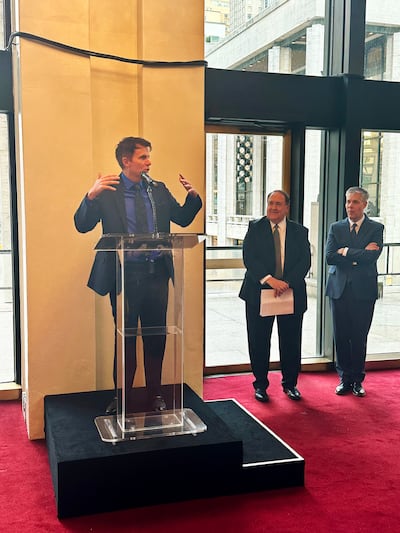
A week later, I made the same trip to see it all come to life.
Seeing ‘Lamb of God’ in New York City
Gardner told me he was initially reluctant when he was a 19-year-old missionary for the Church of Jesus Christ in Bordeaux, France, and his president asked him to write a 15-minute piece about the life of Jesus.
Once he wrote it, though, it never left him.
He told himself he’d one day write a piece that just focused on Holy Week. That idea lingered over the years as he studied business at BYU and scored other musicals. But it was two months into a yearlong graduate program at USC for film scoring that he had the thought to make the story about those who knew Christ in those final days. And once that idea formed, Gardner leapt into action.
The composer booked a recording session in June 2010 with the London Symphony Orchestra — his dream orchestra that played on the original soundtracks for “Star Wars” and “Harry Potter.”
And then he dropped out of grad school to finish writing the music.
“I’m the kind of person, once I get an idea, I need to do it,” he said. “And I felt that urgency.”
From there, Gardner said, “Lamb of God” took on a life of its own pretty much immediately, with groups starting to perform it by the following Easter. Last year, the composer told me, there were over 100 performances of “Lamb of God” within a two-month period — including in Taiwan and Romania.
Now, “Lamb of God” has had one of its biggest moments since the concert film that had a theatrical release during the 2021 Easter season.
On Monday, March 30, as I sat 12 rows away from the massive Lincoln Center stage teeming with New York-based musicians, singers from BYU and Broadway performers, one thing was immediately obvious to me: Gardner’s passion for “Lamb of God” has not diminished in the 15-plus years since writing it.
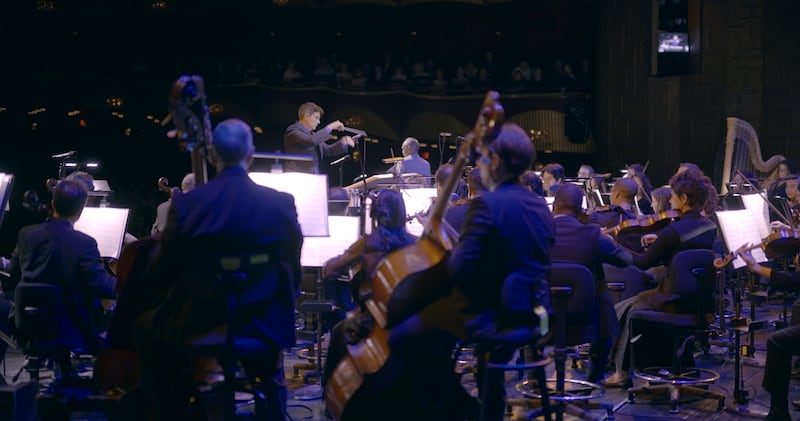
Watching Gardner conduct, it was clear he still believes in this music.
His conducting style was energetic and intense. He sometimes seemed to throw his whole body into the music. His arms would fervently wave up and down as he would demand more sound from the choir or orchestra. Most of the time, he was mouthing every single word along with the choir.
Having just done two performances of “Lamb of God” the week before, this music was still very fresh in my mind. For the first couple of songs, I was actually a bit distracted as I found myself watching the violinists and comparing their style or way of playing a particular passage to my own.
But all of that nitpicking went away when Joy Woods — who recently starred in Broadway’s “Gypsy” alongside Audra McDonald — took the stage to give voice to Martha.
When I was performing “Lamb of God,” I did my best to keep my emotions at bay. Otherwise, I figured, I ran the risk of my tears blurring my eyesight and then I would have a hard time reading the notes. So for the most part (there were a few exceptions), I concentrated on my own music and tried not to get swept away in the story.
But now, being on the receiving end of “Lamb of God” in New York City, it was as if I had been given formal permission to let out all of those emotions.
I cried as Woods, playing the role of Martha, sang of having faith in her Savior but desiring more understanding. She sang “Make Me Whole” with such convincing power that people actually started clapping and cheering when the song was over — something I’ve never seen happen during a “Lamb of God” performance, since applause is typically held until the end.
I also cried when Alex Joseph Grayson — who recently finished a run in the Tony Award-winning musical “The Outsiders” — brought a touching tenderness to “Sometime We’ll Understand,” the penultimate number that is sung by the disciple Thomas after he isn’t present to witness the Savior’s resurrection with the other apostles.
Not now, but in the coming years
It may not be when we demand
We’ll read the meaning of our tears
And there, sometime, we’ll understand
Those words from “Lamb of God” have been running through my mind in the days since seeing it. Throughout the oratorio, the apostle Peter sings of knowing Christ. Thomas sings of his desire to see Christ. John sings of hearing him.
I was reminded to trust him.
The word at the heart of ‘Lamb of God’
At the end of the performance, Gardner faced the full house of roughly 3,800, his blue dress shirt soaked with sweat, and bowed with the hundreds of people who had helped bring this milestone moment to life.
The standing ovation lasted for at least two minutes, with each soloist getting their own vigorous round of cheers and applause.
As people started filing out of the theater, Santino Fontana, who voices Prince Hans in “Frozen” and played the role of John in “Lamb of God,” told me he hadn’t expected that kind of reaction from the audience.
“I think it’s going to take me some time to metabolize it,” he said just minutes after the performance, which marked his Metropolitan Opera House debut. “It’s pretty epic. It just felt epic and very moving, and the audience was incredibly present through all of it.”
Broadway actor Norm Lewis, who played the role of Pontius Pilate, had been visibly emotional and wiping away tears during the standing ovation. After the show, Lewis — who is well known for starring as the first Black phantom in “Phantom of the Opera” on Broadway — stood outside of the Lincoln Center hugging a few of the BYU singers. He praised their sound and compared Gardner’s “Lamb of God” to a Mass.
Even as Gardner has made changes to “Lamb of God” over the years, including adding a few songs and fleshing out some of the characters’ perspectives, he said the one word that inspired him to write it continues to be at the center of it: hope.
As I sat in the Lincoln Center, letting the emotions of the story wash over me, I was reminded of the joy of worshipping through song. It brought me back to that February rehearsal at St. Olaf Catholic Church, when Fjeldsted told us that making this music was a divine privilege.
I realized that if I could have even the smallest of roles in making someone feel as uplifted as I did that Monday night, it was a blessing to not take for granted.
And I can’t wait to have that chance again.
