


Imagine this: Little black pellets made of uranium dioxide are stacked on top of each other in a silver, cylindrical rod. A rogue neutron hits a U-235 nucleus inside a pellet, causing the nucleus to split. This causes fission, which releases heat and more neutrons. The heat boils water and creates steam, the steam spins a turbine, and the turbine generates electricity.
That is, simply put, a nuclear reactor at work.
In the United States, about 20% of electricity is generated by nuclear reactors, and as of December 2024, there were over 315,000 bundles of spent nuclear fuel rods (that are radioactive) sitting in concrete vaults around the country.
In an age when the U.S. has an insatiable need for energy, thanks in large part to the growth of artificial intelligence, there are many prominent lawmakers — including in Utah — who think this plentiful, clean source represents the future of delivering the energy needed to keep the country humming.
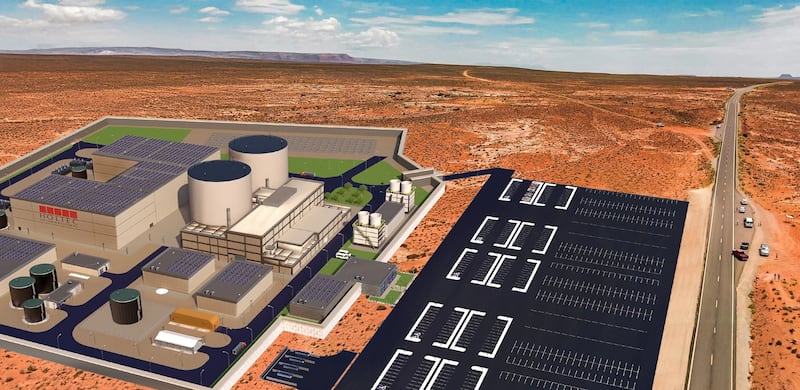
In this new age, Utah intends to lead the way by developing the latest technology needed to generate nuclear energy. Gov. Spencer Cox announced last week that Utah is partnering with two out-of-state companies to build “a complete civil nuclear energy ecosystem from start to finish,” in Brigham City.
Looking to the future, state officials have plans to build several small nuclear reactors across Utah.
It’s clear nuclear energy is making a comeback. But the question remains — is it safe?
Making nuclear energy cool again
In Washington, D.C., this past June, a group of young nuclear energy enthusiasts bopped their heads along to electronic dance music at a “rave for nuclear energy” — in hopes the U.S. will go full throttle with nuclear power.
A list of reasons the U.S. should invest in the power source was taped in multiple places on the venue’s balcony, serving as fuel for conversation about nuclear energy.
Some attendees described themselves as “Clean Firm Power Bros,” and others were at the rave because they believe nuclear power will help the U.S. beat China in the race to develop AI.
There has been a clear vibe switch about nuclear energy in recent years, and Bisconti Research shows public perception softening significantly toward the energy source since 2020.
What sucked the air out of the 2006 nuclear energy hype?
Nick Touran, a nuclear engineer who worked for Bill Gates’ nuclear company TerraPower for 16 years, answered a few questions for the Deseret News about whether people have anything to fear about nuclear power.
After the Three Mile Island power plant accident in 1979 and Chernobyl disaster in 1986 in the then-Soviet Union, Americans became wary of nuclear power.
But around 2006, Touran said there was a rising tide of interest in nuclear energy. It rose without giving way to the type of innovations promised at the time.
Touran believes the hype was deflated by two things: natural gas — horizontal drilling and fracking made natural gas really cheap — and the Fukushima nuclear accident following a powerful earthquake in Japan in 2011, which resulted in electrical grid failure.
Fukushima “was kind of the nail in the coffin,” Touran said. Plans for new nuclear power plants got canceled; of the dozens that were proposed, only two were built.
And the two that were built, Georgia’s Vogtle Units 3 and 4, took seven more years than expected and were over budget by $17 billion.
After Fukushima, the nuclear industry and government agencies invested in enhancing the safety of nuclear power production. The small, modular reactors that are being pitched today produce less waste and are considered safer than their old-school counterparts.
At the Idaho National Laboratory in Atomic City, Idaho, scientists are working to make nuclear energy safer and increase the U.S.’s potential to produce nuclear power, as the Deseret News’ Amy Joi O’Donoghue previously reported.
Should nuclear waste be a concern?
As of 2022, the U.S. generated about 2,000 metric tons of spent fuel (nuclear waste) while producing enough power for more than 70 million homes, per the Department of Energy.
An Olympic-sized swimming pool holds about half that volume.
Compared to energy sources like coal, solar and wind, nuclear reactors do not generate much waste. The average American’s yearly electricity consumption generates waste the size of a brick, and only 5 grams of that is high-level waste (radioactive).
Nuclear engineers store high-level waste in black ceramic pellets, and then stack them inside long metallic tubes. Those tubes are bundled together to form fuel assemblies. After the assemblies cool in water for several years, they’re transferred into dry casks. Each cask is a large concrete-and-steel cylinder that holds a couple dozen fuel assemblies.
Written U.S. law — though it’s not always followed — requires nuclear waste to be stored in Yucca Mountain in Nevada. The U.S. spent $15 billion developing and licensing the facility.
“Well, that’s been totally canceled,” Touran said. “Under (former president Barack) Obama, Harry Reid, the senator from Nevada, became very powerful and basically told Obama he would only sign onto Obamacare if Obama canceled Yucca mountain.”
So, as it currently stands, there is not one final resting place to store all nuclear waste. Most plants just keep the waste near their facilities in thorough, regulated casings.
Even so, Touran said, the “actual hazard is pretty low.” He described the nation’s ability to ship nuclear waste safely as “really impressive.”
“We’ve done these really elaborate demonstrations where we take transportation casks (trucks with nuclear waste packed in them) and run tests where we run into them with a rocket powered train going 100 miles per hour, and then we drop it 90 feet onto a spike, and then we burn it in jet fuel for 90 minutes," Touran said.
Compared to burning coal and natural gas, nuclear energy provides “a clear benefit for health overall, but it still has a lot of stigma around it,” Touran said.
Does nuclear power increase the risk of nuclear weapons proliferation?
Nuclear power only slightly increases the risk of proliferation, and it’s much less than people assume.
A United Nations agency, the International Atomic Energy Agency, sets up inspections, safeguards and cameras at every nuclear power plant to ensure the amount of fuel going in matches the amount coming out.
If people running a nuclear power plant decided one day to switch gears and create nuclear weapons instead, “you could do that, and you could make some weapons material relatively quickly, but that would be a big international incident,” Touran said.
Nuclear power “could arguably increase proliferation risk by at least a little,” Touran said. But he doesn’t think it’s a huge issue, “because if you really want nuclear weapons, it’s a lot easier to just make an enrichment facility instead of a reactor.”
Touran pointed out that Iran has been developing nuclear weapons by digging up natural uranium, putting it into little centrifuges and spinning it really fast. “That’s a lot easier than building a whole nuclear energy program and then building a very complex nuclear reactor and then learning how to do plutonium chemistry, and then doing the separations to get the plutonium.”
Is nuclear power overly regulated?
As of 2017, the nuclear power industry paid the U.S. government $15.7 billion in regulatory liabilities and $219 million per plant, according to the American Action Forum. A large percentage of that cost comes from nuclear waste disposal, but annual regulatory costs related to paperwork compliance are typically between $7.4 million to $15.5 million annually per plant.
“I think it’s important to have certain regulations, but some of them are overly burdensome, take too long or don’t really add that much to safety,” Touran said.
Is Net-Zero emissions possible through nuclear power?
Former president Joe Biden was shooting to achieve net-zero greenhouse gas emissions by 2050, while President Donald Trump in his second term has rejected the initiative.
Over the summer, the Department of Energy released a 151-page review on the effects of greenhouse-gas emissions. The report found that higher carbon dioxide emissions is beneficial for plants, since it increases their water-efficiency and photosynthesis.
One contributor to the report, Ross McKitrick, told The Spectator he believes the only way to achieve net zero would be through carbon capture. “In the absence of that technology, though, to build a net zero means no fossil-fuel use, and that’s just not realistic,” he said.
But Touran believes that if the goal is to reduce carbon emissions, nuclear power can help; it’s part of the reason he began studying nuclear power.
“I think the way to get there is to make a cheap, low-carbon energy source, so we can get low carbon without sacrificing our lifestyles,” he said. “We should be cleaning up the energy supply, improving infrastructure and trying to make the electricity source actually cheaper.”
Touran has been a prominent voice in the nuclear energy field since he began studying nuclear engineering at the University of Michigan.
In the early days of the internet, he and other nuclear engineering students began a website called whatisnuclear.com. Touran still maintains the site today “to enlighten the public” about nuclear energy capabilities.