



- From the struggle of national park employees doing more with less through the rolling back of regulations, 2025 included many significant public land stories.
- Though not exhaustive by any means, highlighted stories hint at the themes most present this past year.
- Themes include fewer regulations, more natural resource extraction and an outpouring of public sentiment towards protecting public lands.
There are still parts of this country where folks only understand the term “public lands” in reference to national parks. The vast territories managed by the Bureau of Land Management, the U.S. Department of Agriculture or the U.S. Fish and Wildlife Services are so far out of mind that they’ve vanished from some Americans’ consciousness.
Even so, some stories in 2025 managed to break through that blind spot and enter the national conversation. Not all, but it was a year of consequential changes for American public lands.
Those changes did not disappoint the demands of the ever-present binary of modern American politics, either. Depending on who’s asked, 2025 either marked “A Historically Bad Year for Public Lands,” or “a return to regular order.”
Despite that perception gap, this year saw some big moves across our publicly owned places of recreation, business, conservation, worship, or “multiple use and sustained yields.”
Supreme Court and the impact on environmental review
The year of major public lands stories kicked off on Jan. 13 with a Supreme Court decision: In response to Utah’s lawsuit against the United States that argued it’s unconstitutional for the federal government to hold millions of acres from state control in perpetuity, the court responded with just 10 words: “Motion for leave to file a bill of complaint DENIED.”
This would not be the last attempt in 2025 to wrest control of public lands from the federal government, nor was it the most far-reaching of the court’s public lands decisions this year.
In May, the Supreme Court weighed in on a proposal to build 88 miles of train tracks in the Uinta Basin to transport extracted natural resources to other parts of the country. That decision will now wield immense influence over how the National Environmental Policy Act is interpreted.
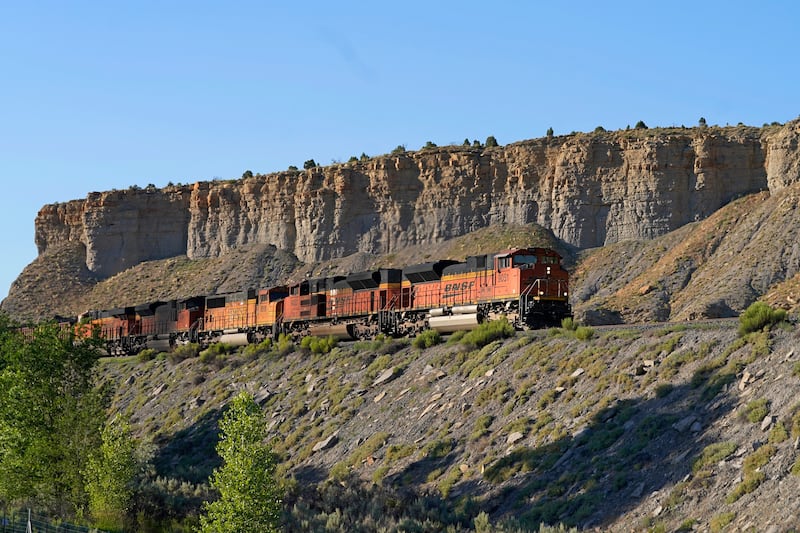
With a unanimous 8-0 decision (Justice Neil Gorsuch recused himself), the court ruled in Seven County Infrastructure Coalition v. Eagle County that NEPA reviews are not responsible to assess all downstream effects — or broader issues at play on a regional, national or international scale — of a project.
The D.C. District that prevented the railroad expansion from moving forward found that the NEPA review conducted did not substantially take into consideration all of the environmental impacts of not only the railroad — such as wildfires and water pollution — but also those that the natural resources might have after they were transported.
After hearing arguments, the justices of the highest court in the land all agreed that this overstepped the intentions and scope of NEPA.
“NEPA is a procedural cross-check, not a substantive roadblock,” wrote Justice Brett Kavanaugh in the court’s opinion. “The goal of the law is to inform agency decisionmaking, not to paralyze it.”
With the adamant decision, the courts limited what can be included in an environmental review. The focus of NEPA reviews, going forward, must be the immediate affects of the reviewed project and not any broad environmental concerns that surround it.
“Fewer projects make it to the finish line,” Kavanaugh wrote. “Indeed, fewer projects make it to the starting line.”
As a result of this case, there is room — for good or for ill — for more projects to start and finish.
Staffing and struggles at national parks

On Feb. 14, the Department of Government Efficiency made its first staffing cuts to the National Park Service. Approximately 1,000 people were let go on what’s been referred to as the NPS “Valentine’s Day massacre.”
As a cost-cutting measure, hiring for the parks service was frozen, probationary employees were let go and only a percentage of seasonal employees were brought on for the busy summer season. Year over year, the National Park Conservation Association found that the National Park Service was operating with 24% fewer staff than it was in 2024.
In the midst of the reduction in staff, Secretary of the Interior Doug Burgum issued secretarial order 3426, “Ensuring National Parks Are Open and Accessible,“ in April.
The parks were directed to stay open and ensure that all guest-facing operations were prioritized over other responsibilities of the NPS — such as preservation for future generations. That order also required secretarial approval prior to closure, so the parks were forced to make do.
The ensuing discomfort and struggle for National Park employees was heavily covered by local and national media outlets. Some former park superintendents lamented that the NPS had already been in a staffing and budgetary crisis for years prior to 2025.
All of this transpired before the federal government shut down in the fall, leaving the parks themselves understaffed and open, and their employees without pay, for 43 days. It was widely reported that it was a difficult year for the nation’s national park employees.
Putting public lands up for sale
During this summer’s budget reconciliation process, proposals were made by both the House Committee on Natural Resources and the Senate Committee on Energy and Natural Resources to sell public lands as a means to address the federal deficit.
The mere suggestion kicked off quite a fracas, with negative responses pouring in from Republicans and Democrats alike. That was true especially after The Wilderness Society, a conservation advocacy group, published a map detailing what public lands would fit the criteria for nomination for sale set out by the office of Sen. Mike Lee, R-Utah.
By The Wilderness Society’s reckoning, the senator’s parameters could include more than 250 million acres. That fact was misinterpreted across social media — Lee was not trying to sell 250 million acres of land; rather, he was creating a pathway for some 3 million acres to become available for sale — and helped create a groundswell of negative attention.

Following the public backlash, it was Senate procedure that forced the public land sales proposal to be withdrawn. The Senate parliamentarian ruled that land sales were a matter of policy rather than the budget and Lee pulled it from the bill.
Though much of the accusations are leveled at Lee, his colleagues in the House had included public land sales in their proposals, too.
Utah Rep. Celeste Maloy and Rep. Mark Amodei of Nevada, both Republicans, proposed an amendment to the bill that added the sale of some 500,000 acres of public land in Utah and Nevada.
Prior to that also being withdrawn, the committee chairman, Rep. Bruce Westerman, R-Ark., supported the measure. He understood it to be a necessary business for the federal and state governments to support their local municipalities’ needs.
“We’re not talking about selling off vast swaths of national parks or forest service or anything like that,” Westerman said. “Without land sales from the federal government, you can’t build or let communities expand or meet (their) needs.”
Once the measures were removed, Benji Backer, conservative conservationist author and member of Turning Point USA, seemed to speak for many who opposed the sale of public land: “Victory,” he wrote on X.
“Beyond proud of what we all did,” Backer wrote. “This moment showed us that conservation of our environment is an American value, not a partisan one.”
The ‘One Big Beautiful Bill’

Though the public land sales brouhaha took center stage during the reconciliation debates, the final bill — dubbed the “One Big Beautiful Bill” — is perhaps the larger public lands story due to the range and scale of its actual impacts on American public lands.
The most notable provision mandated a return to quarterly lease sales for oil and gas drilling in nine states. That provision also stipulated that 50% of all land nominated for lease needed to be made available within three months, and the remainder put up for sale within 18 months.
The lease sales are what Aaron Johnson, vice president at Western Energy Alliance, a trade organization representing oil and gas companies across nine western states, said was a “return to regular order.”
The bill also created a way for companies to pay for expedited NEPA reviews, expanded the scope of what lands could be nominated for drilling lease sale and also gave tax and royalty reductions to energy companies.
“The one big beautiful bill helps the Department of Interior return to regular order when it comes to federal oil and natural gas leasing,” said a spokesperson for Lee earlier this year.
Whether or not these provisions ultimately affect the national deficit is yet to be seen. For now, however, their impacts on public lands have already started. At least two lease sales have already been conducted and we’ll see at least four more — by mandate — in the coming 12 months.
Rolling back regulations
To address the regulatory burden imposed by the federal government, the Trump administration announced that it will be overturning two major public lands rules.
The first was announced in June by Brooke Rollins, the secretary of Agriculture. She said the USDA would be repealing the 2001 Roadless Rule, a policy that prevents roads from being built through 44.7 million acres of U.S. Forest Service land.

The rule was implemented to protect a few totally wild ecosystems and watersheds and ensured some of the country is protected from development. Though the roadless areas are a large percentage of the Forest Service’s lands — some 30% — they represent 2% of America’s total holdings.
The rule has widespread support across the country, but the current administration argued that leaving things alone is not the same thing as management.
In a conversation with Deseret News this summer, Tom Schultz, chief of the U.S. Forest Service, said, “This notion of, ‘if I want to protect something, I leave it alone,’ that’s a fallacy. That’s a false narrative.”
The rule is currently under review following a public comment period, but a decision is expected by March, with a new rule established by the end of 2026.
The other regulation under review and likely to be overturned is commonly referred to as “the public lands rule.”
This rule establishes “conservation” as one of the multiple uses allowed on public lands and most specifically on those of the Bureau of Land Management.
Prior to its implementation under the Biden administration, “multiple use” referred to — as Deseret News reported in November — three broad and nonexhaustive categories: extractive, scientific and recreational. Conservation was a whole other category of use that was by its very nature exclusionary.
Though this rule does not have a massive impact on management in the day-to-day work of the land agencies, getting rid of it is an indication of the sea change of this year. Rolling back regulations and removing protections that may hamper multiple use was part and parcel of 2025’s public land stories.
Other honorable mentions

A wide variety of public lands stories surfaced or stayed relevant this year, each with champions and specific pressure points. Some are acute matters for large segments of the American population, even if they make for somewhat droll reading. Most of them have been ongoing in some form or another for a long time.
Here are several honorable mentions:
- In a push for some version of “all of the above” energy production, nuclear energy projects in Utah and Wyoming were spurred onward as the country took a decidedly pro-energy production stance with the new presidential administration.
- Droughts still linger across much of the West and Southwest and the Colorado River continues to be in crisis, without resolution.
- There was a genuine attempt to rekindle America’s coal production, but the private sector’s interest appears to be waning for now.
- Wildfires — a natural and healthy part of Western landscapes — were national stories again this year, with massive fires engulfing Los Angeles and the Grand Canyon.