

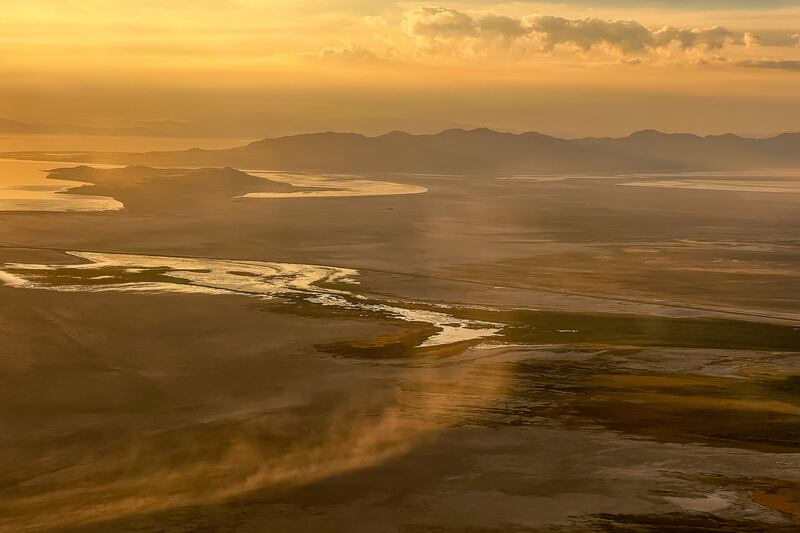
The shores of the Great Salt Lake, the largest saltwater lake in the Western Hemisphere, have been receding for several decades, but Utah Gov. Spencer Cox seems determined to fill it back up.
In 1986, the state’s iconic lake covered about 2,300 square miles, and today its average is 1,700.
But by the 2034 Winter Olympic Games, which are set to take place in Utah, “the Great Salt Lake will be full,” Cox promised at the end of January.
It’s a promise that will require no small effort.
To pull the lake out of its currently-labeled “serious adverse effects” status, Great Salt Lake Commissioner Brian Steed said the state will need to add 261 billion gallons of water (800,000 acre-feet).
The lake’s current crisis was largely brought on by municipal and industrial water use, which pulls water from reservoirs and rivers before it can reach the lake. Smaller contributing factors include warmer average temperatures, which increase the rate of evaporation, and the state’s low total rainfall.
This year, the governor’s determination mirrors many lawmakers in Utah’s Legislature.

Bills from Utah’s 2026 session attack the shrinkage from many fronts
Utah lawmakers have spent more time discussing and analyzing the Great Salt Lake than any other issue in recent years, Senate President Stuart Adams, R-Layton, said recently.
Here are three bills from the 2026 session aimed at stopping the shrinkage of Great Salt Lake:
- Requiring data centers to report water use (HB76).
- Rep. Jill Koford, R-Ogden, sponsored this bill, which would require data centers to report their water usage or face a daily $10,000 penalty until they report.
- Making it easier for farmers to temporarily redirect their water (HB348).
- Koford also sponsored this bill, which creates a “dedicated water application.” Farmers can apply to dedicate part of their water right to storage in Colorado River System reservoirs, sovereign lands or instream flow.
- Increasing the price of watering lawns (HB155).
- Rep. Doug Owens, D-Millcreek, sponsored a water rights amendment bill, which would increase the rate for additional water used, in order “to provide a clear price signal or financial incentive” for the water-buyer “to consider reducing” their water use.
- Diverting $200 million of funding to the Great Salt Lake (SB250).
- Sen. Nate Blouin, D-Salt Lake City, sponsored a bill that would reallocate $200 million from the Bear River Development (BRD) to the Great Salt Lake. Utah’s Legislature initiated the BRD in the early ‘90s to help provide municipal water to the Wasatch Front.

Utah may redirect US Magnesium’s water rights to the lake
After a Salt Lake City-based mining company, US Magnesium, declared bankruptcy last September, Utah won a $30 million bid for their land, water rights and mining agreements.
US Magnesium, the largest magnesium producer in the country, owned 4,500 acres of Great Salt Lake’s southwest shore, and in 2024, they pumped more than 52,000 acre-feet of lake brine and groundwater.
Although the Legislature has not confirmed it yet, Utah will likely keep the nearly 17 billion gallons of water in the lake, as part of their efforts to halt its decline.
US Magnesium has also been a major contributor to Salt Lake Valley’s pollution, responsible for up to 25% of the chemicals that help form fine particulate pollution in the Wasatch Vally, the Deseret News previously reported.
Utah originally bid $15 million for the company’s land, water rights and mining agreements. The sale closed for $30 million on Thursday.

More dust monitors are needed to accurately assess the risk of dust
The most widespread worry about the shrinking Great Salt Lake is what the exposed lakebed could do to Utahns’ health. Scientists have found arsenic, mercury, PM10, PM25, PFOS and other contaminants in the lakebed that, when breathed in, cause serious health issues.
However, Kevin Perry, a professor of atmospheric sciences at the University of Utah, told the Deseret News, he has not seen “direct evidence that arsenic from the lake is increasing the arsenic concentrations in the surrounding communities.”
Currently, there are only six functioning dust monitors in northern Utah, and Perry said they are in areas that aren’t the most likely to experience dust from the exposed lakebed.
Meanwhile, the areas most likely at risk of the dust are the cities northeast of Farmington Bay, like Syracuse, Layton and Clearfield. None of these areas has a dust monitor.
Cloud seeding technology could bring more snow and rain to Utah
In 2023, Utah’s Legislature approved a one-time $12 million payment and an additional $5 million per year to study and support cloud seeding in the state.
Cloud seeding is a weather modification technique used to increase average precipitation. It disperses silver iodide or salt into clouds, which gives water droplets more to cling to.
Utah’s Division of Water Resources found that cloud seeding in the state has led to an increase in precipitation of 5-15% in seeded areas.
Utah’s cloud seeding program has been “going really well,” Joel Ferry, the executive director of Utah’s Department of Natural Resources, told a natural resources subcommittee at Utah’s Capitol on Jan. 30.
“We’ve been able to swap out all of our ground-based cloud feeders — the generators — with remote generators. So now they’re placed up at high elevations where they’re more effective, instead of just being down in the valley where they can get trapped in the inversion,“ Ferry explained.
During the committee meeting, Rep. Calvin Musselman, R-West Haven, said he was excited about the program. “I think what we’ve been doing is the right direction. It’s augmentation. We’ve constantly been thinking about conservation, and I’m not saying we shouldn’t, but these are the types of programs we need to be concentrating on.
Utah has also invested in a drone-based cloud seeding program in the Bear River Range, in collaboration with Idaho.
The Salt Lake Valley’s inversion is not caused by dust
In January and February, the Salt Lake Valley observes a temperature inversion that traps pollutants near the ground, and while it sometimes looks like it is, it is not dust.
The area provides the perfect combination of factors for an inversion. The valley is flanked by the Oquirrh Mountain Range and the Wasatch Range, letting warm air begin acting like a lid. In these early months, the Salt Lake Valley has long nights and weak sunlight, which prevent the warm and cold air from mixing.
But Perry told the Deseret News that Utah “doesn’t typically get dust when we have an inversion, because there’s no wind.”
“And the lake is typically wet this time of year,” he added.
