



- The winter in the West was the warmest in the 131 years of record keeping.
- Every major river basin is in a snow drought, with the snowpack the lowest in recorded history.
- Researchers and water managers say there isn't reason to panic, but there might be next year.
Through December, January and February, Daniel Swain found himself wearing T-shirts around Boulder, Colorado. The climate and weather scientist for the University of California lives along the Front Range of the Rockies and was struck by the unusually warm winter.
“Wherever I’ve been in the American West in the last few months ... it just hasn’t been cold in a way that you would typically expect for the winter,” he said. “Yes, there have been some individually cold days, but overall it’s been, um well — for lack of a better word — ridiculous how warm it has been, and how conspicuously not cold it has been.”

Not just warm, either. The higher temperatures, which predated the current heat wave the West is experiencing, translated to less snow.
“The amount of snow we’ve gotten in most places is pretty abysmal,” Swain said. In Boulder, “we’ve had a few days of snow this year that I can count, I think, on one hand. This part of the world usually gets 80 inches ... and we’ve gotten maybe 25.”
Boulder’s story is a common one. While some locations in the northern Rockies, like parts of Idaho, western Wyoming and southern Montana, have received snowfall commensurate with a typical year, much of the broader region has received far less.
As of mid-March, Denver received less snow than the 30 inches or so that fell in Columbus, Ohio. Park City, Utah, which averages around 300 inches a winter, has only received 158 so far. Salt Lake City is having one of its least snowy winters ever with almost no accumulation to speak of.
Some areas still had regular precipitation that fell as rain — much of California, for example — but others had dry winters, too. Overall, however, whatever moisture did fall on much of the Intermountain West, simply did not stick.
What is the snowpack?

Without snow, the West is left without a snowpack. That’s the term for the mass of compressed snow that accumulates on mountains and higher elevation locations throughout the winter.
Some researchers calculated the amount of water deposited every year in the West’s snowpack to be about 162 million acre feet. Each acre foot — picture the water it would take to fill a space a little smaller than a football field — contains roughly 325,000 gallons of water. The trillions of gallons of water in the snowpack is hard to fathom.
As such, the snowpack is understood by climatologists and water managers as a massive and free-to-operate reservoir that distributes a mind-boggling amount of water to surrounding ecosystems and communities at precisely the time it’s needed. This ideal water storage system melts out in the spring and early summer, right when agriculture needs are acute and folks start watering lawns.
This year, that reservoir is depleted, and is the smallest it has been since records have been kept. According to the National Snow and Ice Data Center, only 34% of average snowfall accumulated in January. In February, it was 38%. At this point, every major water basin in the West is experiencing some form of snow drought.
Of course, there is variation across locations and elevations. Lower and mid-elevations of around 3,000 to 5,000 feet have mostly no snow at all, while higher elevations have maintained more normal levels. But, in Wyoming, 42% of stations that record snow levels — snow-tell stations — are in a drought. In Utah, it’s 74% of stations. In Colorado, it’s 94%. Some regions in Arizona and New Mexico have 1% or less of the snowpack they usually do at this point in the year.
“We’re at the lowest snow covered area in the 26-year MODIS record,” said Bea Gordon, a snow research professor at the Desert Research Institute, referring to the Moderate Resolution Imaging Spectroradiometer satellite sensors operated by NASA that record Earth’s water levels.
“Just tootling around the snow-tell stations, a lot of the snow-tell stations — especially in Colorado, Utah, and Oregon — are really at the lowest recordings that they’ve had.”
What that means for the following months and years is not yet certain. The West could get a lot more precipitation over the coming months, though the notion of a big spring snow dump is unlikely with the timing of this March’s record-breaking heat wave. As it is, the dwindling snowpack will deplete water stockpiles risking next year’s supplies. There’ll be less water for agriculture and there’s a good chance wildfire danger will increase.
Laura Haskell, the drought coordinator for the Utah Division of Water Resources, said that the state gets about 95% of its water from the snowpack. As one of the driest states in the nation, she said, its runoff is what fills reservoirs.
“That is our water source for the year. We are currently — if you take a statewide average — at the record low snowpack of all the years they’ve taken data,“ Haskell said, ”So, that is not good news.”
How will the snowpack impact water managers?

Utah’s water management systems rely on a series of more than 45 reservoirs around the state. While there are rivers and groundwater, the majority of the state’s useable water comes from these liquid stockpiles.
Right now, the reservoirs are — statewide — sitting at about 68% full, which is 4% higher than it usually is this time of year. Snowmelt would normally backfill them, but that is not going to happen this year.
There are big variations between localities, too. Right now there’s enough to cover the majority of the state’s needs for this year but not for any future needs.
To explain the thinking, Haskell describes the reservoir system of water management like a bank account. The reservoirs are the checking or savings account, and the snowpack makes deposits.
“We have water in these reservoirs, like we have a fairly full bank account, but we lost our job by not having the snowpack. If we get another job in the fall (we get a great snowpack), we’ll be doing great,” Haskell said.
“If we go a year or two and can’t get a new job (don’t have a good snowpack), we’re gonna be very concerned.”
The snowpack’s melt generally backfills the reservoirs by about 20% every year. Realistically, the state’s water accounts are not going to get all of that additional water this year, which means Utahns will have to be conservative with water usage.
“We’re not going to get the water that we typically get in the spring, we’re going to be relying on stored water and if we’re not careful with that, we might need to panic later,” Haskell said. “We don’t need to panic now, but we might get to a place of panic if we aren’t careful.”
Are water restrictions coming?

Scott Paxman, CEO and general manager of the Weber Basin Water Conservancy District, said that the bright star of having good precipitation this winter, even if it did not fall as snow, is that soil moisture is up about 110% of what it normally is.
“The water’s not going to sink into the soil nearly as quick as it melts and comes down the streams and rivers,” Paxman said. “It’ll be delivered to our reservoirs very efficiently, which means there’s not going to be a lot of losses.”
That does mean that his district won’t be able to generate the power it usually does from water flowing into its reservoirs, but, more importantly, it is going to need to do a lot more water pumping.
“There’s good groundwater right now,” Paxman said. “It’s oversaturated, if anything, which means there is water to pump, but pumping water means that you’re going to be using a lot more energy as a result.”
That energy costs money, though it won’t get passed to his customers; rather, it will just be a hit to his operation.
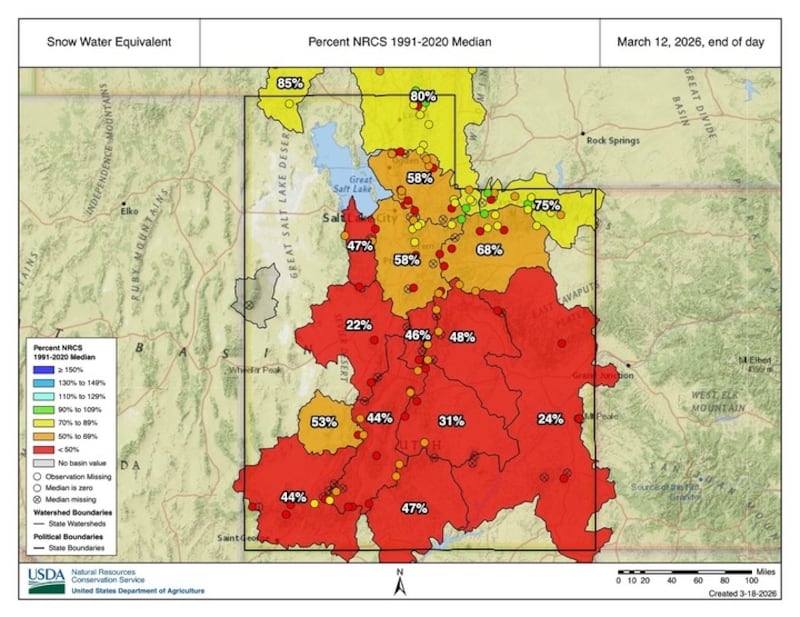
Overall, the reservoirs in his region are sitting at 60% capacity. The largest, Willard Bay, is less than 50%. But the way these systems were designed, Paxman explained, was to create two years worth of water storage so there is time — like Haskell said — before folks need to worry too much.
Weber Basin will be implementing some water restrictions this year.
“We’ll push irrigation — whether it’s secondary irrigation or (agriculture). We’ll push that to May 15th instead of April 15th," Paxman said.
For agricultural needs, he said that managers cut contracts by 20%. If an outfit usually gets one acre-foot of water for the summer, it will get 0.8 of one for this year.
He reminded folks to really pay attention, if they have them, to their water meters this year.
“We just want to make sure that they’re looking, and we do not want to be shutting people off in mid-July because they’ve used all of their water and that will happen,” Paxman said. “We’re going to be very strategic in making sure that people aren’t taking more than their allotment and using it to the best that they can.”
Facing the possibility of more wildfires

In a broad sense, a smaller snowpack might lead to more wildfires as there will be less water distributed over time across the entirety of the West’s ecosystems. Those environments are meant to burn and prone to burn as it is, yet there is no definite way to tell if it means this wildfire season will be more intense than past years.
Still, Gabrielle Boisrame, a research professor in hydrology at the Desert Research Institute, who studies the relationship between the snowpack and wildfire said, “I’m very nervous. It’s a very big problem for agriculture.”
She detailed how the snowpack’s slow release means water is released slowly across the West’s ecological and agricultural ecosystems and can be absorbed at different points in time. When it happens quickly, plants dry out and their presence in hot weather can lead to more fire.
“Even if the plants stay alive — if there’s not as much water in the leaves and they’re water stressed — they can burn a lot more easily," Boisrame said.
Boisrame also said that with lower stream flow and subsequent less robust riparian areas — wetlands adjacent to bodies of water — there’ll be fewer natural firebreaks preventing the spread of fire, too.
Even so, Boisrame is measured in her concern about this one particular snowpack. The West has survived quite a few droughts and low snowpacks.
“We’ve had long droughts before. It was 2012 to 2015 (that) really was bad. (In) 2016, we started to get out of it, and then 2017 was super wet again,” she said. “So there’s been a lot of whiplash the last few decades and there’s really no reason to think that it’s going to stop whiplashing.”
Considering it could rain a lot or there could be big year-to-year weather changes, she does not think that folks should fret over one particularly dry year or one particularly low snowpack.
“In the last 12 years, I think the West has seen both its lowest snow year and its highest snow year on record,” Boisrame said.
As such, she said the water management issue posed by the low snowpack is a more pressing concern. Still, she said, “the wildfire is probably a problem.”
What does this all mean?

Haskell stressed how important it is to be conservative with water this spring and summer. There will be various restrictions, of course, but the stability of the water resources Utah has will come down to how thoughtful folks are about their usage.
“We’re going to draw (our reservoirs) down and we just don’t know what we’re going to get next year,” Haskell said.“ So we really want people to pay attention and be careful because if we have to rely on that next year as well, it’s going to be a worse situation.”
Which is a concern that Swain stressed.
Much of the snowpack averages that are calculated today already account for a significant amount of global warming that has occurred since 1990, Swain said. That is to say, they are not compared to data from earlier last century.
If that were the case, the degree of change — for both temperature warming and snowpack depth — would be 10% to 15% greater than the already record breaking numbers. All of which is to say, this winter is historically significant.
Yet, there is potential for more snow and rain in the coming months. Boisrame also said there is a curious relationship between wildfires and snowpack melt: trees cause the snowpack to melt more quickly and regions of recent fire often hold more snow for longer. It might just be that more wildfires in the West could help mitigate premature snowmelt in years to come. And, of course, next winter might have more precipitation and the snowpack will be larger than historical precedent.
With the snowpack, Swain explained, its relative health has many different implications and most folks’ takeaways are specific to their interests. Yet, he said there’s an overarching concern that people should focus on when looking at this year’s historically low levels.
“Some people think about snowpack only in terms of winter recreation, and that’s one story. Then they think about it in terms of water supply, and obviously that’s a big picture one, or of wildfire and ecology. And that’s yet another broader question,” Swain said.
“Just imagine how weird this year feels, and then imagine what it will feel like when a winter like this one is not weird anymore.”