

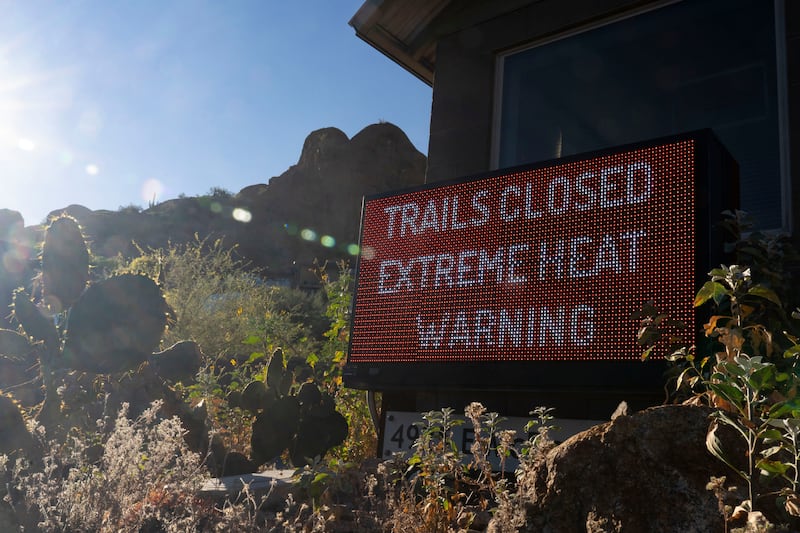

After recording one of its warmest winters since record-keeping began, Utah and much of the West are continuing trends of warmer-than-normal weather.
The heat wave was felt the hardest in the Southwestern region of the U.S. as Arizona and California set the record for the hottest temperature recorded in the country. During the month of March, the two states recorded temperatures of 112 degrees at Martinez Lake, Arizona, and Squaw Lake, California, Yale Climate Connections reported. Many other states also experienced record-setting heat — some areas shattering records by more than 5 degrees.
The historic temperatures aren’t expected to subside until midway through the first week in April, and as the heat dome moves further east, much of the country will be smothered.
“Basically the entire U.S. is going to be hot,” meteorologist Greg Gallina told The Associated Press Monday. “The area of record temperatures is extremely large. That’s the thing that’s really bizarre.”
What areas are most affected?

In Salt Lake City, temperatures hit 84 degrees on March 21, surpassing the previous March record of 80 degrees. Other states have experienced historic heat, including Wyoming, New Mexico, Colorado and Idaho.
Kansas, Nebraska, South Dakota, Missouri, Iowa and Minnesota have also notched their hottest March day on record.
Why are we receiving so much heat?
Heat domes are “high pressure systems way up in the atmosphere that help create and encase heat, kind of like a lid on a pot that holds in steam,” according to The New York Times.
This heat dome has led to a historic heat wave that will likely dwarf previous heat domes in terms of physical area, like in 2012 in the Upper Midwest and Northeast, as well as in 2021 in the Pacific Northwest, the Canadian Broadcasting Corporation reported.
CNN reports that the heat is a result of increasing climate change pushed by “planet-warming pollution. Heat waves are becoming more frequent, more severe and lasting longer as the world warms.”
Research from climate scientists at World Weather Attribution says if it weren’t for human-induced climate change, events like these would be “virtually impossible.”
Why the increase in temperature is troublesome

Not only are heat waves like these problematic for their increasing heat, but they are especially worrisome when they act as a quick one-two punch, leading with extreme heat that causes drought conditions.
Scientists based in Australia and South Korea have researched this exact phenomenon since 1980. When they first started, these high heat and dry extremes only covered about 2.5% of the Earth’s land. In 2023, it was up to 16.7%. Since the study’s last year, these extremes have likely increased, AP reported.
Throughout the study, the rate at which these conditions grew was constantly increasing. In the last 22 years of research, the rate at which the heat-first extremes increased was eight times compared to the previous two decades.
Areas where extreme heat strikes first were the center of the study, because when the heat comes before the drought, the drought is much stronger than if the drought came before or without extreme heat, said Sang-Wook Yeh, a climate scientist at Hanyang University in South Korea. These conditions, when met with wildfire risk, are the most dangerous. The 2021 heat dome is a prime example.
“The Pacific Northwest heat dome illustrates how quickly these compound extremes can escalate — temperatures near 122 degrees in Lytton (British Columbia) were followed by rapid drying and extreme wildfire conditions that destroyed the community,” Andrew Weaver, a climate scientist at the University of Victoria in British Columbia, Canada, said.
What impact will the heat wave have on our water?
Shrinking 20% since 2000, the Colorado River flow has decreased as the West’s population has grown — and more water is needed. Currently, the river’s largest basins, Lake Powell and Lake Mead, are only 25% and 34% full, as the Deseret News reported.
The concern for the river only increases amid the record-breaking heat wave sweeping across the country.
“It’s way too early to be having 80-degree weather and of course, the snowpack is a concern,” Utah Gov. Spencer Cox said during his monthly news conference.
Superblooms and cherry blossoms
On the bright side, March’s high temperatures did bring some early spring color.
Currently, superblooms are meeting their peak in Death Valley. The once-a-decade phenomenon, where the brown desert floor is turned into a field of color, is a reminder that life can exist in the harshest conditions on Earth.
Cherry blossoms in some areas are also in an early bloom. Usually meeting their peak in early to mid-April, Salt Lake City’s cherry trees are already showing their full beauty, likely with a shorter time frame.