

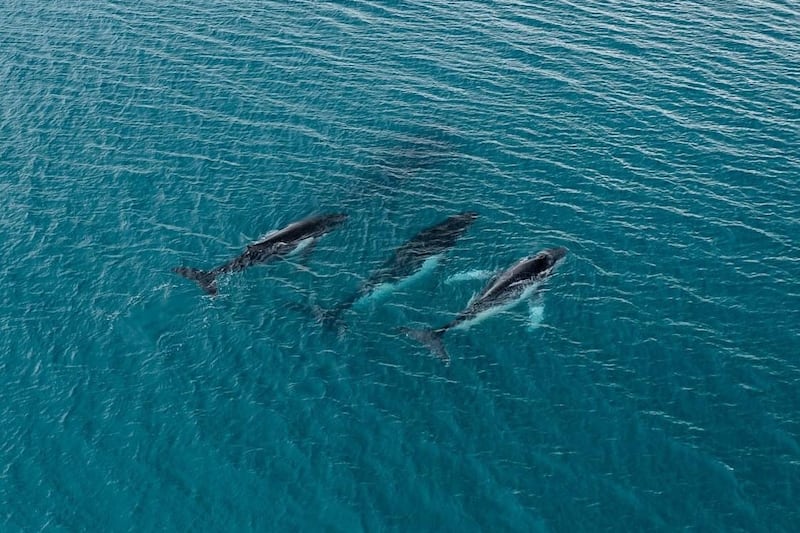

Not one, but two humpback whales made separate record-breaking treks across oceans between Australia and Brazil, reports say.
Traveling in opposite directions, the two humpbacks traveled farther than any other humpback known to man.
“It’s a very rare event, but it is a really wonderful demonstration of just how wide-ranging these animals are,” Phillip Clapham, former head of a NOAA whale research program, told The Associated Press.
Whales often travel large distances between high-latitude feeding areas and tropical mating grounds, sometimes 5,000 miles, according to a NOAA website, so the rough estimate of 9,000 miles by the record-setters is well beyond the norm.
When the whales were sighted
In the report released by Royal Society Open Science Tuesday, which included 40 years of pictures, one whale was spotted near Brazil in 2003 and spotted again in Hervey Bay, Australia, 22 years later in 2025.
The other whale was spotted in Hervey Bay in 2013 and located again in 2019 off the coast of São Paulo.
How the whales were tracked
It is possible the 9,000 miles could be less than the actual distance traveled, since tracking aquatic animals is difficult due to the water blocking radio and GPS signals.
Instead of trackers, recognition software was used to identify the whales based on their unique tails. AP reports the scientists analyzed more than 19,000 whale images from the past four decades taken by research groups and citizen scientists.
Why such a long trip?
Researchers do not know exactly what caused the migration of these whales but say it “challenges” previous assumptions about the aquatic mammal, study co-author Stephanie Stack told AP.
“Finding not one but two individuals that have crossed between Australia and Brazil challenges what we thought we knew about how separate these populations really are,” she said.
Stack also said these migrations are rare, but they matter for the long-term health of the species, as occasional whale migrations can “help maintain genetic diversity across populations.”
She added song styles may even be able to spread to different populations, similar to music styles among humans.
CBS News reports the finding could back up a theory called the “Southern Ocean Exchange,” an idea suggesting whales sometimes migrate to Antarctic feeding grounds but take a different journey home, ending up in a completely different breeding area.
Climate change could also be a factor, and may result in more instances of large distances covered by humpbacks as conditions continue to change, including ice shifts and the distribution of Antarctic krill, the creature’s main prey, Griffith University told CBS.