


In an 1898 obituary of Mary Holmes Dalton, her piercing grief over children lost to early death figured prominently: “Just why, perhaps some day we’ll understand. Those little tots were not permitted to remain long, and one by one as they grew to be a few months old, and just at the time this mother loved them more than life itself, they were taken away.”
“During all this sorrow,” the tribute concluded, “she acknowledged the hand of a kind providence in it all.”
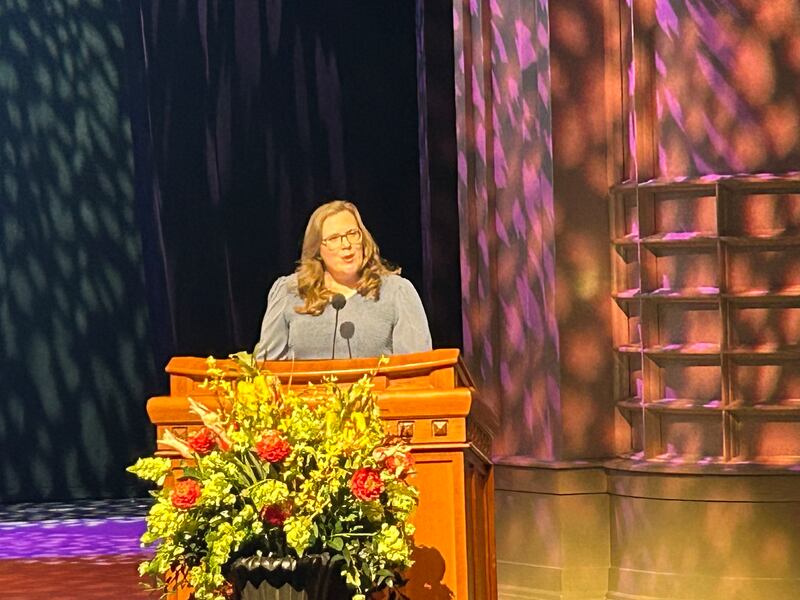
This historical glimpse was shared by Anne Berryhill, associate historian in the Church History Department of The Church of Jesus Christ of Latter-day Saints, as part of a panel discussion entitled, “‘Had witnessed for themselves’: Latter-day Saint women testify of the Savior.” The panel took place Saturday near the close of a two-day conference, “‘I am in your midst’: Jesus Christ at the center of Church History,” held in Salt Lake City and sponsored by the Church History Department.
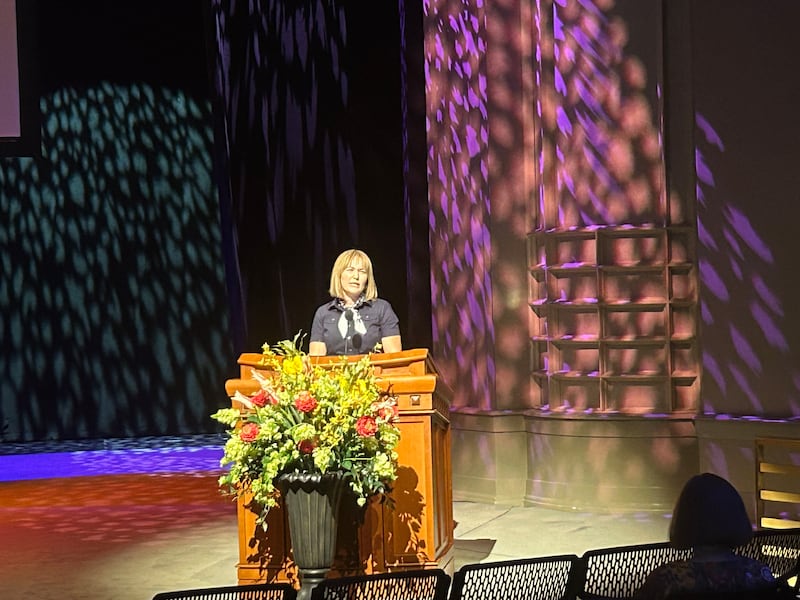
Jennifer Reeder, 19th century women’s history specialist in the Church History Department, also participated along with Rachel Cope, BYU professor of Church History and Doctrine.
“I see history as a work of healing, an opportunity to identify past wounds and the privilege to help overcome the effects of those wounds in the world around us,” Cope said.
She went on to call history “an invitation to remember every soul, indeed, to ask ourselves if we have forgotten the people — ‘the least of these’ — Jesus invited us to remember.”
‘More loving than the most tender mother’
“Faith has been central to the lives of Latter-day Saint women since the beginning of this dispensation,” shared Anne Berryhill. “It not only provided the foundation for personal beliefs, but was a motivating force behind their actions.”
Born to a multiracial family in the south at the height of hostility to free blacks, Eleanor Georgina Reed Jones was baptized in 1844 and became a devoted Latter-day Saint, being endowed in Salt Lake City in 1869.
Berryhill recounted how this woman donated to the construction of the Salt Lake Temple, and performed temple work for family members — citing Jones’ conviction that prayer was the “foundation rock of every Christian’s life.”
“It is well for you to remember while traveling on this journey of life that there is no prison so dark, no pit so deep, no expanse so broad that the Spirit of God cannot enter,” Jones wrote. “And when all other privileges are denied us, we can pray and God will hear us.”
“Although your prayers may be like the wailings of the most feeble infant, God being more loving than the most tender mother will hear and answer you.”
Berryhill cited historian Amy Easton Flake as observing that lay early Latter-day Saint women “were not simply repeating the exegesis of their church leaders, but instead, were using scripture to address their own needs and situations, to affirm life decisions (and) to gain comfort.”
Berryhill said this is illustrated pervasively in the discourses of Eliza R. Snow (whom fellow panelist Jennifer Reeder called “my friend Eliza R. Snow”). Snow taught, “Our religion is not a fable. It is a reality. And if we live so as to have the Spirit of God in our hearts, no matter what we are called to pass through, God is with us, to comfort and strengthen us.”
“Did he ever leave us when we went with relying confidence to him for his aid and assistance in any trouble, whatever?” Mary Ellen Kimball similarly wrote in 1891 about the Savior. “No never. To this I can testify, and so can many others that are living today, besides those who have gone home to rest in heaven.”
‘The work of remembering’
Historian Rachel Cope described a moment of clarity that drew her to study history in college, when she resolved that “I would engage in the work of remembering.”
Early in her historical training, the more limited presence of women’s voices in sacred history and scripture, she said, caused her to wonder: “Did women really matter? Did God see women and value women as much as he saw and valued men?”
These questions which “pierced” her heart and mind at the time, Cope concluded, “mattered to a fractured world filled with hurt people, and they mattered to God.”
“Historical absence is not a divine mandate. It is a mortal flaw,” she stated, speaking now from her perspective as a BYU professor. She explained how stories that often get featured in history “reflect societal values, perspectives and understandings of the world, of the time and place of those who produce the history.”
As a new historian, Cope “began to consider the impact of forgetting as well as remembering on the historical narrative” — recognizing that so much of human history had been “forgotten, overlooked, ignored or undervalued.”
As a result, Cope said, many have concluded false ideas of inferiority or insignificance, even to the point of creating “rifts of misunderstanding between God and His children.”
“For me, being a historian has become a more sacred work,” Cope said, describing it as “a work of hallowed remembrance, a form of discipleship, an invitation to value humanity in deeper and broader ways, an opportunity to consider whole persons — physical and spiritual — a reminder that every story matters and that every human counts.”
‘An urgent search for the divine’
As Cope began to dig into the histories of early believers, she was initially concerned that she “would discover a dearth of primary source material by or about women.” But combing through archives and repositories led to “a wealth of information” contained in journals, diaries, correspondence, scrapbooks, narratives, periodical literature and church records, that were “overflowing with female voices, thoughts, feelings, visions, dreams, theological ruminations, conversion narratives, hopes, fears and divine encounters.”
She called women’s voices “abundantly present” in these records, albeit sometimes requiring more creativity to find them.
Cope cited historian Gerda Lerner as describing a “depth and urgency of the search of Jewish and Christian women for connection to the divine. That was the same depth and urgency of spiritual seeking that, she said, “seeped from the pages I read.”
“It filled pages and pages of diaries. It extended year after year after year. Relationship with the divine was an ever present theme in the lives of women.” Conversion was a “work of restoration” for these women, she added, “restoring the self, restoring relationship with the divine, restoring relationship with others.”
“They shaped and were shaped by religion,” she said, citing Harvard scholar Ann Braude, as stating, “Women’s history is American religious history.”
‘Doing something extraordinary’
Jennifer Reeder concluded the panel, saying: “Latter-day Saint women preached since the beginning, from Sarah Leavitt, who had fire in her bones and preached the word in local pubs, to Lucy Mack Smith, addressing people on her steamboat in the frozen Lake Erie to raise their faith and prayers to Heaven, to Elizabeth Ann Whitney (who) immediately rose and sang in tongues in the Kirtland Temple, each one expounding and exhorting in their own ways.”
It was Joseph Smith, she noted, who taught in 1842 “the organization of the Church of Christ was never perfect or complete or whole until the women were organized with the express purpose to relieve the poor and save souls.”
At the first meeting of the Relief Society, Emma Smith said, “We are going to do something extraordinary.”
As Emma subsequently expounded scripture, Reeder said, “she opened the door for future women to expound scriptures. This was the beginning of better days for sister scriptorians who speak up and speak out.”
After everyone present arose and spoke in an early Relief Society meeting, Eliza R. Snow writes in the minutes that, “the Spirit of the Lord like a purifying stream refreshed every heart.”
“Oh, how I wish every Relief Society meeting could be like that,” Reeder reflected with a smile.
At another meeting, Lucy Mack Smith said: “We must cherish one another, watch over one another, comfort one another, and gain instruction that we may all sit down in heaven together.”
For these early Latter-day Saint women, Berryhill summarized, faith “addressed their needs. It affirmed life decisions. It provided them comfort and … empowered them to do all that was required, to be alone, to keep showing up, to mother, to lose, to grieve and to testify.”
Later Relief Society President Eliza R. Snow said, “If you find any that is weak in the faith, try and comfort them and strengthen them … if you find a sister feeling cold, take her to your bosom heart, as you would a child to your bosom and warm it up.”
“If we have each a little of the right spirit and come together, it is like putting coals of fire together,” she continued. “When they are separate, they cannot burn and soon go out. But when they are put together, soon burst out in a blaze.”