

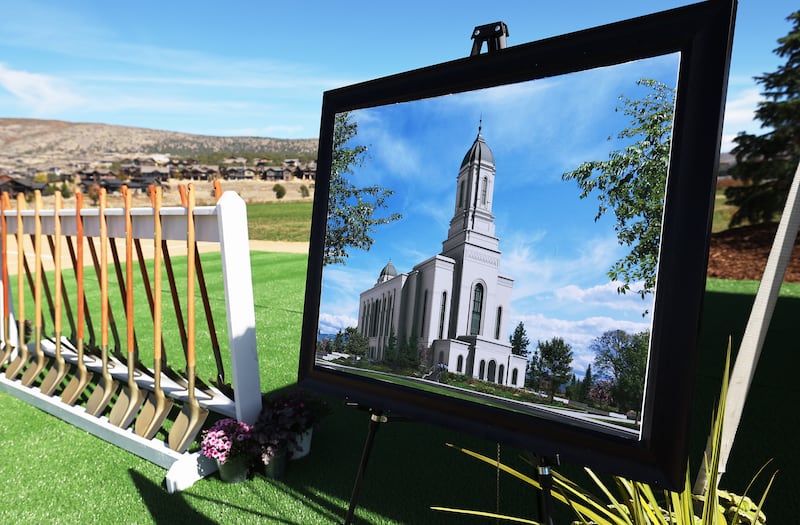

The Church of Jesus Christ of Latter-day Saints asked the Utah Supreme Court on Monday to lift the injunction that halted construction of the Heber Valley Utah Temple while four men appeal the dismissal of their lawsuit seeking to stop it permanently.
If the court refuses to lift the injunction during the appeal, the attorney representing the church asked the justices to increase the bond the men posted to protect the church during the appeal from $10,000 to at least $7.5 million.
That would cover the likely increase in the cost of construction supplies if work was halted for 12 months, said David Jordan, the attorney who represented the church.
Jordan told the court during oral arguments Monday afternoon that an 18-month delay is estimated to cost the church $11.4 million. He asked for a ruling instituting a bond for that amount if the appeal runs that long and the church prevails.
The church began construction in late August, a month after a district judge gutted a lawsuit by four men seeking to overturn the approval of the temple’s location by the Wasatch County Council.
The men appealed their case to the Utah Supreme Court in September. Days later, the same district court judge who had ruled against them last summer granted the men an injunction to stop the temple’s construction while the Supreme Court considers the appeal.
That could take a year or more. The appeal is still in its earliest stages. Neither side has filed briefs, and it is expected that oral arguments won’t be scheduled for months.
“It’s some months down the road before all the briefing is done,” Jordan said. “We anticipate a decision from this court on the ruling regarding the injunction much sooner.”
Jordan told the Supreme Court justices that the church is confident it will win the appeal. He said the church is willing to assume all risks that might happen if it continues construction and the court eventually rules for the four men — Bruce Van Dusen, Bruce Quade, Shawn Savarinos and Dominic Savarinos.
That includes the possibility the church would have to demolish the temple if the Supreme Court eventually ruled against it, Jordan told the justices.
Of course, if it lost, the church first would seek to correct whatever flaws the Supreme Court might find in Wasatch County’s process or the church’s proposal to the council to build the temple, Jordan said.
An attorney representing Wasatch County sat with the church’s attorneys at their table during Monday’s hearing.
Chief Justice Matthew Durrant and Justice Jill Pohlman have recused themselves from the case. They were replaced by Utah Court of Appeals Judge David Mortensen and Second District Judge Camille Neider.
Justice Paige Petersen acted as chief justice. She was joined by Justice Diana Hagen and new Justice John Nielsen on his first day of oral arguments.
All five each asked questions of both Jordan and Robert Mansfield, who represented the four petitioners.
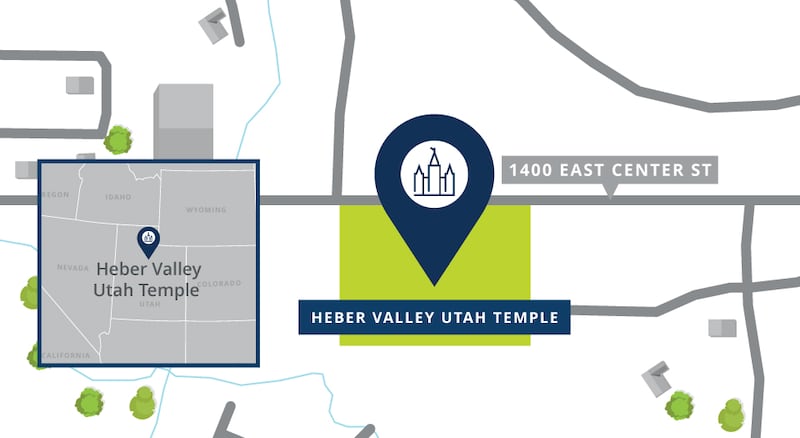
Many of the questions were technical, about whether the Supreme Court should use Rule 8 or Rule 62 of the state’s rules of civil procedure to determine whether Third District Court Judge Jennifer Mabey correctly issued the injunction against construction.
Many of the justices wanted to know if they needed to remand the case back to Mabey if they ruled in the church’s favor on the injunction or if they could rule on their own.
“The court wanted to consider what would be the appropriate standard of review in this case and what elements should be used in order to determine whether the trial court’s decision was or was not correct,” Mansfield told the Deseret News.
Mansfield asked the justices to uphold Mabey’s injunction and reject the request for a larger bond.
He said after the hearing that the case includes a number of novel legal questions the Supreme Court has not considered or decided.
“These are issues that have not been presented to the Supreme Court previously, and so these are factors that they’re going to have to weigh in on and let us know what those standards are,” Mansfield said.
“There’s a lot of issues of first impression in this whole case,” he added, “and I think that’s primarily the reason why the Utah Supreme Court retained jurisdiction of this case. They want to opine on those factors.”
One justice asked if the four petitioner’s would meet the larger bond if it were imposed. Mansfield said he would have to confer with his clients if that happened.
He called it a significant and impractical amount during the hearing, then went farther outside the court chambers.
“Candidly,” Mansfield said, “that would likely be an overly restrictive number that, from a practical point of view, just may not be feasible, but we’ll have to wait and see what the court says and what they do.”
Fewer than 25 people attended the hearing, including the petitioners and church representatives. The justices sat in tall leather chairs in front of the 19-foot-tall mural “Capitol Reef.”
Mansfield and Jordan separately made their arguments at a podium between the attorneys’ tables.
Mansfield said allowing construction to continue jeopardized the water table. He said the site is a flood plain and that the church would redirect 1 million gallons of water a day during construction. Construction would permanently redirect 750,000 gallons a day once the temple is complete.
Jordan said Wasatch County considered the environmental impact and approved the plan. Mabey found in her July ruling that the county council’s decision was legal.
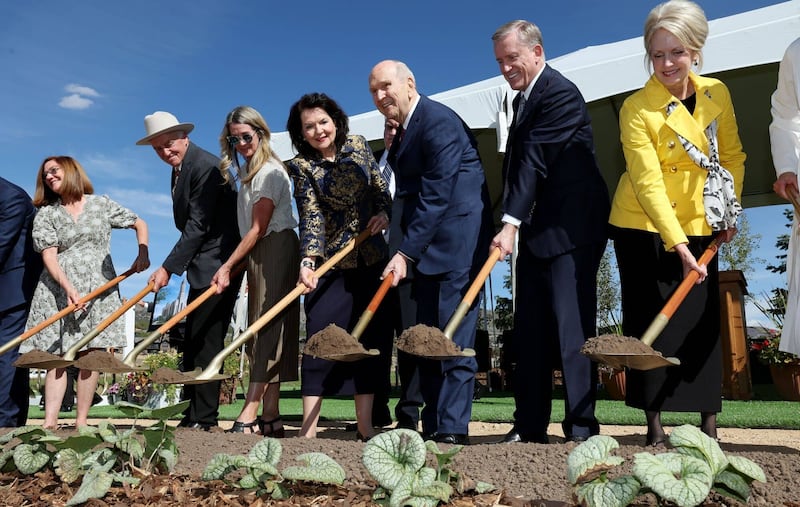
President Russell M. Nelson announced plans to build the temple during the October 2021 general conference. The First Presidency announced the temple’s location in September 2022.
Protesters picketed across the street when President Nelson dedicated the site at a groundbreaking ceremony in October 2022.
“We pray that the construction of this temple may be completed to accommodate thy divine purposes,” he said.
The county council determined the church’s proposal for the temple met its land-use rules and enacted an ordinance for construction in November 2023.
The four men sued Wasatch County, alleging that the county council broke Utah and federal law when it allowed the temple’s construction.
The church said it voluntarily postponed construction at that stage to allow a judge to review the lawsuit.
Save Wasatch Back Dark Skies attempted to reverse the Wasatch County Council’s unanimous approval of the temple by adding a referendum to the 2024 general election ballot. The effort required 3,235 signatures but fell 25% short of that number.
In a hearing on June 2 this year, Wasatch County argued the men didn’t have standing to sue, but Mabey ruled the following month that they did.
It was the only argument the men won. Mabey ruled for the county on every other issue, clearing the way for construction, pending appeals.
The temple project combines two lots for a total of 18.17 acres. Plans call for a footprint of 26,089 square feet. The proposed temple would have three floors, for a total of 87,626 square feet.