
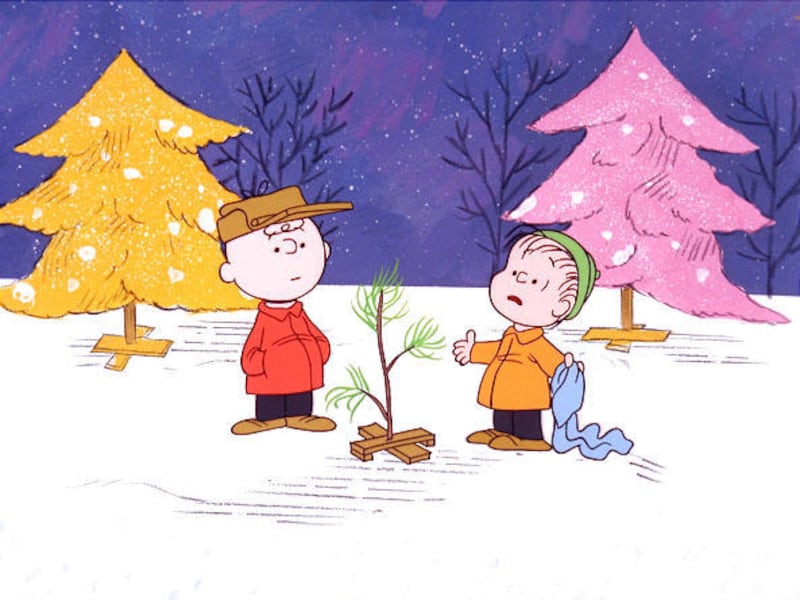

When CBS executives viewed a completed cut of “A Charlie Brown Christmas” in 1965 — 10 days before it was scheduled to air for the first time — they were horrified.
“They hated it,” producer Lee Mendelson recalled in a 2003 interview with the Archive of American Television. “The two top people just hated it. They said, it’s too slow and it’s very religious … and it’s not particularly funny.”
At the time, the show’s producers even agreed.
“I was just devastated,” Mendelson said, “because I didn’t think it was that good either.”
“We all thought we had ruined Peanuts,” the producer admitted — remembering the moment in a 2015 speech. “We were in great despair.”

Commissioned by Coca-Cola, the animated special had come together on a shoestring budget over a short period of six months. Executives worried the show was slow and crudely animated. They worried about the real-life children’s voices, especially without a laugh track common in TV comedies at the time. And they chafed at Vince Guaraldi’s score that mixed Christmas music, Beethoven and jazz, which they thought didn’t belong in a cartoon.
The Linus Nativity
But the real sticking point came from the narrative arc of the show, which began with the titular character Charlie Brown announcing early in the program, “Christmas is coming, but I’m not happy. I don’t feel the way I’m supposed to feel.”
Amid bickering and personal letdowns, Charlie Brown later laments, “I guess I don’t really know what Christmas is all about. Isn’t there anyone who knows what Christmas is all about?”
“Sure, Charlie Brown, I can tell you what Christmas is all about,” responds Linus.
And here’s where it got unsettling for producers and executives alike.
Linus walks into a spotlight in the middle of the school auditorium and begins: “And there were in the same country shepherds abiding in the field, keeping watch over their flock by night. And, lo, the angel of the Lord came upon them, and the glory of the Lord shone round about them: and they were sore afraid.”
Then, Linus says something that causes him to drop his own security blanket: “And the angel said unto them, Fear not: for, behold, I bring you good tidings of great joy, which shall be to all people. For unto you is born this day in the city of David a Saviour, which is Christ the Lord.”
Without pausing, the recitation from Luke 2:8—14 concludes: “And this shall be a sign unto you; Ye shall find the babe wrapped in swaddling clothes, lying in a manger. And suddenly there was with the angel a multitude of the heavenly host praising God, and saying, Glory to God in the highest, and on earth peace, good will toward men.”
“That’s what Christmas is all about, Charlie Brown.”
What stood out about this scene for Andrew Stanton, who directed the Pixar film “Finding Nemo,” was how the animators “stopped everything: just a single spotlight on a kid standing on stage, saying this long passage. It was very moving because of the stillness, because of everything stopping for the simplicity to it.”
‘You can’t put the Bible on television’
Charles Schulz had been sketching Peanuts for 15 years prior to agreeing to Coca-Cola’s pitch for a CBS Christmas special. But there were “certain parameters” the cartoonist laid down up front.
“If we’re doing this show,” Mendelson recalled Schulz saying, “I’m going to add some meaning to it. I don’t want it just to be something funny.”
“If we’re going to do this, we should talk about what Christmas is all about, not just do a cartoon with no particular point of view,” the cartoonist said, according to another interview with Mendelson.
Schulz wanted to emphasize “the true meaning of Christmas,” telling his team, “I think we’ve lost that.”
“(Director) Bill (Melendez) and I just looked at each other,” Mendelson said about his interactions with the other producer in a 2010 Time Magazine interview. “We weren’t so sure it was a good idea.”
When they asked Schulz more about how exactly they were going to add meaning to the Christmas special, Schulz responded, “well, I think one of the kids could read from the Bible.”
Schulz, who died in 2000, remembered saying, “You know, the more we think about it, we cannot do this show without including the famous passage from St. Luke.”
Schulz later called the reading of Luke “the key” to the special and “the highlight of the show.”
But at the time, Mendelson felt uncomfortable, “Bill and I looked at each other and said, ‘Uh oh, that doesn’t sound very good.” He recalled thinking, “there goes our career right down the drain.”
“Are you sure you want to do that?” they pressed. “You can’t put the Bible on television,” Jean Schulz, Charles Schulz’s wife, remembered Melendez saying.
“This is religion,” Mendelson told Schulz. “It just doesn’t go in a cartoon,” according to comments made in Charles Solomon’s 2012 book on Peanuts.
Moving forward anyway
Even Schulz would later acknowledge, “no one would ever put biblical passages in an animated show.” Doing so on prime-time TV — especially in a children’s cartoon — was virtually unheard of.
But at the time, Schulz was unmoved, saying, “if we don’t do the true meaning of Christmas, why bother?”
Even with all these objections from the creative team and CBS, it was too late to turn back. The show had already been widely promoted.
Mendelson described the “head guy” at CBS saying, “well we’re going to have to run it, it’s scheduled.”
“They had to run it anyway, because they had booked the airtime,” Jean Schulz told Yahoo Entertainment. Even with all their objections, she said “they thought, ‘Oh well, we’ll just let it go.’”
A speechless magazine critic
Schulz stood alone in his optimism, with a few exceptions. Time Magazine TV critic Richard Burgheim asked to see the show before it aired, Mendelson recalled in a 2010 interview. CBS executives told him they had “better not let him see it.”
They relented, and Mendelson sat in a viewing room alone with the magazine critic.
“He watches and he doesn’t say a word, doesn’t take any notes, gets up and leaves,” the producer recollected. “I said, ‘Oh my … we’re dead.’”
The week of the show’s airing, Time Magazine published Burgheim’s positive review, which is believed to have made an impact on the public response.

A surprising response
When the special aired on Dec. 9, 1965, few could have predicted what would happen. Fifteen million people — an estimated 45% of all possible viewers — tuned into the premiere. It finished second in national ratings that week after “Bonanza,” the biggest show on television.
The show would eventually win an Emmy for Outstanding Children’s Program that year, and subsequently a Peabody award.
Here are some direct quotes from period critics around the time it first aired:
- “Delightfully novel and amusing.” — The Washington Post
- “A breath of fresh air.” — Chicago Tribune
- “A special that really is special.” — Time Magazine
Coca-Cola was delighted with the special and renewed immediately. CBS acknowledged the response was overwhelmingly positive, and admitted they had misjudged the special.
Yet, when one of the CBS executives who hadn’t liked the show called to tell Mendelson they were going to buy four or five more Charlie Brown shows, he added, “I wanted you to know that my aunt in New Jersey didn’t like it either.”
‘What Christmas is all about’
Schulz grew up in a Christian home with parents committed to the Lutheran faith. He was quiet, earnest and introverted as a child, and described deep reading of the Bible at an early age, later saying: “I thought God was very real and very close.”
“He just loved the Bible, and thought there were just marvelous things in the Bible that were true,” Jean Schulz said years after the cartoonist died.
The cartoonist’s faith evolved and shifted as he aged. But Mendelson remembers Schulz during story development discussions stating, “We cannot avoid the religious nature of Christmas.”
In a 1997 interview with Gary Groth, Schulz reflected on the earlier controversy. “I didn’t think there was anything wrong with reading from the Bible. It’s the basis of the holiday.”
Schulz explained why he saw the scripture as essential.
“I wanted Charlie Brown to feel the way I feel about Christmas,” he said. “I wanted him to understand what Christmas is all about.”
‘Best thing I ever wrote’
Charles Schulz died Feb. 12, 2000, the day before his last Sunday comic strip was published. Later that year, an interview about his faith was published in Charles M. Schulz: Conversations, where Schulz spoke candidly about his complex views on faith. While noting that he felt deeply about God and spirituality, Schulz also spoke with humility about the limitations of answers he had.
Charlie Brown reflected some of the cartoonist’s own uncertainty and existential melancholy, while the character Linus represented his own early, childlike faith. Lucy also voiced a more rigid and dogmatic religious voice, and was modeled after Schulz’s own assertive, first wife, Joyce Doty.
Even when Schulz’s own faith became more uncertain, he never regretted the Christmas special, which was the most explicitly Christian moment in all of “Peanuts.”
When asked about the Christmas special in an interview in the 1990s, Schulz said, “I think it’s the best thing I ever wrote.”

“A Charlie Brown Christmas” can be streamed on Apple TV+.