

When you think of patriotic anniversaries and U.S. commemorations, it’s probably the summer months of July (Independence Day), June (Flag Day), or May (Memorial Day) that come to mind — or possibly February (Presidents Day), or November (Veterans Day).
But how about December?
It was in December of 1620 that the Pilgrims landed in New England and — having agreed in the Mayflower Compact to “covenant and combine ourselves together into a civil Body Politick” — established Plymouth Colony, launching America’s audacious experiment in self-government.
More than 150 years later, it was in December of 1773 that the Sons of Liberty, protesting the British Parliament’s imposition of the Townshend Acts and the Tea Act, threw 342 chests of tea into Boston Harbor, setting in motion the series of events that triggered the American Revolutionary War.
Washington’s momentous Decembers
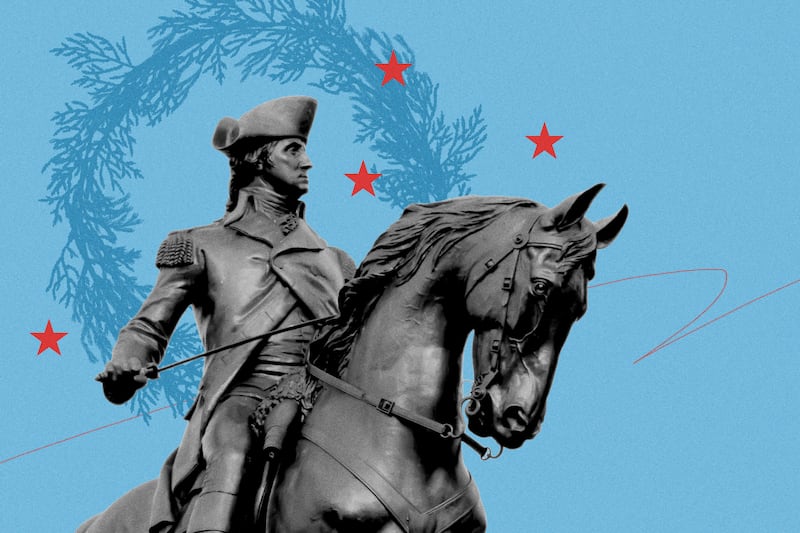
Several sobering years later, it was in December of 1776 that Gen. George Washington, in a bold maneuver of extraordinary logistical and operational complexity, led a column of Continental Army troops across the ice-choked Delaware River. That daring crossing enabled the overmatched American troops to win surprise victories at Trenton and Princeton, giving an urgently needed boost to patriot morale and keeping the Revolution alive.
It was in December of 1777, a year later, that Washington led the underfed, underfunded, undersupplied, long-suffering troops of the ragtag Continental Army — held together at that point only by the general’s strength of character and the soldiers’ trust in him — into their winter encampment in Valley Forge, the crucible of the Revolution.
Then, in December of 1783, Washington — having persevered through eight long, lonely, perilous years of fighting to win America’s independence against all odds — resigned as commander in chief, returning his commission to the Continental Congress and heading home.
King George had famously said that were Washington to voluntarily give up power, he would be “the greatest man in the world.” He did, and he was.
It was in December 1799 that Washington — having reluctantly returned to public life, first presiding over the Constitutional Convention and then serving as the new nation’s first president — died quietly at home.
What didn’t happen in December, at least during his sixteen combined years of leadership in the Revolutionary War and the presidency, was a relaxing celebration of Christmas at home. For George and Martha Washington, Christmases together at Mount Vernon were festive, joyous and all too few.
Some years they were together, but far from home. That was the case in 1775, when Martha hazarded the arduous journey to the army’s winter encampment in Cambridge, Mass. She did the same in 1779 in Morristown, N.J.; and again in 1781 in Philadelphia.
More often, they spent Christmas far apart.
To the lengthy list of Washington’s exemplary qualities of character, we should add this: homesickness. Throughout his many protracted absences, he yearned to return to Mount Vernon. His longing for home, hearth and Martha was genuine.
What kept him away was his devotion to duty — duty only he could fulfill.
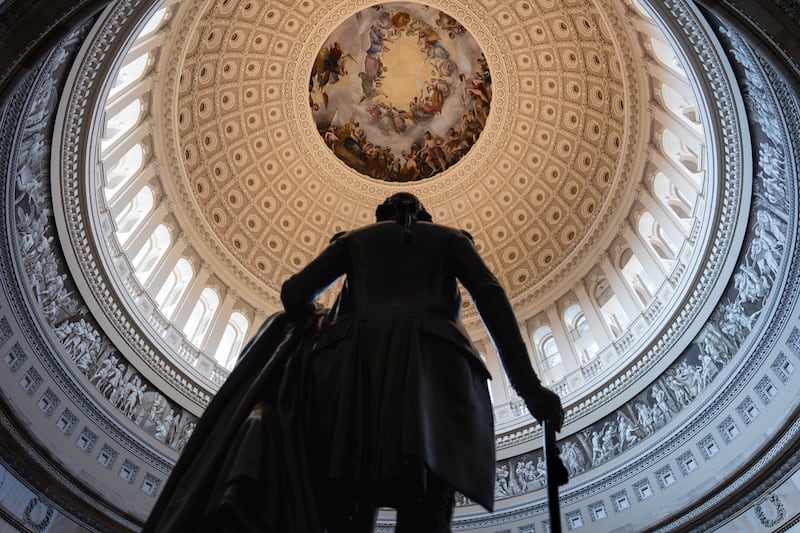
Among our nation’s founders — a constellation of political talent never seen before or since — Washington was the one indispensable man, the Founding Father.

In a nation as bitterly divided by partisan passions as ours is now, it’s hard to imagine anyone winning any office unanimously, let alone the highest office in the land. But Washington did so — four times:
- He was unanimously elected by the Continental Congress as commander in chief of the Continental Army.
- He was unanimously elected by the Constitutional Convention as its president.
- He was unanimously elected as the first president of the United States.
- He was unanimously reelected as president of the United States.
Even more remarkably, he voluntarily relinquished each office and its associated powers, repeatedly returning to life as a private citizen.
“The genius of George Washington,” write Michael and Jana Novak, “was to shape himself to become a man of high integrity and sober reserve, a man of honor and internal fortitude, who could be trusted by all Americans, of all backgrounds. It was as if he knew that he might one day have to be the only man in the whole country of whom it could be said that everybody trusted him.”
Upon Washington’s death, the United States Senate declared: “Let his countrymen … teach their children never to forget that the fruit of his labors and his example are their inheritance.”
No wonder that to the revolutionary generation, he was “first in war, first in peace and first in the hearts of his countrymen.”
Eisenhower’s December witness
Fittingly, it was also in December that Gen. Dwight D. Eisenhower, president-elect of the United States, said in a 1952 address to the board of directors of Freedoms Foundation at Valley Forge: “The great struggle of our times is one of spirit. It is a struggle for the hearts and souls of men — not merely for property, or even merely for power. It is a contest for the beliefs, the conviction, the very innermost soul of the human being.”
Eisenhower’s assertion recalls that of his predecessor John Adams: “What do we mean by the American Revolution? Do we mean the American War? The Revolution was effected before the War commenced. The Revolution was in the minds and hearts of the people — a change in their religious sentiments, of their duties and obligations.”
For the nation to be strong, Eisenhower asserted, its people had to be strong; and “we must be strong first in our spiritual convictions,” because “our form of government is founded on religion.”
The incoming president hastened to clarify that he was endorsing no particular denomination or faith, simply recognizing that the Founding Fathers were trying to translate “a religious concept … into the political world,” namely “the Judeo-Christian concept … that all men are created equal.”
Speaking extemporaneously, he elaborated: “Our ancestors who formed this government said … you remember, that a decent respect for the opinion of mankind impels them to declare the reasons which led to the separation. And this is how they explained those: ‘We hold that all men are endowed by their Creator’ — not by the accident of birth, not by the color of their skins or by anything else, but ‘all men are endowed by their Creator.’”
“In other words, our form of government has no sense unless it is founded in a deeply felt religious faith,” he summed.
“There,” Eisenhower continued, “is the basic doctrine to which we must always cling.”
What were the implications of this? As he explained, first, America’s strength in world leadership relied not on imperialism but “integrity, with a belief in the dignity of man”; second, that what we seek to “pass on to our children and grandchildren” isn’t guaranteed riches, but the guaranteed “opportunity to live in dignified fashion with their God and with their fellow citizens.”
“That,” he added, “is all our government was ever expected to give to each of them.”
In his candid call for faith, Eisenhower was again echoing Adams, who said: “We have no government armed with power capable of contending with human passions unbridled by morality and religion.”
“Avarice, ambition, revenge, or gallantry, would break the strongest cords of our Constitution as a whale goes through a net,” Adams continued. “Our Constitution was made only for a moral and religious people. It is wholly inadequate to the government of any other.”
As the year draws toward its close and we enjoy the festivities of the season, may we also reflect on the blessings of freedom, their ultimate Source, and those Founding Fathers and Mothers who spent many of their Decembers securing them for us.