




From inspiration in the face of terminal illness to acts of heroism during tragedy, the Deseret News documented hundreds of powerful stories in 2025 that highlighted faith, resilience and hope.
The following reviews 11 of these narratives, ranging from the story of a man who “died” and rebuilt his life five years later to how UVU’s president is grieving both personal loss and the murder of Charlie Kirk on her university’s campus.

Cancer limited Caroline Klein’s tomorrows. Here’s what she did about it
The late chief communications officer at Smith Entertainment Group, Caroline Klein recalled being calm the moment she learned she had cancer.
She was sitting next to her boyfriend Mike Gartlan on the chairlift at Sundance Resort in September 2023, when she noticed two missed calls from Dr. Mark Mahan — the doctor at University of Utah’s Huntsman Cancer Institute who had first helped her discover the tumor she had just had surgically removed.
They had expected the tumor to be benign, Klein told Krysyan Edler of the Deseret News this May. But in a third call, the doctor told Klein the tumor had come back positive for proximal-type epithelioid sarcoma. Klein and her boyfriend just stared at each other.
“So I have cancer,” Klein said she uttered. “I was so calm about it because there was nothing that I could do in the moment. So to me, I handled it kind of like everything else. I was very practical.”
The next month, Klein started 35 sessions of radiation on her right leg, where the tumor was situated. But as the cancer spread and her diagnosis became terminal in February 2024, Klein’s calm response turned proactive.
“I took my terminal cancer diagnosis, and I saw it not as a death sentence, but a license to live,” she said. “My terminal diagnosis does not mean that my life is over. It will be soon. We don’t know when, but it gave me this refreshed attitude to just live every day like there might not be a tomorrow.”
And Klein did. Three days after her terminal diagnosis, Gartlan proposed to Klein, and in August 2024, the two were married. At work, Klein ushered Smith Entertainment Group through one of its busiest chapters, helping it celebrate the Utah Jazz’s 50th season and welcome an NHL — the Utah Mammoth — to the state. And with family, Klein made efforts to travel and introduce her niece and nephews to her love of hiking national parks.
Klein — who died Aug. 21 at age 40 — had days where she was mostly confined to her couch, unable to eat and barely able to speak. But those days only strengthened her resolve to make the most of the days she did feel well.
“I personally don’t think my story is anything special,” she said. “I hope that people don’t need a story like mine to be living life the way they want to or the way that would bring them a lot of joy. But again, if there’s one good thing that can come out of this, then that makes me happy.”

Astrid Tuminez is grieving. What UVU’s president can teach us after her husband’s death, Charlie Kirk’s murder
Utah Valley University President Astrid Tuminez’s childhood was a cascade of crises.
Born in a farming village but raised in the slums of Iloilo City in the Philippines, she and her family were stalked by violence, danger and deadly illness. By age 10, Tuminez had seen her first murder victim — a man shot in the head. And as a young girl, Tuminez often waited in fear as tropical storms and typhoons battered her family’s hut.
None of these experiences, however, prepared her for the loss of her husband, Jeffrey Tolk, Tuminez told Tad Walch of the Deseret News.
A man dubbed “The Incredible Tolk” — a poet who thoughtfully gave up Wall Street riches for work he found more meaningful — Tolk was her soulmate, Tuminez explained. In February, her soulmate and husband collapsed and died on a South American peak, and Tuminez’s anguish was felt by many of the school’s 46,000 students.
The hurt, shock and grief she had been alchemizing since then was later amplified when she learned Charlie Kirk was graphically assassinated on the UVU campus this September.
“They are two very different griefs but happening in the same year,” she said, adding the two events have caused her to identify with Christ’s disciples struggling against storm-tossed waters.
Tuminez was sincere in telling the Deseret News that she is still grieving and does not have all of the answers. But her experiences this year have provided her with hard-won insights, which she has shared to help others — especially her students.
“Grief transforms you,” Tuminez said. “It will alchemize your life. To become human is to go through grief like that, that shatters you. In the shattering, you’re going to put yourself back together again.”
Tuminez said she tells UVU students to feel and embrace their pain. Her advice, combined with several practical efforts, have been essential to rebuilding a sense of safety on campus.
On a broader scale, Utah Gov. Spencer Cox similarly sought to restore hope, using the national spotlight that was thrust upon him in the days following Kirk’s murder to invite all to “disagree better” and take responsibility over how they engage with others — both friend and foe.
“People keep waiting for somebody to lead us out of this … and I think that’s a mistake,” the governor said Sept. 14 on “Meet the Press.” “I don’t think any one person — certainly not a governor, I don’t think a president — I don’t think any one person can change the trajectory of this. It truly is about every single one of us.”

5 years ago, Roman Ruiz ‘died.’ Here’s how he rebuilt his life
Roman Ruiz doesn’t remember anything from the day he died. And he doesn’t remember much of the first year after, either. He relies on a YouTube video for that.
“My brain injury really affects my memory,” Ruiz, now 27, told Krysyan Edler of the Deseret News in August. “So, anything from the past, I don’t really remember, but I’ve heard the story.”
When Ruiz woke up the morning of March 7, 2020, he was a Division I track athlete with Olympic aspirations. Hours later, he suffered cardiac arrest, lying unconscious on the track at Utah State University, technically dead for 35 minutes while a good Samaritan and paramedics worked to revive him.
Ruiz was then flown by helicopter in a medically induced coma to an intensive care unit in Ogden, and his parents and younger brother quickly traveled from Washington to Utah to sit at his bedside 24/7 as he remained in a comatose state for several days.
“I was afraid of the worst outcome,” Ruiz’s father, Javier, said, defining the worst outcome as his son dying or getting stuck in a vegetative state.
To cope, Javier spent a lot of time in the hospital’s chapel, where he received spiritual reassurance that he, Ruiz and his family would “weather this storm.” And they did.
Initial recovery challenged Ruiz to relearn how to hold up his head, sit up, walk and talk. But now almost six years into a physically and emotionally taxing journey, Ruiz has been able to gradually rebuild his life, and his family has witnessed it.
“If there’s anything I’d want people to know it’s that God has a plan,” Ruiz said recently. “Whatever happens in your life, that’s God’s plan for your life.”
Today at 27, Ruiz volunteers as an assistant coach for both Special Olympics and his high school track team in Pasco, Washington. He’s taking college classes again, one per semester, as he relearns how to learn. And he remains active in his faith as a Latter-day Saint, serving in the temple and attending church activities.

Sisters fight to pick up the pieces after catastrophic car crash
For sisters Sabrina and Jessica Wilhite, what began as a northbound drive home to Utah for Thanksgiving and their little brother’s missionary farewell turned catastrophic when a southbound Silverado truck crossed into their lane and crumpled the silver Kia the two sisters had been driving.
The crash on Nov. 22, 2024, badly shattered the two sisters’ bodies — causing then-22-year-old Jessica to suffer an aortic tear, a bladder rupture, one broken cervical vertebrae, two broken lumbar vertebrae and a hole in her bowel. As for then-24-year-old Sabrina, the accident left her with injuries including two broken knees, two broken ankles, one broken toe, one broken heel and four broken ribs.
This sobering toll of damage, however, was met by an equally inspiring amount of miracles, the Deseret News’ Lois M. Collins reported.
The first unfolded before the crash even happened. Desmond Sandoval, a former police officer who stopped to help alongside his wife, had inexplicably brought his special seatbelt-cutting knife that day — something he never carried. This knife would prove essential in freeing Sabrina from the wreckage.
Then came the human connections: the young Baptist missionary and his friend who prayed and gathered scattered belongings; the hotel owners who provided a month of free lodging for the sisters’ family; and the employer who continued paying Jessica until she was back on the job.
The medical miracles followed. Doctors initially feared the worst, with the sisters’ parents uncertain for six weeks if both of their daughters would survive. Yet within three months, both of their conditions steadily improved. Sabrina, for instance, progressed from requiring mechanical breathing assistance to walking independently.
“Three months ago I broke literally everything and I’m walking today,” she said during rehabilitation.
Reflecting on the experience, the sisters’ mother said her big takeaway is about God. “There have been a lot of things that I believed about God and about Jesus and how they help you through things, and the power that they have to overcome the physical whatever.
“I believed it before, but I know it now,” she said. “I lived it. I feel it to my bones.”

An ER doctor ran into a burning Grand Blanc church again and again
The Grand Blanc Stake Center was engulfed in flames, but an emergency room doctor ran back inside. Then he did it again. And again, reported Tad Walch from Grand Blanc, Michigan, this September.
Dr. Bridger Frampton, his wife and five children had been worshipping in the chapel when 40-year-old Thomas Sanford slammed his truck into the church, entered the building, set it on fire and started shooting at members of The Church of Jesus Christ of Latter-day Saints on Sept. 28.
Amid the chaos, Frampton ran in to retrieve some of his children and help other victims. The ER nurses who work with Frampton, a fourth-year resident at nearby Henry Ford Genesys Hospital, said they weren’t surprised he did. He is wired to help, they said as they told the Deseret News about Frampton’s heroics.
Frampton “wasn’t going to not run in there,” said Elyse Vinson, a registered nurse in the medical ICU at Genesys Hospital. “That’s not him. He’s not going to stand by the wayside. He is going to push in effect for change and help people. That’s just him. He’s amazing.”
Vinson and the other nurses also spoke of Latter-day Saint ER doctor Jared Hicken, who sustained gunshot wounds along with his 6-year-old daughter. They said Hicken had been helping others escape when he was shot in the thigh, and his daughter on her back.
Hicken took his family to safety in a van behind the church, helped the wounded in the parking lot and eventually drove himself to the hospital, where he also helped patients. Eventually, he consented to be a patient himself, they said. And he and his daughter were later released.
Like Frampton and Hicken, many other Latter-day Saints fought under gunfire and flames to save each other. And an outpouring of support came as members and friends of the church both near and far offered prayers and began raising funds for victims and their families — as well as for the wife and son of the shooter who was killed after exchanging gunfire with officers.

Her life ‘shattered into a million pieces.’ 14 years later, she’s stronger than ever
For Jenedy Paige — an artist and mother of four based in Pleasant Grove, Utah — there is a date that separates her life into two distinct parts.
On Sept. 26, 2011, she pulled her 3-year-old son, Victory Morgan, motionless from a swimming pool. The act shattered her life into a million pieces, she told Lottie Johnson of the Deseret News in September.
“I don’t know if there really are the words to describe how it feels to lose your kid,” she previously said in a video clip posted on social media. “You realize that you’re super broken, that you’re just shattered. You gotta find a way to channel it.”
Paige’s son died Nov. 12, 2011, after seven weeks in the hospital. Art became an immediate outlet for her. But finding she needed something more to work through her grief, the artist began running.
Four years later, the artist continued building her strength through fitness classes and eventually got into rock climbing. Not long after that, she received an impression while at the gym to try out for “American Ninja Warrior.”
“I just kind of brushed it away,” Paige told the Deseret News in July. “But I’ve just learned in my life that God is really persistent with me, and if I ignore him, then he will keep telling me the same thing until I listen.”
Paige eventually filmed an audition video, and since then she has competed six times on the show — growing from reaching her goal of doing one pullup to now being able to complete at least 19 pullups in a row. In four years, Paige has also completed 30 paintings of women who have inspired her with their own stories. These were on display at the Hale Centre Theatre in Sandy on Sept. 26.
“I literally burst into tears,” Paige said, recalling her reaction upon learning Sept. 26 was the only day the theater had available. “That’s the day I became a strong woman. That was the day that God asked me to step up to something super hard. It feels divine, but it also feels totally coming full circle.”
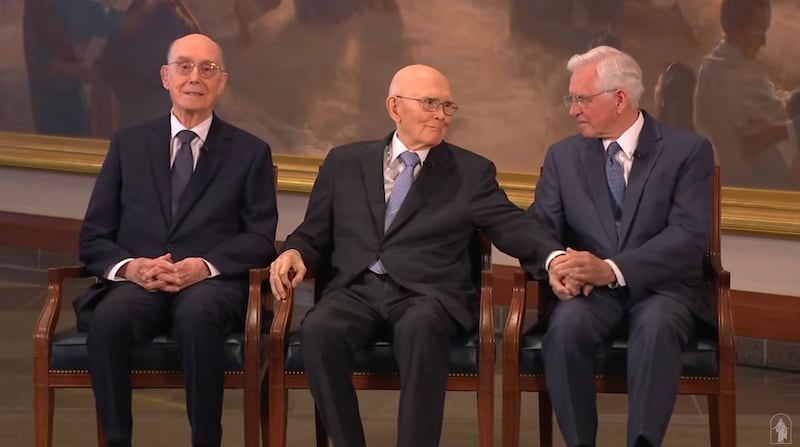
Who is President Dallin H. Oaks? A man shaped by loss, defined by resilience and warmth
For more than 41 years, President Dallin H. Oaks has stood behind the pulpit — his legalistic mind coming forward as he has testified of Jesus Christ and his gospel in a clear, unequivocal manner, first as an apostle and now as the 18th prophet-president of the Church of Jesus Christ.
Before that, his life experience included becoming one of the nation’s brightest legal students, serving as the acting dean of one of the United States’ most prestigious law schools and standing as a justice on the Utah Supreme Court. But backtrack several chapters and President Oaks’ prodigious intellect and potential was not readily apparent, Tad Walch wrote.
In fourth grade, his teacher read his spectacularly bad math scores out loud to the class, President Oaks told his biographer, and high school kids hazed and bullied him on the school bus.
“I just couldn’t concentrate,” he said. “Looking back on it, I’m sure my problems were due to the emotional disturbance of losing my father and mother at the same time. But as far as I was concerned at the time, I was just the dumbest boy in the world.”
President Oaks’ father died in 1940, when the young boy was just seven years old. His mother, who had maintained faith and optimism that her husband would recover from tuberculosis, was with him when he died in Colorado, and she later suffered a nervous breakdown that required her to leave for treatment the following year.
During this time, President Oaks was cared for by his maternal grandparents. And about two years later, President Oaks and his siblings were reunited with their mother, after which the four of them moved to Vernal, where she accepted a teaching position.
President Oaks said the combination of having his family reunited and the influence of his fifth-grade teacher, Pearl Schafer, turned his life around — eventually leading him to accomplish a remarkable body of work and service that culminated recently in his ordination as the church’s 18th prophet.
President Oaks is wise, kind and energetic, Sister Kristen M. Oaks said recently in describing her husband.
“He is not judgmental (and) if you were coming to someone and you wanted someone to advise you or help you, I’d go to him always,” she said. “Because when he gives his talks, you know exactly where he stands, but when you’re with him in private, he’d be so compassionate and so caring. He’s a very special man.”

Mia Love shares her living wish for the America she knows
Former Utah Congresswoman Mia Love died March 23 at age 49, after facing a three-year battle with brain cancer. But right as her battle was coming to an end, she took up her pen, “not to say goodbye but to say thank you” and express her “living wish” for the America she knew.
“My battle with brain cancer is coming to an end,” the late congresswoman, who had also served as mayor of Saratoga Springs, Utah, wrote in a Deseret News piece published March 11. “The disease is no longer responding to treatment and my family and I have shifted our focus from treatments to enjoying every moment and making memories with the time we have.”
Love did not know how much longer her battle would last, she said. But as she wrote her living wish — and “hopefully ‘enduring wish’” — she said that as a daughter of immigrants, the America she came to know growing up was filled with excitement about living the American dream.
“I was taught to love this country, warts and all, and understand I had a role to play in our nation’s future,” she said. “I learned to passionately believe in the possibilities and promise of America.”
Love then said that when her parents’ encountered tough times, “they didn’t look to Washington, they looked within.” Likewise, she encouraged readers to be self-reliant, exercise their freedoms, give back, make tough choices and be determined.
“The America I know is great — not because government made it great but because ordinary citizens like me, like my parents and like you are given the opportunity every day to do extraordinary things,” she said in closing. “That is the America I know!”
Love died 12 days after her piece was published in the Deseret News, and seeing her life extended 10-15 months past her initial prognosis, she thanked her “countless friends” — both known and unknown — for their faith and prayers on her behalf.

The legend of Davy Crockett: Utah’s ultrarunning man
He isn’t Forrest Gump crisscrossing the country nonstop, but Davy Crockett from Saratoga Springs, Utah, has run at least 109 100-mile races and is the 15th person in the world to finish 100 races at that distance.
People who learn of his “obsession” often swarm the 66-year-old ultrarunning man with all kinds of questions, such as: Do you sleep? Does it hurt? Are you crazy? And, of course, why?
“You run 100 miles, that’s kind of beyond people’s understanding because so many people think the marathon distance is really the limit to human endurance,” Crockett told Dennis Romboy of the Deseret News in April. “All that is just some silly magic number. Certainly you can go further.”
The answer to most of those questions is yes. Ultrarunners do get drowsy, but Crockett sometimes sings ‘70s tunes out loud to keep himself awake. Yes, it does hurt at times, but the ultrarunner got to the point where he could recover in three days. Yes, you have to be a little bit crazy. And the why?
“There’s never really a good answer as to why,” Crockett said. “It’s kind of like why do you climb to the top of a mountain? Well, it’s there. To run 100 miles is because I can do it.”
But Crockett couldn’t always do it.
In 2002, he was a 230-pound “couch potato” in the midst of a midlife crisis. His physical condition complicated him getting down on the ground to play with his kids. And on annual backpacking trips, he usually trailed behind his buddies. Things continued this way until one year, Crockett answered a “fitness wake-up call” and eventually stumbled across ultrarunning.
Since then, he has spent the last 20 years building his endurance. What once was a 10 1/2 hour trip up and down Mount Timpanogos now takes him just over three hours. And while he stopped recording his annual mileage a few years ago, when the cumulative total hit 41,450, he figures he’s up to about 50,000 now. That’s equivalent to running around the circumference of Earth two times or running across the U.S. 17 times.

Jane Clayson Johnson’s relentless quest to find hope
An accomplished journalist whose career has included working high-profile broadcast roles at ABC News and CBS News, Jane Clayson Johnson has interviewed U.S. presidents and politicians such as George W. Bush and Colin Powell.
She has also interviewed public figures such as Tom Hanks and Yo-Yo Ma, had her face appear on every bus in New York City, and for several years, had a limo whisk her to the studio on Fifth Avenue to co-anchor the “Early Show” on CBS News each morning.
Yet for the accomplished journalist, it was sitting with Grace Ninsiima — a young mother from Masaka, Uganda — and other students of BYU–Pathway Worldwide in Africa, that ultimately brought into focus the humanity that has always motivated her work.
“Their vulnerability and their willingness to share their lives with me — I find that to be almost a sacred responsibility, that they would trust me,” Johnson told Mariya Manzhos of the Deseret News in October.
Sitting inside her Boston home’s red-accented living room, Johnson spoke of the resilience amid poverty and sickness these students exemplified as she interviewed them for “Pathway to Hope,” a documentary exploring the transformative power of education in their lives.
Like in their stories, Johnson has looked for hope in hardship in every season of her life — never shying away from confronting the most difficult and uncomfortable parts of the human experience, even while living through them.
In her 2007 memoir “I Am a Mother,” for instance, Johnson wrote candidly about her shift to motherhood after walking away from her star-studded career. And about a decade later, she transformed the pain of a crushing bout of depression into a book that connected her story with that of more than 150 people. This book, published in 2018, was titled “Silent Souls Weeping.”

How a prayerful surgeon — Dr. Russell M. Nelson — helped ensure many years for former BYU coach Heather Olmstead and her family
Forty-five years ago, former BYU coach Heather Olmstead’s mother — Trudy Olmstead — wasn’t wishing her daughter would become a nationally renowned college volleyball coach, Jason Swensen wrote.
No. She just wanted her unborn daughter and her twin sister, Nicole, to survive. And, God willing, she wanted to survive herself.
The odds, however, seemed unlikely.
At a point in her pregnancy, a team of doctors discovered a life-threatening lump on Trudy Olmstead’s right lung. They told her they would need to remove it if she wanted to live. And to live, they added, she would have to abort her unborn twins.
Turning to a set of specific lines in her patriarchal blessing, however, Trudy Olmstead and her husband decided they would seek a Latter-day Saint doctor and an option that did not include losing the twins.
Miraculously, Trudy’s parents had connected with then-Dr. Russell M. Nelson at the Salt Lake Temple, shortly before Trudy’s diagnosis and about four years before the surgeon was called to serve as an apostle.
The surgeon would review Trudy’s records and agree to perform the operation. “The Lord and I will talk about this tonight,” Trudy recalled the surgeon telling her father upon receiving her records. “I’ll call you in the morning.”
In a book of insights from his life, the late surgeon and prophet later recalled the operation proved to be more complicated than he anticipated. “The tumor was so close to the heart that I did not have a clamp narrow enough to put a clamp on the artery and still have space for the cutting blade of the scissors,” he said.
The pulmonary artery thus had to be cut without being clamped, he explained. “My only option was to put my finger in the artery to stop the blood and keep my finger there until I was able to suture the artery closed. All the time, I kept thinking, ‘I have three lives depending on my finger.’”
The operation, which ultimately required the removal of Trudy’s right lung, proved successful. And five months later, two baby girls — Heather and Nicole — joined the Olmstead family.