



When Ryan Burge was about 14 years old, his congregation at First Baptist Church of Salem, Illinois, was shaken by an internal rift. The pastor had grown more Calvinist in his teachings and the shift caught many by surprise. The discussion came to a head at a congregational meeting, where members cast a vote on whether to freeze the pastor’s salary.
The measure passed by a single vote, 49-48.
The moment was formative for Burge, a political scientist and former American Baptist Church pastor, who is known for analyzing complex data to make sense of religion in American public life.
“It was like, holy cow — democracy in action,” Burge said, recalling the close vote, in a recent Zoom interview. The church’s future and the pastor’s livelihood hinged on a single vote.

But the moment crystallized a larger point: Everyone had their opinion and his vote mattered. (He voted in favor of freezing the salary.) That interfaith conflict ignited a deeper curiosity about the ways religion and politics shaped a community, and one another.
Burge, who after 13 years at Eastern Illinois University is now a professor of practice at Washington University in St. Louis, has a knack for turning complex data into accessible stories that paint a picture of the shifting role of religion in America. But he has also drawn notice for his unusual career blend — a social scientist with a growing following on Substack and X, and until about two years ago, the pastor of a small rural American Baptist congregation. He was interviewed on “60 Minutes” and had spoken to religious communities across the country.

Burge is remarkably prolific. He’s written six books, including “The Nones,” “The Great Dechurching” and, most recently, “The Vanishing Church: How the Hollowing Out of Moderate Congregations Is Hurting Democracy, Faith, and Us‚” which documents how politics has fractured American religion. His Substack newsletter “Graphs About Religion” has more than 27,000 subscribers. He’s a contributing writer to this publication. He is now teaching undergrads to do what he loves most — to mine data to tell stories about religion and politics.
Over the years, and especially since ending his career as a pastor, Burge has come to see his work as a kind of mission, almost a ministry. He aims to provide people with what he calls “mental scaffolding,” helping them make sense of the current moment in America and find their place within it.
“To me, it’s the most valuable thing I can do,” he told me. “To take away some of the existential dread people feel about their lives, and give them at least something to grab on to.”
A safe ‘cocoon’
As a kid, Burge’s life revolved around church. He didn’t like staying home, so nearly every other evening, he spent at his Southern Baptist church in rural Illinois.
“Being at the church was a great place to be,” he told me.
The rigid constraints of evangelicalism provided a safe “cocoon” from the confusing and threatening world. The church also offered a roadmap not only to eternal salvation but to everyday life: what movies to watch, what music to listen to, what T-shirts to wear and mission trips to go on.
“You had all your questions answered,” he said.
Burge doesn’t describe himself as an evangelical anymore — “evangelical sympathetic” would be more accurate — but he’s still nostalgic for the “warm embrace” of the simplicity and predictability of his childhood faith.
This worldview began to expand in college at Greenville University, a small Christian college in Illinois affiliated with the Methodist Church.
“I went to college believing and realized there was a lot more gray out there,” he writes in “The Vanishing Church.” “Learning about other religious traditions made me question my own. … My faith was complicated and ever evolving.”

After finishing his sophomore year in college, he was looking for a job and got a three-month internship as a youth pastor. That turned into a three-year pastoring gig at First Baptist Church of Centralia, Illinois, which was part of the American Baptist tradition, a more moderate strain among the Baptists, which is why it’s considered part of the mainline church.
Burge still wonders how he ended up pastoring for 20 years.
“It was just people kept calling and I’m really bad at saying ‘no,’” he said. “I fell into ministry over and over again.”
‘I don’t know a whole lot’
Burge has always been a doubter, he writes. Even though he participated in church activities, he held out until 15 years old to get baptized.
“When the pastor would declare with a raised voice and clenched jaw, ‘Jesus is the only way to heaven,’ my immediate reaction was, ‘How can you be so sure?’ I was always jealous of people who knew Christianity to be true,” Burge writes.
He found that the mainline church was more welcoming to Burge’s inquisitive, skeptical disposition than his evangelical tradition. Yet, he still misses the simplicity of a faith, where right and wrong were clear and belief offered real psychological security.
At one point during our conversation, Burge asked if he could read me a quote by the late itinerant celebrity chef Anthony Bourdain.
“I love Anthony Bourdain. I think about him all the time,” he told me.
Then, Burge read: “There is no final resting place of the mind; no moment of smug clarity. Perhaps wisdom ... is realizing how small I am, and unwise, and how far I have yet to go.”
He’s grown to be more at peace with this unknowing.
“I’ve realized I know a little bit of something,” he said. “But I don’t know a whole lot.”
Church closing
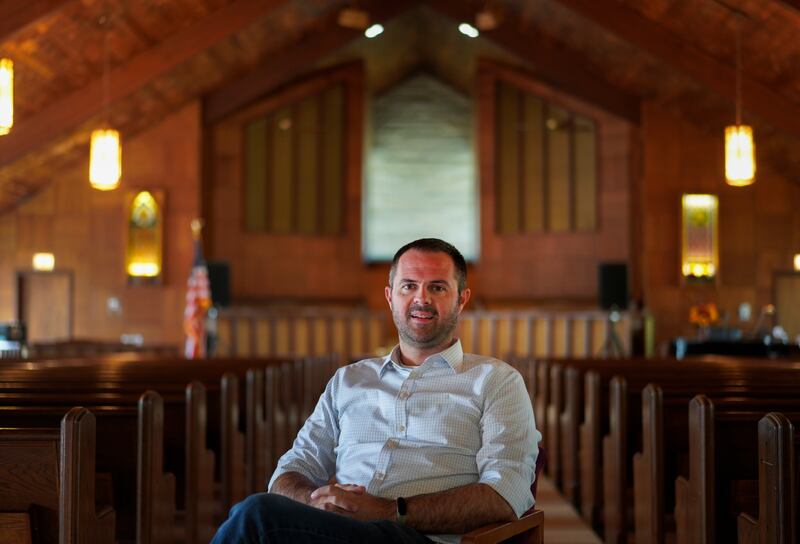
Unlike Bourdain, Burge has never lived more than an hour-drive from where he was born, which he says is unusual for academics. He likes it that way. He has no ambition to live in a cosmopolitan hub like New York or Chicago, which some of Burge’s academic friends find strange, he told me.
“I’d rather live in the middle of nowhere,” he said. “I like small-town life.”
This rootedness, he says, has shaped his approach to faith and his understanding of American religion.
At 24, during his graduate studies in political science, he began preaching at First Baptist Church of Mount Vernon, Illinois, which wasn’t far from his campus.
During the next 17 years, life happened. Burge got married, got a master’s degree followed by a Ph.D., had two boys, bought a house and got a dog.
“I grew up in front of these people,” Burge told me. “In many ways, it was probably the best blessing I could have ever had, because my kids had like 10 sets of grandparents at the church.”
Gail Farnham, who is 82 and has attended First Baptist since she was 4 years old, had known Burge for 18 years. She said he started out as more of a preacher and matured into a pastor responsive to the needs of the congregation.
“He’s a teacher, first and foremost; I would call him a teaching preacher,” Farnham recalled. “Ryan was all about the story, and he still is.”
She could always remember what he had preached about the previous Sunday.
After years of losing members and financial pressures, in July 2024, Burge and his congregation made the decision to close the doors. “The church closing its doors was a burden lifted off our shoulders, a weight that some of them had been carrying for decades,” he wrote in this publication.
Burge told me that he did not really love being a pastor — on Saturday, he would get a version of the “Sunday scaries” but on Saturday night, before he had to preach. The pay was small; there were always complaints.
“It’s a no-win situation,” he said.
But he had a duty and an obligation to his members, so he persisted.
Burge struggled not to interpret the decline of First Baptist and then its closure as a personal failure. For a while, he thought he could turn things around, that the church would revitalize. Then, the goal was to survive another week.
“It just gets a little bit harder because you don’t see the outputs,” he said. “In the world of religion almost everything is uncountable, and for a guy who likes to count things for a living — literally it was really hard for me.”
Looking back, he doesn’t regret how things unfolded. “I had great examples of what it meant to be a good person, a good Christian, a good church member, a good father, a good husband,” Burge said, speaking from a home that he bought from a member of his church. “They showed me what community and generosity looked like — and poured it into the institution.”
To his neighbors, Ryan Burge isn’t a sought-after expert who gets quoted in The New York Times and The Wall Street Journal. He’s a dad, a fellow congregant, a sports fan — and that common ground is often enough to build relationships based on shared life experiences rather than political convictions.
The loss of moderate middle
Burge mourns the loss of these textured and diverse church communities in his book.
Churches used to be places where Democrats and Republicans once worshipped side by side. Churches, he argues, were among the few institutions that regularly brought Americans of different political stripes into sustained contact with one another.
Over time, those communities have come to mirror the polarization of American political life. In “The Vanishing Church,” Burge traces how religion in the United States — across evangelical, Catholic and mainline Protestant traditions, as well as among the religiously unaffiliated, or “nones”— has increasingly sorted itself along red and blue lines. Evangelicals, once more politically mixed, are now overwhelmingly Republican. Meanwhile, for the first time in decades, mainline Protestant churches now contain more Democrats than Republicans.
“Churchgoers are far less likely today to worship alongside people who vote differently than they do,” Burge writes. “And religion itself is increasingly coded as right-wing.”
What is disappearing fastest, he argues, is the religious middle. Evangelicals have consolidated into a powerful conservative political bloc, while parts of the Catholic Church have shifted rightward, driven in part by the rise of “trad Cath,” or “traditional Catholic,” voices. Burge’s own mainline protestant church, once the most influential religious group in American public life, is shrinking rapidly.
“In short, American religion has become an ‘all or none’ proposition,” he writes in his book — “conservative evangelical religion or none at all,” he writes. “This leaves tens of millions of theological and political moderates with no place to find community and spiritual edification, or to work collectively to solve societal problems.”
Burge calls this phenomenon the “Big Sort,” and he argues it isn’t limited to politics. The people most likely to remain in church today are college-educated, married parents earning around $80,000 a year. That growing ideological and economic sameness, he warns, is unhealthy for both religion and democracy.
“The average American church is less and less the great meeting spot where blue-collar and white-collar people gather for common cause, and the average Christian looks more and more like a person who did everything ‘right’ in life — good education, middle-class salary, married with children. This simple fact is making the church both more politically unified and less welcoming to people on the fringes of society,” he writes.
Are we that polarized?
At the same time, Burge pushes back against the idea that everyday Americans are as polarized as the national conversation suggests. In a chapter titled “How Polarized Are We, Really?” he shows that polarization is largely concentrated at the elite level — among institutions, political leaders and media ecosystems — rather than among ordinary believers.
“But rank-and-file Methodists and Baptists — these people are very pragmatic, they’re very compromising, they’re very consensus seeking,” he said. Many, he argues, are quietly looking for a “rational middle.” But those voices are largely absent from social media and public debate.
Burge recalled a moment when after an event, an audience member told him he’d been scrolling through Burge’s X feed and couldn’t figure out whether he was a Republican or a Democrat. “I take that as a badge of honor,” Burge said.
He speaks to atheist groups, evangelical groups and everyone in between.
“They know I’m just going to try to tell the truth,” he said.
Data, he says, has enabled him to be an “impartial referee,” relying on evidence rather than ideology to cut through partisan noise and heated emotions. In his posts, he avoids biased language and tries to stay neutral, he told me. The size of his audience, Burge believes, reflects a real hunger for a more measured, fact-based approach to understanding politics and its overlap with religion.
Burge’s advice to those dismayed by politicization of the church is to just find a church that’s “good enough” — a community of imperfect people navigating life together.
“I’ve been part of four churches now,” Burge said. “None of them have been perfect, but all of them have been good. They’ve been good to me, for the community and for the kingdom.”
His advice is simple: Set up shop, invest yourself and stay.
‘I’m still a pastor’
Sundays look different for Burge now since his church closed. He goes to the Methodist service where sometimes, former First Baptist parishioners, including Farnham, fill a whole row.
He then sneaks out to join his wife and children, who are Catholic, at Mass at the church three blocks away. Worshipping in different Christian denominations hasn’t been a big deal for his family, he says. His older son is going through confirmation.
“I just want them to be a part of a Christian community,” he said.
During Mass the other day, a thought struck him: “You’re still a pastor.” He then switched to first-person as if interpreting what that meant.
“I’m going to be a pastor until I put the very last member of First Baptist Church into the ground.”
Since the church closed down, Burge has administered two funerals of his former congregants. There will be more ahead.
“It’s still my moral obligation to do that until the end of their lives.”