


American religion and politics have become so entangled that partisan identity now often shapes faith more than theology and faith do.
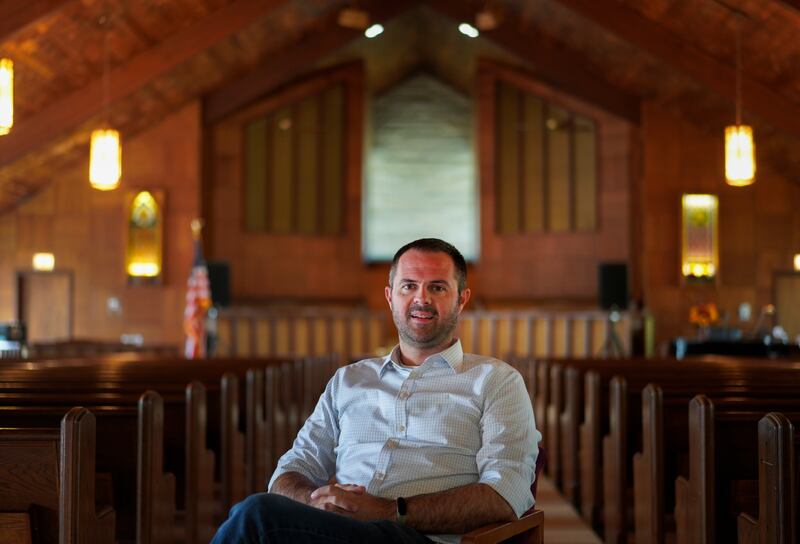
That’s the premise of Ryan Burge’s new book “The Vanishing Church: How the Hollowing Out of Moderate Congregations Is Hurting Democracy, Faith, and Us (Why the Culture Wars Led to Polarization and What We Can Do About It).” He tells this story through charts and graphs, but also through his personal experience of pastoring a graying congregation at First Baptist Church of Mount Vernon in Illinois for 17 years, its closure and what spiritual home life looks like for him now.
Last week, I had the chance to speak with Burge, and I hope you’ll read the full story. Here, though, I wanted to share a few insights from the book that stood out to me — observations that illuminate the growing gulf in American religion and point toward what people of faith and churches might do to help the country heal.
On the Big Church Sort
“Today, the Big Church Sort is nearly complete. The two Christian groups that have managed to maintain a robust membership, Catholicism and evangelicalism, have done so by drifting to the right. That’s certainly made them a haven for cultural conservatives, but it has also tended to scare away people whose politics are further to the left. The mainline’s commitment to ideological diversity has left its denominations on the verge of collapse.
“Meanwhile, the nones have gone from little more than a rounding error to representing the most significant cultural shift in the United States over the last three decades, becoming the default landing spot for political liberals who can’t find a place in American Christianity.”
On socio-economic sorting of churches
“Churches in the United States have become places where people who have done everything ‘right’ are gathering. The pews are filled more than they ever have been with people who are college educated, middle class, and married with two children, while those who chose to take alternative courses are feeling less and less inclined to show up.
“Most religions emphasize that followers need to help those who are less fortunate, but unfortunately those kinds of people are becoming less inclined every year to come in close contact with regular attendees of religious services. The result is that religious people may see less opportunity to reach out to those who are living on the fringes. In other words, religious practice has become a thing of privilege.”
On average Americans
“Yes, white evangelicals are more likely today to identify as Republicans and conservatives than they were 20 years ago, and atheists are more likely to see themselves to the left side of the political spectrum. But does that mean they actually agree with their respective parties on an entire range of issues? A raft of polling data says they do not. In fact, average Americans are often much more pragmatic, sensible and open-minded than they are given credit for. In other words, the average American doesn’t want to be polarized but feels they must be if they want to fit into the religious and political landscape of the United States.
“The culture war is more about us versus them than about policy positions on hot-button issues. As data in this chapter makes clear, the average American is not on their extreme edge of the abortion debate. Additionally, the typical Christian (and even the average evangelical) is not entirely convinced of some of the most basic Christian doctrines, such as belief in Jesus being the only pathway to salvation. Most Christian parents would not be unhappy if their son or daughter married someone from a different faith background.”
On solutions
“While I am under no illusion that American religion is the greatest panacea for all that ails the United States, I am convinced that the American church can be part of the solution. People gathering under one roof to sing together, pray together, and work in common cause to create a better community and a better society will certainly move us closer to the ideals that were set forth by the Founding Fathers of our country. There’s nothing simpler and more consequential than people getting up on Sunday morning, getting dressed and making their way to a local house of worship. The fate and future of American democracy may be at stake.
“Exposing ourselves to differences from both the pulpit and the pews is essential for the future of American religion and American democracy. It’s also good for one’s own well-being. Finding points of agreement while also being willing to talk through areas of difference allows us to strengthen our intellectual muscle. It expands our worldview and extends our empathy for those who are different from us. On these measures, many congregations more than fit the bill. Stop seeking the perfect church for you and just pick one that’s ‘good enough.’ Your presence there will make it better.”

On Latter-day Saints
When I asked Burge about the latest findings about Latter-day Saints, he pointed to a Pew survey which asked Americans whether racial and religious diversity are good or bad for society. The study showed a sharp divide between white evangelicals and Latter-day Saints. While white evangelicals are significantly more likely to view both racial and religious diversity as negative, Latter-day Saints see diversity as a positive.
The contrast is striking because, on the surface, the two groups look similar: both are largely white, socially conservative, politically Republican, highly religious and family-oriented. Yet, their attitudes toward diversity diverge sharply. " I think it’s just a fascinating window into the LDS worldview," he said.
The difference, Burge says, has to do with religious status. White evangelicals tend to see themselves as part of the country’s dominant religious culture and are more resistant to social change. Latter-day Saints, on the other hand, understand themselves as a minority faith.
“The Latter-day Saints are open to change because they realize that being open to other groups means they’re more open to LDS too.”

End notes
In honor of the Martin Luther King Jr. Day, I’ll conclude with a quote from MLK’s speech “Loving Your Enemies” that he gave at Dexter Avenue Baptist Church in November of 1957.
“The person who hates you most has some good in him; even the nation that hates you most has some good in it; even the race that hates you most has some good in it. And when you come to the point that you look in the face of every man and see deep down within him what religion calls ‘the image of God,’ you begin to love him in spite of.
“No matter what he does, you see God’s image there. There is an element of goodness that he can never slough off. Discover the element of good in your enemy. And as you seek to hate him, find the center of goodness and place your attention there and you will take a new attitude.”