

This article was first published in the State of Faith newsletter. Sign up to receive the newsletter in your inbox each Monday night.
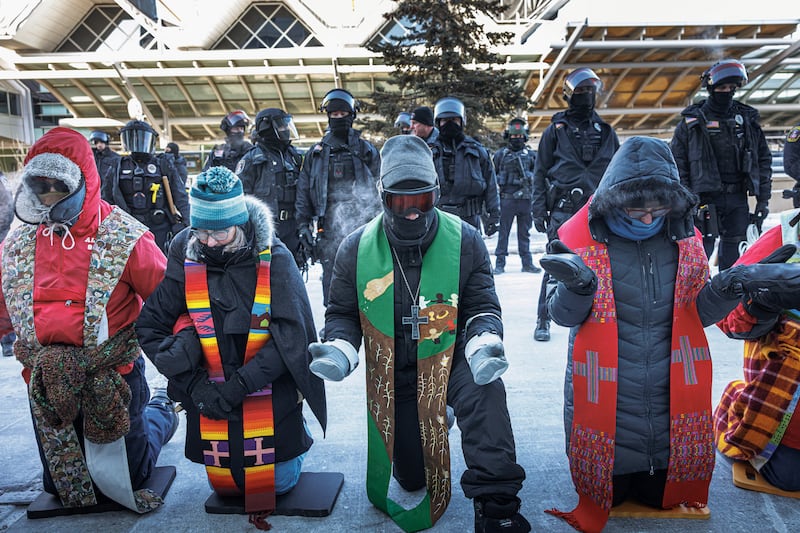
On Sunday evening, about 30 rapid-response and mutual aid volunteers in Minnesota gathered on a Zoom call to offer one another spiritual care. The host led the group in a meditation, then in song and a reflection as a video of a crackling fire played on screen.
Next, participants were invited to share a small act of care they had noticed around them or in their community. Responses poured in: “hot food and beverage,” “mutual aid efforts increasing,” “Thank yous and check ins.”
As ICE has intensified its immigration crackdown in Minnesota, the group has been meeting daily to provide spiritual relief to faith leaders and volunteers serving their communities.
I also learned about the sprouting mutual aid networks in the metro area delivering food, diapers and other necessities to immigrant families who are too frightened to leave their homes regardless of their legal status. Local businesses and churches are functioning as donation hubs and some volunteers are even helping children from immigrant families walk to and from school.
Writer Caitlin Flanagan drew attention to these acts of care in a recent post on X: “A lot of Minnesotans are fighting this insanity with the state’s most powerful weapon: the casserole.”
But within churches, there have been disagreements about how to respond to immigration enforcement.
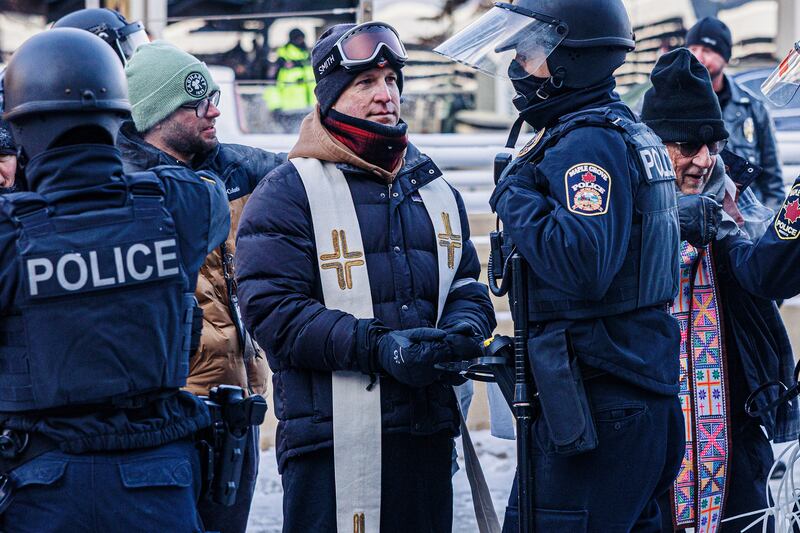
Many Christians argue that faith requires prioritizing compassion for immigrants and newcomers, while others contend that enforcing immigration laws is necessary to maintain safety and order.
Following the death of Alex Pretti, an ICU nurse, who was shot by federal agents on Saturday, themes of restraint and human dignity have threaded through statements by religious leaders.
Archbishop Paul Coakley of Oklahoma City, president of the U.S. Conference of Catholic Bishops, called for “calm, restraint and respect for human life in Minneapolis.” Speaking during his Angelus address on Jan. 25, Pope Leo XIV urged people to pray for peace in areas torn by violence and conflict, noting that true peace comes from honoring human dignity rather than pursuing political or economic interests.
Archbishop Coakley echoed Pope Leo’s sentiment: “Peace is built on respect for people.”
Other faith voices took a more hard-line stance. “ICE must leave Minnesota. The officers behind these killings must be held legally accountable, as must any officers who kill civilians,” reads a statement from Interfaith Alliance, a coalition of clergy and religious organizers.
However, Archbishop Bernard A. Hebda of the Archdiocese of Minneapolis-St. Paul sought balance in his messages, inviting people to recognize divine origins in both immigrants and federal agents.
“While we rightly thirst for God’s justice and hunger for his peace, this will not be achieved until we are able to rid our hearts of the hatreds and prejudices that prevent us from seeing each other as brothers and sisters created in the image and likeness of God,” Hebda wrote in a statement after Pretti’s death.
“That is as true for our undocumented neighbors as it is for our elected officials and for the men and women who have the unenviable responsibility of enforcing our laws. They all need our humble prayers.”
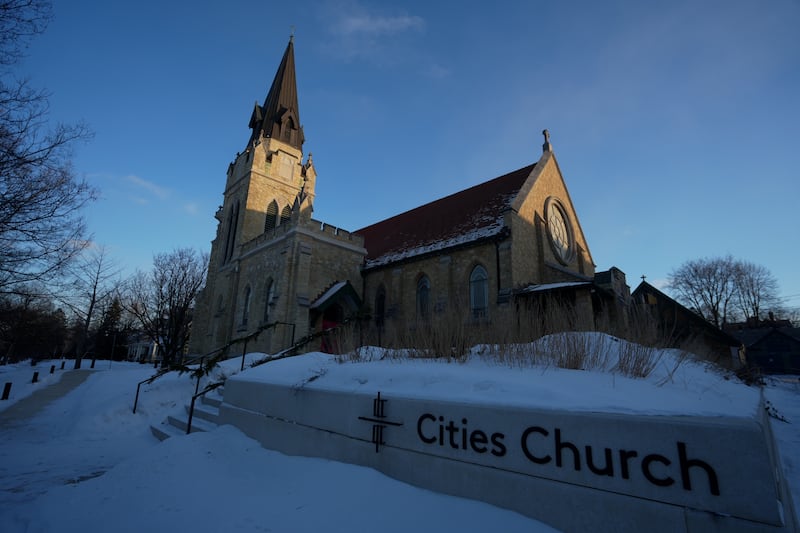
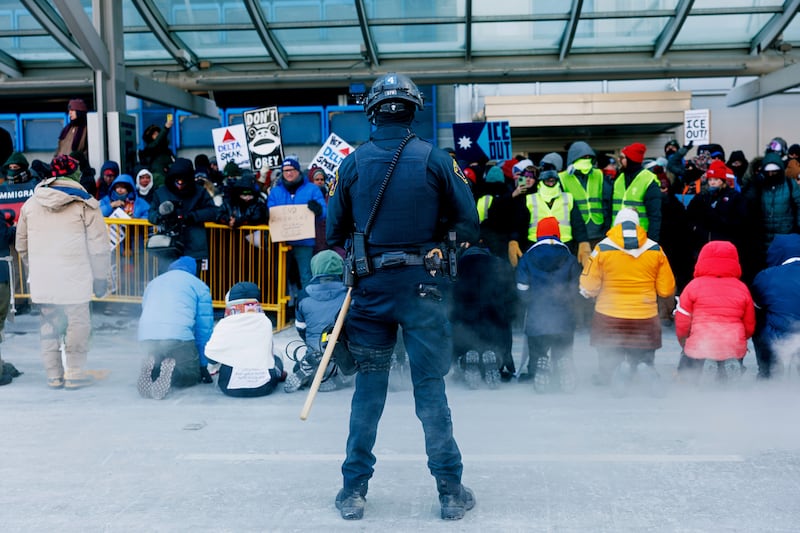
Last Sunday’s church protest that interrupted a service at Cities Church in St. Paul, where one of the pastors also works for ICE, exposed divisions among religious leaders and has brought into focus a question: when should religious leaders take a public stand regarding the government’s actions and what means do they use to do that?
Earlier, Bishop Robert Barron, a prominent Catholic leader who has served on Donald Trump’s Religious Liberty Task Force, called for restraint from federal immigration agents, political leaders and protesters alike.
Bishop Barron suggested that ICE should focus only on “undocumented people who have committed serious crimes.” He urged politicians to lower hostile rhetoric and asked demonstrators to “cease interfering with the work of ICE,” warning that constant conflict and mutual demonization are unsustainable. “And everyone on all sides must stop shouting at one another and demonizing their opponents.”
Where voices across the political and theological spectrum appear to find common ground is in the belief that ongoing violence and chaos are eroding trust in Minneapolis communities and that any inhumane treatment of immigrants contradicts the Christian understanding of all people as children of God.
Archbishop Hebda made this point in a Wall Street Journal op-ed published before Pretti’s killing, offering what he described as a vision rooted in “reality rather than ideology.”
He proposed a balanced immigration approach that includes legal status for long-term contributing residents and emphasized that compassion can coexist with law enforcement and border limits.
He concluded:
“As a pastor, I see the human cost on all sides. I minister to immigrant parishioners who are fearful of driving their children to school or shopping for groceries regardless of their legal status. I also serve those who feel abandoned by leaders who have seemed more interested in political posturing than in protecting their communities. The church can’t choose one flock over another. Neither should the nation.”
Fresh off the press
- The story about the unlikely friendship of professors Robbie George and Cornel West doesn’t cease to inspire.
- His mom hated the book ‘Wonder.’ Now he’s the face of the new musical.
Catholic Church in Latin America
Over the past decade, the number of Catholics in several Latin American countries has declined, according to a recent report from the Pew Research Center, and a growing number of adults in the region identify as “nones” — or atheist, agnostic or “nothing in particular.”
The number of religiously unaffiliated almost doubled in Argentina, Brazil and Chile, tripled in Peru, and almost quadrupled in Colombia, the report found. In some countries, the “nones” outnumber the Protestants.
Still, Catholicism remains a dominant religion in Latin America across Argentina, Brazil, Chile, Colombia, Mexico and Peru.
In these countries, the proportion of Catholics has dropped by 9 percentage points over the past decades while the share of the “nones” has gone up by 7 percentage points.
Pew found that about 90% of adults in these countries say they believe in God and for nearly half adults, religion is “very important” in their lives. Most people in Brazil, Colombia and Peru pray at least once a day, the report found.
“By these measures, Latin Americans are more religious than adults in many other countries the Center has surveyed in recent years, especially in Europe where many adults have left Christianity since childhood,” per Pew.
What I’m reading:
- In power hubs like Washington, D.C., some Protestants are converting to Catholicism. “Roman Catholics exiting their church are disproportionately driving declining rates of Christianity in America. And far more Catholics convert to Protestant denominations than vice versa. But you wouldn’t know it if you looked only at places like Washington and some influential university campuses. A small but vocal group of Protestants is converting to Catholicism — and in even smaller numbers to Eastern Orthodoxy. They tend to be ambitious, highly educated and well-connected. Catholics now provide much of the conservative movement’s intellectual horsepower — and they are picking up Protestant converts along the way.” — The Lure of Rome, World
- Doctors told these parents their child would have Down syndrome and suggested abortion. The parents did not listen. — The Baby We Kept, Plough Magazine
- Long before becoming Pope Leo, Robert Prevost had doubts about his priesthood, saying at one point that “maybe it would be better to leave this life and get married; I want to have children, a normal life.” Father Paul Galetto, now a priest in Philadelphia, described Prevost this way: “There was no whoa, but he was a solid guy. He spoke when spoken to. Always cordial and nice, and not trying to impress.” — The Making of the First American Pope, The New Yorker
End notes
This past week, I spent several days in Rome reporting on a fascinating and ambitious project to build a Catholic AI. In the spirit of my subject, I decided to use AI to help me navigate the city in a language I didn’t know at all.
I first turned to AI to identify experts relevant to my story who were in fact based in Rome. I was also curious whether any faith-related events were happening during the short window I was there. And sure enough, ChatGPT suggested that an ecumenical Mass was going to take place at the Church of Santa Lucia.
It sounded intriguing: I had never attended an ecumenical Christian Mass before and I wondered what the experience might be like. After confirming the event on the church’s website, I set out on foot to find it.
I still wasn’t sure what to expect until I saw a cross, a lit building and heard the sound of African drums. A group of Ethiopian Christians dressed in traditional white clothing led the procession while playing the drums and chanting. Behind them followed religious leaders from Catholic, Methodist, Orthodox and other churches. I knew I was in the right place.
Throughout the Mass, I pointed my phone at the program and used my iPhone’s “Translate” feature, which extracted the text of the readings and translated it into English in real time. There, I learned that it was the Week of Prayer for Christian Unity, a tradition of 100 years that is celebrated internationally.
Amid the alarms about AI pulling us away from the real world, my experience, at least in this case, suggested the opposite: AI didn’t distance me from the world — it led me more deeply into it.