

This article was first published in the State of Faith newsletter. Sign up to receive the newsletter in your inbox each Monday night.
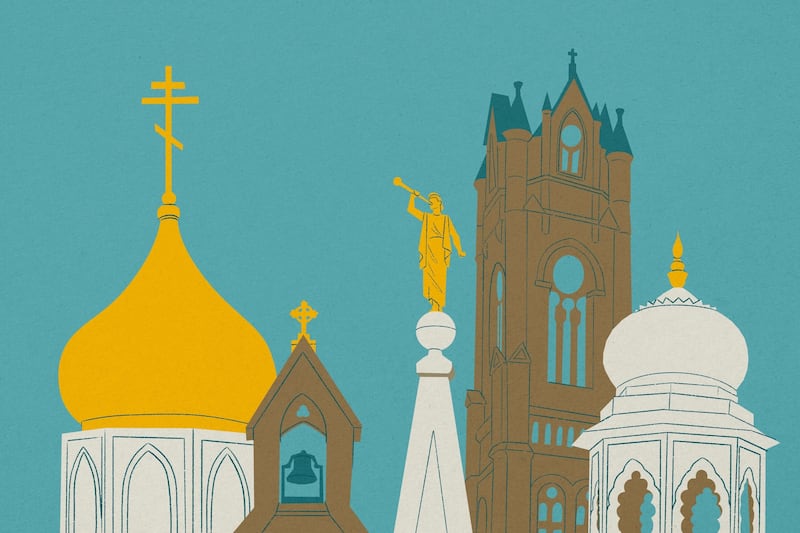
Among countries with populations of at least 120 million, the United States comes up as the most religiously diverse, according to a new report from the Pew Research Center. Most fall into two camps: About 64% of Americans identify as Christian, while roughly 30% are religiously unaffiliated — or the “nones.” The remaining 6% includes Muslims, Hindus, Buddhists, Jews and others. Nigeria, Russia, India and Brazil trail behind the U.S. in religious diversity.
Among smaller nations, Singapore ranks as the most religiously diverse, with Buddhism as its largest religious group. In Suriname, on the northeastern coast of South America, nearly half the population is Christian. France is the only European country in the top 10 most religiously diverse nations: 46% of its population is Christian, 43% religiously unaffiliated and 9% Muslim. South Korea has one of the largest shares of religiously unaffiliated people in the world, at 48%.
What’s interesting is that across 194 countries and territories, nearly half or more of the population belongs to one religious group. Slightly fewer countries also have a pretty even split between two faiths. For example, in Eritrea, Christians and Muslims live side by side (47% and 52%, respectively). A little over half of Estonians are Christian (53%) and slightly fewer (44%) are religious “nones.” In Mongolia and Japan, the two major groups are the nones and the Buddhists.
There hasn’t been much change in religious diversity between 2010 and 2020, Pew found. But as more people disaffiliated from religion, Christian populations have been dwindling. After Christian share fell by 14% during that decade, Pew now classifies the religious diversity of the U.S. as “high” rather than “moderate.”
This week, I spoke with Adam Phillips, the CEO of Interfaith America, who succeeded Eboo Patel as the nonprofit’s leader. We talked about what it means to be both American and religious as the nation approaches the 250th anniversary of its independence (stay tuned for the full story). In light of the Pew report, one idea stood out from our conversation: Pluralism does not require diluting the distinctive features of faith traditions in favor of a bland consensus. Instead, it depends on people being deeply rooted in their own traditions — their holidays, prayers and wisdom — and bringing that fullness into public life.
“If people are able to root down in the distinctiveness of their faith traditions and see that as a bridge to cooperate across differences, something really special can happen, something for the common good,” Phillips said. Each tradition brings a kind of spark to the table, he said, and these distinct sparks can inspire each religion to celebrate each other — together.
He compared American pluralism to a potluck: samosas and fried chicken alongside spicy dip next to another kind of spicy dip. They’re not uniform and boring.
“People are bringing the best in what they’re most proud of,” he said. “So how do you make sure that everyone has a seat at that table so that a new feast can happen?”
Faith in the news
- Ash Wednesday and the Burden of Living Your Beliefs — The New York Times
- President Oaks calls another apostle: Elder Clark G. Gilbert joins Quorum of the Twelve Apostles — The Deseret News
- What President Oaks said at BYU in his first devotional as church president — The Deseret News
- Rod Dreher thinks the enlightenment was a mistake. (It was a deceptive headline, he noted on X) — The Atlantic
- Why I’m done with Notre Dame — First Things
- Catholic congressional Dems rebuke Mike Johnson’s biblical defense of ICE — RNS
End notes
I was really moved by a message by James Van Der Beek, an actor, who died on Feb. 11 after a battle with cancer. In an Instagram video that he recorded last year on his birthday, while going through treatment, he explored the evolution of his identity from his early acting days to the time when he was battling cancer. “When I was younger, I used to define myself as an actor, right?” he said. “Which was never really all that fulfilling.” Then, he took on the identity of a husband, “and that was much better.” Then followed children, so he became “a father, a provider, steward of the land we’re so lucky to live on.” But his cancer diagnosis challenged all those identities.
“I was away for treatment, so I could no longer be a husband who was helpful to my wife. I could no longer be a father who could pick up his kids and put them to bed and be there for them. I could not be a provider because I wasn’t working. I couldn’t even be a steward of the land because at times I was too weak to prune all the trees during the window that you’re supposed to prune them.”
While meditating on this moment, one answer crystallized for Van Der Beek:
“I am worthy of God’s love, simply because I exist.”