

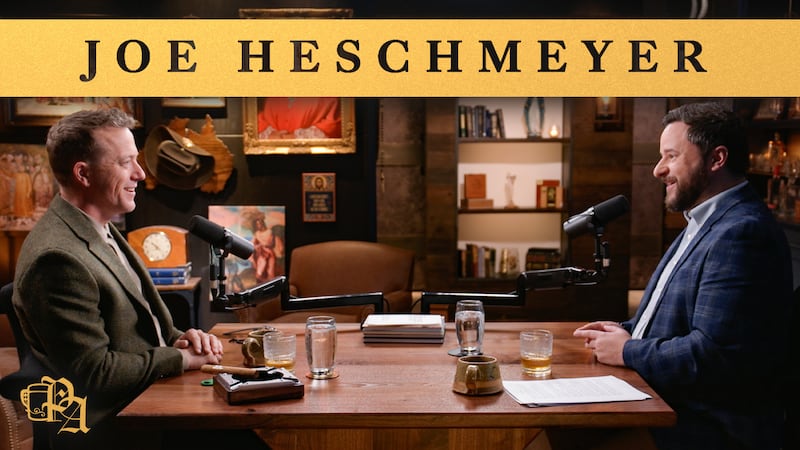

Matt Fradd has done some remarkable good in the past, dating back to his book on “Exposing the Reality Behind the Fantasy of Pornography.”
But in late February, Fradd had a conversation with Catholic apologist Joe Heschmeyer on his Daily Wire show “Pints with Aquinas”— Fradd playing the role of a naive interlocutor inquiring about the faith, without any Latter-day Saint in the room.
The show was titled “The Incoherence of Mormonism” and portrayed the faith as not worth engaging seriously.
Talking ‘about’ others
There are strategic advantages to framing a conversation without the subject in the room, of course. We see it on cable news with liberals talking about conservatives or conservatives about liberals.
Free from clarification or balance by the person in question, you can really put on a show. And that’s what Fradd did in his conversation with Heschmeyer.
Yet punctuated by incredulous looks and knowing laughs, these conversation partners quickly gave away the game. The overall tone resembled family members trading stories about an eccentric relative they both know is crazy.
This could all be avoided by inviting a Latter-day Saint to join. Snide remarks would likely go away, along with impulses to call the faith by its nickname (“Mormon” 124 times) rather than the name it’s asked to be referred by. Or to call beliefs you don’t like “bananas” or an “absurdity.”
This would also keep the conversation more honest — less likely to subtly distort others’ views — such as suggesting Latter-day Saints look to a God who is “just kind of powerless.”
Heschmeyer did acknowledge how often Latter-day Saints have been an object of “mockery and derision by a lot of Americans,” although he failed to appreciate how cynical caricatures lay the groundwork for continued derision.
Latter-day Saint influencer Jackson Wayne described the podcast as another instance where the faith’s beliefs are “sensationalized, caricaturized or displayed in a way that has kernels of truth, but ultimately is misrepresented to a point that it seems so absurd and antithetical to Christianity.”
Catholic-Latter-day Saint friendship
Recent decades have seen growing affection and collaboration between Latter-day Saints and Catholics. For instance, many Latter-day Saints were touched by one Utah Catholic church’s decision to hold a special mass for President Russell M. Nelson following his death.
Earlier that same fall, then-Elder D. Todd Christofferson of the Quorum of the Twelve Apostles praised Catholic teachings about human dignity on a panel in Rome.
When it comes to podcasting, Fradd could take some pointers from Daily Wire colleague Michael Knowles, who also speaks from deep Catholic conviction, but does so in a way that nurtures respectful pluralism.
In the wake of an attack on a Latter-day Saint congregation in Michigan, many members of the church also appreciated Knowles calling for more national attention to “anti-religious bigotry” behind the attack — while cautioning about an environment where faith groups like Latter-day Saints were becoming acceptable targets of vitriol.
Even so, the seeds of a more productive conversation are evident here on three different issues the podcast touched on:
1. The true nature of God?
Heschmeyer accurately described Latter-day Saints as rejecting “the idea of creation from nothing,” saying: “They believe in creation from preexisting matter” — comparing this to the way an “artist is a creator. … We can call Michelangelo a creator in a certain sense, but he doesn’t create the marble.”
Fradd highlighted how different this is from a Catholic view of creation, where “God is the unconditioned ground of existence, the only uncaused cause, the metaphysically necessary being whose nonexistence is impossible, the creator of all creation.”
“That’s what we mean by God,” Fradd continued — pointing out correctly that Latter-day Saints “don’t believe in a thing like that.”
“They would regard a thing like that as the corrupting influence of pagan philosophy,” Heschmeyer added, observing that Latter-day Saints “really like the idea that we are not ontologically different than God.”
“They feel a closer intimacy” to that kind of Father, he said.
This is the point at which the conversation goes sideways — with Fradd insisting that these views differ so much from a Catholic view of God that Latter-day Saints “don’t believe in God strictly speaking.”
“We’ve got to give their God a different name,” Fradd continued, “so we know what we’re talking about” — with Heschmeyer insisting that “philosophically,” Latter-day Saint teachings were a “species of atheism.”
Translation: Because you view God differently than me — and because I’m correct — then you don’t believe in God at all.
These and other important questions deserve better, with guidance for others to find open-hearted exploration of competing perspectives about following Jesus Christ.
2. A true understanding of continuing revelation?
Heschmeyer’s longest commentary is where he departs furthest from what Latter-day Saints actually believe. Rather than accurately summarizing the faith’s earnest pursuit of understanding God’s will for our day and time, the apologist portrayed “continuing revelation” as involving confusing contradictions at best — and at worst, strategic shape-shifting that “reverses itself” when convenient and which allows core doctrines to fluctuate in a relativistic way.
“It would seem to me,” Fradd added at one point more sympathetically, “that if you’re dealing with a religion who doesn’t believe that their scriptures are inherent or their prophets are infallible, there’s probably going to end up being a lot of flex in the joints.”
But it was mostly exasperation that arose for these men from Latter-day Saints’ willingness to follow prophetic teaching that sometimes varied across different periods. As Heschmeyer underscored, “We don’t think that the pope is a prophet in the way that Peter was, you know, receiving ongoing revelation — any of that.”
“There’s not anyone who is receiving revelation in the sense Peter did after Peter.”
3. The true great apostasy?
That ongoing revelation has ceased is “not a controversial claim” for Catholics, Heschmeyer said. “We would say that’s not an apostasy — that was part of the plan of God.”
By contrast, Latter-day Saints would say “something has been lost,” the apologist continued — admitting that “ironically, this case is stronger the more you listen” to the faith’s emphasis on the biblical prophet Amos‘ teaching, as he put it, that “one of the ways we know that there must be a prophet is God says in the Old Testament he won’t do anything without revealing it first to his prophets.”
Wouldn’t that prophetic warning apply to the apostasy itself, Heschmeyer asked — before insisting that nothing in the Bible referenced an “ongoing apostasy happening either in or immediately after the time of the apostles.”
Here’s where it might have been helpful to have a Latter-day Saint in the room, reminding them about Peter’s caution of “false prophets and false teachers among the people” and Paul’s anticipation that the second coming would not come “except there come a falling away first.”
‘You’ve changed my mind’
Despite this conversation’s limitations, there was some evidence of the kind of intellectual charity they aspired toward. For instance, Heschmeyer later mentioned the kindness he felt each time he visited Utah, which prompted Fradd to say he had “such respect” for Latter-day Saints, including those he encountered through his work in the anti-pornography realm.
And when Fradd critiqued Latter-day Saint desires to be called by its own identity and name, Heschmeyer pushed back, comparing this to “Roman Catholic” as a “term we were originally called by the Anglicans” as a “pejorative.”
“Look, you’ve had situations, I’m sure, where someone will say, ‘Oh, you Romanists or you papists,’” he continued, “and you just roll your eyes … every Catholic has had the experience of being told … ’you guys worship Mary.’”
“I don’t want to do that to Mormons,” Heschmeyer said.
“You might be convincing me,” Fradd responded. “I’m open to changing this.”
“If I’m burning a bridge over a term that they find offensive, I’m burning the bridge needlessly,” Heschmeyer concluded. “I mean, Mormon was a name given by outsiders.”
“You’ve changed my mind,” Fradd said. “I’ll call them LDS from now on.”
Beyond the caricature
Heschmeyer ended the conversation reiterating his disagreements with Latter-day Saint theology, but predicting that in the future, there would also be increasing “appreciation for the unique kind of genius that you find within Mormonism.”
When people realized that the Latter-day Saint faith was “stronger than it was presented to them” — and different from the “caricature” disseminated, he anticipated more would join.
The irony seemed to be lost on these otherwise thoughtful believers that they too had just finished perpetuating these same caricatures.